The site and its setting
Rome grew on hills above a bend in the Tiber at the lowest convenient crossing point, some twenty-five kilometres inland — far enough from the sea to be safe from raiders, close enough to reach it.
The low ground between the hills was marshy and had to be drained; the Cloaca Maxima, originally an open channel, is the engineering that made the Forum usable and is still functioning as a drain.
Foundation
Founded by Romulus on 21 April 753 BCE, after he and his twin were suckled by a she-wolf.
The date is a late Republican calculation, not a record, and the twins belong to civic myth. Archaeologically there is Iron Age settlement on the Palatine from around the tenth century BCE, and the traces of an early wall on the Palatine reported in 1988 have been claimed as a foundation-period circuit — a claim that is disputed.
History of the settlement
The city expanded from hilltop villages into a single settlement through the seventh and sixth centuries BCE, under kings whose historicity is uneven and whose last, Tarquin the Proud, the tradition says was expelled in 509 BCE.
Republican Rome grew by conquest and absorbed the population and the plunder of the Mediterranean. The late Republic saw the first great building programmes financed by commanders; Augustus claimed to have found a city of brick and left one of marble, and the claim is reported by Suetonius rather than made in his own Res Gestae.
The imperial city reached a scale nothing in Europe would match again for a millennium and a half. It was sacked in 410 and 455 CE, and its population collapsed in late antiquity, leaving monuments standing in a much smaller town.
Urban plan
Rome, like Athens, was not planned. It grew, burned and was rebuilt piecemeal, and its street pattern was irregular enough that Tacitus records the debate after the fire of 64 CE about whether the new regular streets were an improvement or made the city hotter.
The Forum Romanum was the civic centre; when it filled, emperors built additional fora beside it, culminating in Trajan's. The Campus Martius held theatres, baths and monuments; the Palatine held imperial residences; the Aventine and Trastevere held much of the working population.
Ordinary Romans lived in insulae, multi-storey apartment blocks. Because Rome's own examples are largely buried under the modern city, the best evidence for how they worked comes from Ostia.
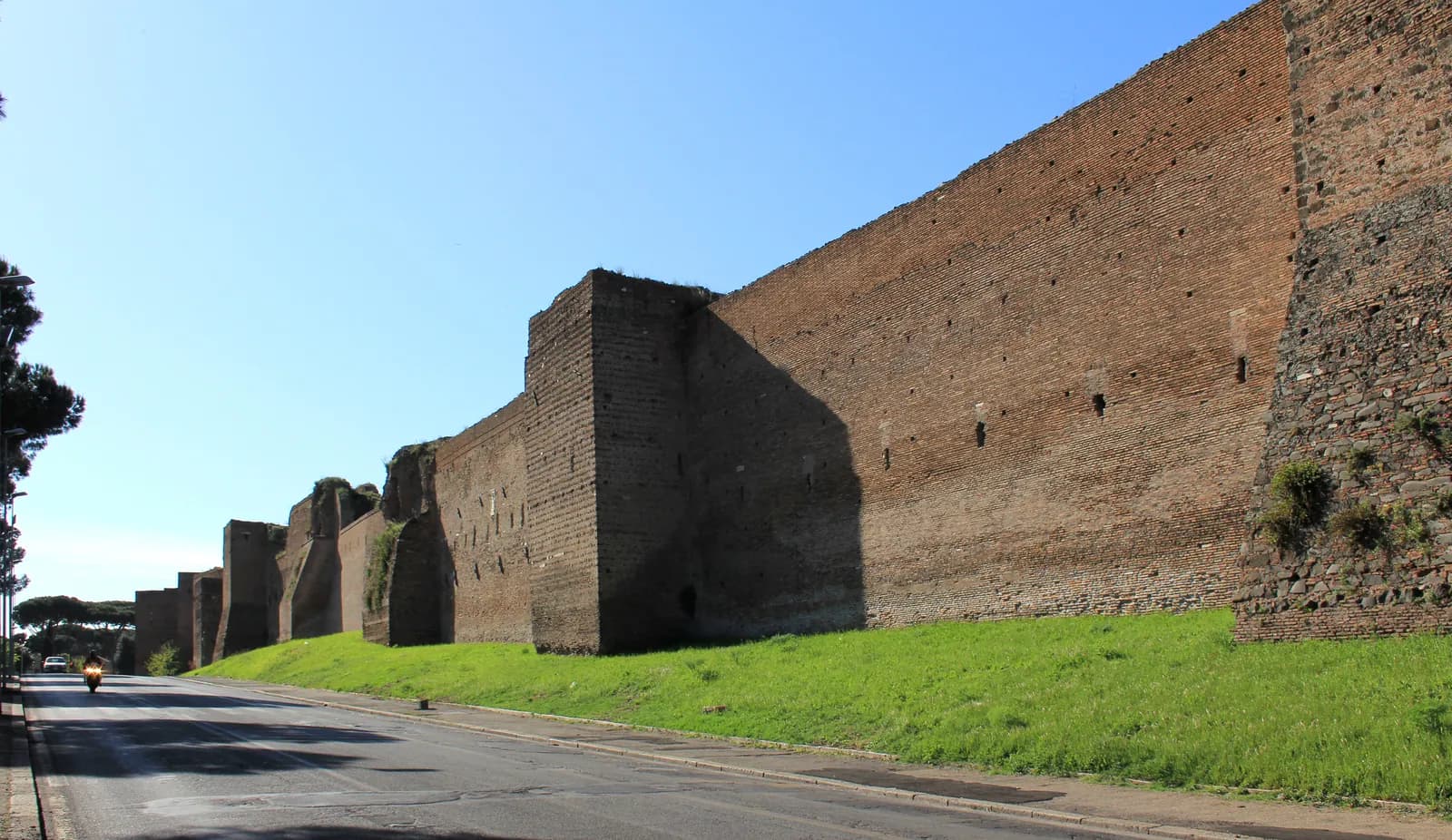
The Servian Wall enclosed the Republican city; the Aurelian Walls, built 271–275 CE, enclose a far larger area and largely survive.
Economy and supply
The city consumed and did not produce. Grain came from Sicily, North Africa and Egypt, was landed at Ostia and Portus and moved upriver, and was distributed to a registered list of recipients — some 200,000 adult male citizens under Augustus.
Water arrived by aqueduct in quantities no European city matched again until the nineteenth century. Frontinus, appointed water commissioner in 97 CE, wrote a treatise on the system that is our best account of Roman public administration in operation.
The Monte Testaccio is the physical residue of the supply: an artificial hill some fifty metres high composed of an estimated fifty-three million discarded olive-oil amphorae, whose stamps record the shippers and the provinces they came from.
Cult and sanctuaries
The Capitoline temple of Jupiter Optimus Maximus was the state cult's centre, and a Roman triumph ended there.
The Forum held the temple of Vesta and the house of the Vestals, whose maintenance of the sacred fire was a state responsibility, and the Regia, the office of the pontifex maximus.
The city accumulated foreign cults continuously — Magna Mater from 204 BCE, Isis, Mithras, and eventually Christianity — and the mithraea excavated beneath later churches are among the most vivid religious survivals.
The city at war
Rome was not besieged successfully for eight centuries after the Gallic sack traditionally dated to 390 BCE, which is why the Republican city could afford to outgrow its walls.
The Aurelian Walls, built in the 270s CE, are the physical marker of a changed strategic situation: the capital of the empire now needed defending.
Population
Ancient population figures are quoted with a confidence the evidence never supported. Each estimate below carries what it rests on and what it is worth.
The city at its height, 1st–2nd century CE
Commonly given as about one million
Modern inference from the number of grain-dole recipients, the built area and assumed household sizes and densities
There was no census of city residents; the Roman census counted citizens across the empire. The million figure is a reconstruction, and serious estimates range from roughly 500,000 to over a million. It is quoted with a confidence the method does not support, though the conclusion that Rome was far larger than any other ancient Mediterranean city is secure.
Recipients of the grain dole under Augustus
About 200,000
Res Gestae 15, in which Augustus records his distributions
A documented administrative figure, and the firmest quantity we have for the city. It counts adult male citizens on a register, not residents: women, children, non-citizens and the enslaved are all outside it, which is why converting it into a total population requires assumptions that are where the disagreement lives.
Monuments
- Evidence level: Documented
Developed from the 7th century BCE onwards
The Forum Romanum
The civic centre, containing the Curia, the rostra, the temple of Vesta and successive basilicas.
- Evidence level: Documented
Inaugurated 80 CE
The Colosseum
The Flavian Amphitheatre, built on the site of the lake of Nero's Golden House — a deliberate return of appropriated land to public use.
- Evidence level: Documented
Hadrianic, c. 126 CE, on Agrippan foundations
The Pantheon
Its unreinforced concrete dome remains the largest of its kind. It survives because it became a church in the seventh century.
- Evidence level: Documented
Column completed 113 CE
Trajan's Column and Forum
The column's helical relief is the fullest pictorial source for the Roman army on campaign, and an idealised state monument.
- Evidence level: Documented
271–275 CE
The Aurelian Walls
Nineteen kilometres of circuit, largely surviving, marking the point at which the capital required defending.
Archaeology and excavation
Rome has been excavated continuously since the Renaissance, and the history of that work is inseparable from politics. The clearances of the 1920s and 1930s under the Fascist regime opened the imperial fora by demolishing an inhabited quarter and driving a road through the site, exposing monuments and destroying stratigraphy and later phases. Modern work is largely rescue archaeology conducted under a living city, most visibly during metro construction.
The central difficulty is that Rome never stopped being occupied. Ground level has risen many metres, monuments were quarried for building material, and much of the ancient city is inaccessible beneath the modern one. Ostia and Pompeii are studied partly because they preserve what Rome cannot.
Museum collections
Where the finds are now. Where a holding is contested, the entry says so.
Capitoline Museums · Rome
Founded in 1471 with a papal donation of bronzes, and generally described as the oldest public museum collection. Holds the she-wolf, the colossal Constantine fragments and the equestrian Marcus Aurelius.
Museo Nazionale Romano (Palazzo Massimo, Baths of Diocletian, Palazzo Altemps, Crypta Balbi) · Rome
Sculpture, frescoes including those from the Villa of Livia, mosaics, and the coin collection. The Crypta Balbi site is an exceptional demonstration of a single block's stratigraphy from antiquity to the present.
Vatican Museums · Vatican City
The Laocoön, the Apollo Belvedere, the Augustus of Prima Porta and a very large collection of Roman sculpture and inscriptions.
Open questions
How many people lived in imperial Rome?
Estimates from roughly 500,000 to over a million are all defended. The disagreement turns on how to convert the grain-dole register into a total, what household size to assume, and how densely insulae were occupied. No method is decisive.
Is there archaeological evidence for a foundation in the eighth century BCE?
Excavation on the Palatine has produced Iron Age huts and, in work published from the late 1980s, traces of an early wall claimed as a foundation-period circuit consistent with the traditional date. The interpretation is contested, and the coincidence with a date calculated centuries later invites caution.
Primary sources
Augustus, Res Gestae Divi Augusti
Augustus's own account of his building and distributions, inscribed publicly across the empire.
Frontinus, On the Water Supply of the City of Rome
The water commissioner's technical and administrative account of the aqueducts.
Tacitus, Annals 15.38-43
The fire of 64 CE and the rebuilding, including the debate about regular streets.
Pliny the Elder, Natural History 36
On the city's building materials and monuments.
How to read the evidence labels
- Evidence level: Documented
- Supported by a named primary text or by excavated material evidence.
- Evidence level: Probable
- Supported by strong inference that most specialists accept.
- Evidence level: Disputed
- Substantial specialist disagreement exists; competing readings are stated.
- Evidence level: Literary
- Belongs to poetic or mythological construction rather than to history.
- Evidence level: Mythological
- Belongs to shared religious or mythic tradition rather than to any single text.
- Evidence level: Unknown
- The available evidence is insufficient to decide.
These labels describe the status of the evidence, not our confidence in a conclusion. A claim marked Literary is not a claim we doubt; it is a claim about what kind of thing a poem is.