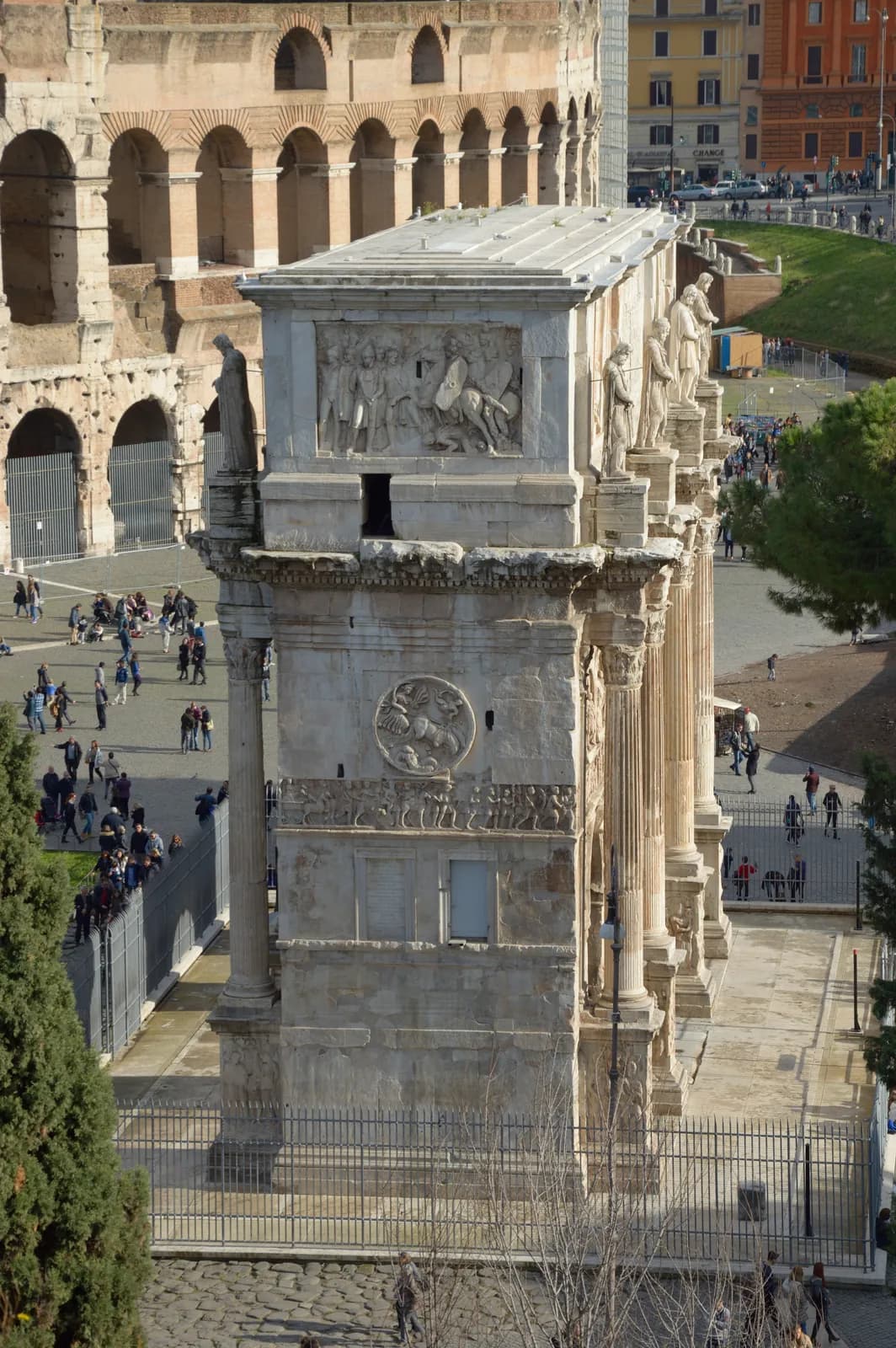
What it is
The Arch of Constantine — the spoliated Hadrianic tondi and Aurelian panels, the Trajanic frieze, the Constantinian carving, and the deliberately unspecific inscription of 315.
Built Dedicated 315 CE, on the tenth anniversary of Constantine's accession. The principal date, dedicated 315 CE, is fixed.
312 CE
The Milvian Bridge
Constantine's defeat of Maxentius outside Rome, the event the arch commemorates.
315 CE
Dedication
Dedicated by the Senate and People for the decennalia. The date is given by the inscription and by the Chronographer of 354.
medieval – 1804
Fortification and excavation
Built into medieval fortifications, then freed and restored in the early nineteenth century.
Who ordered it built
Each attribution carries what supports it. Ancient buildings are routinely credited to people on the authority of writers centuries later, and that is not the same claim as an inscription on the building.
- Evidence level: Documented
Dedicated by
The Senate and People of Rome
The attic inscription, which names them as the dedicators.
- Evidence level: Disputed
Commissioned by
Constantine
The arch honours him and was dedicated to him by the Senate; whether the emperor commissioned it or received it is a different question, and the inscription's phrasing suggests the latter. Some scholars have argued that an earlier arch was reworked, which would change the answer again.
What it was for
A commemorative arch honouring Constantine for the defeat of Maxentius and marking ten years of his rule, straddling the processional route between the Colosseum and the Palatine.
It was also a piece of political reconciliation. The Senate had backed Maxentius, who had held Rome; the arch is the body's formal act of accommodation with the man who took the city from him.
How it was built
A triple-bay arch with detached Corinthian columns on tall plinths, an attic with inscribed panels, and reliefs at four distinct dates set into one composition.
The reuse is systematic rather than opportunistic: eight Hadrianic hunting tondi, eight Aurelian panels from a lost monument, and a long Trajanic battle frieze cut into four sections, arranged symmetrically and with the imperial heads recut to Constantine and his colleague. This is spoliation as design.
The new Constantinian frieze runs in a narrow band above the side bays and tells the campaign of 312 in sequence — the departure from Milan, the siege of Verona, the battle at the bridge, the entry into Rome, the address to the people, the distribution of money.
Materials
- Evidence level: Documented
Marble, reused
The great majority of the sculptural decoration, taken from monuments of Trajan, Hadrian and Marcus Aurelius
- Evidence level: Documented
Marble, newly carved
The narrative frieze over the side bays, the plinth reliefs, the victories in the spandrels
Measured
Every figure states what it rests on. A modern survey, an ancient text, a conversion from an ancient unit and a modern estimate are four different kinds of statement and are not interchangeable.
Height
21 m
Modern survey.
Width
25.9 m
Modern survey.
What it meant
Reusing the sculpture of Trajan, Hadrian and Marcus Aurelius and giving it Constantine's face is an argument that he belongs in their line. The three chosen emperors are the ones the fourth century regarded as the best, which makes the selection a statement rather than a convenience.
The inscription says Constantine won instinctu divinitatis, by the prompting of the divinity, and mentions no god by name. Written three years after the Milvian Bridge and two years after the toleration settlement, by a body with pagan and Christian members, it is one of the most carefully unspecific sentences in Roman epigraphy, and every account of Constantine's religious position has to deal with it.
The stylistic gap between the reused panels and the new frieze — frontal, squat, hierarchical figures against classical proportion — was read for centuries as evidence of decline. It is now more often read as a deliberate change of register: the new frieze is legible from below at a distance and organises its figures by importance rather than by perspective.
After antiquity
Incorporated into medieval fortifications, which preserved it. Freed in the early nineteenth century and restored in 1804 under Pius VII by Raffaele Stern, with missing elements replaced and some heads recut again.
It stood in the middle of the twentieth-century parade route past the Colosseum, and was a fixture of Fascist processional staging.
Condition today
Standing
Standing and substantially complete, with its reliefs in place. Some of the free-standing statues on the attic and details of the columns are restorations.
Study of the fabric has established which elements came from which earlier monuments, and in several cases from which specific building — the Trajanic frieze is generally assigned to the Forum of Trajan, though the identification is argued.
Investigation of the foundations has produced evidence read by some as indicating an earlier arch on the site reworked for Constantine, and by others as ordinary preparation.
Scattered fragments
What has left the building, and where it is now. Where a holding is contested, the museum page says so.
- Evidence level: Disputed
The Great Trajanic Frieze, of which the four panels on the arch are the surviving sections
In position on the arch
Its original monument is not securely identified; the Forum of Trajan is the usual proposal.
- Evidence level: Documented
Two of the Aurelian panels' companions, from the same lost monument
Written about in antiquity
Panegyrici Latini 12(9) and 4(10)
The Latin panegyrics of 313 and 321 on the campaign against Maxentius and the entry into Rome. Court oratory delivered close to the events, and the nearest thing to a contemporary narrative.
Eusebius, Life of Constantine 1.28–31
Eusebius on the vision before the battle, written decades later and after long acquaintance with Constantine. It should be read beside the arch's inscription, which says something considerably vaguer.
Still argued
Was there an earlier arch on the site?
A proposal advanced since the 1990s holds that the core of the monument is Hadrianic or later and was reworked in 315, on the evidence of the brickwork and the fit of the reused panels. Others hold that the structure is a single build using older sculpture. The question matters because it changes what the Constantinian workshop actually made.
What does instinctu divinitatis mean?
Readings range from a deliberate compromise formula acceptable to Christian and pagan senators, to a genuine reflection of Constantine's own solar monotheism at that date, to conventional language with no religious content. The phrase is not a Christian formula and it is not a pagan one either, and it was chosen by a body that had reason to avoid both.
How to read the evidence labels
- Evidence level: Documented
- Supported by a named primary text or by excavated material evidence.
- Evidence level: Probable
- Supported by strong inference that most specialists accept.
- Evidence level: Disputed
- Substantial specialist disagreement exists; competing readings are stated.
- Evidence level: Literary
- Belongs to poetic or mythological construction rather than to history.
- Evidence level: Mythological
- Belongs to shared religious or mythic tradition rather than to any single text.
- Evidence level: Unknown
- The available evidence is insufficient to decide.
These labels describe the status of the evidence, not our confidence in a conclusion. A claim marked Literary is not a claim we doubt; it is a claim about what kind of thing a poem is.