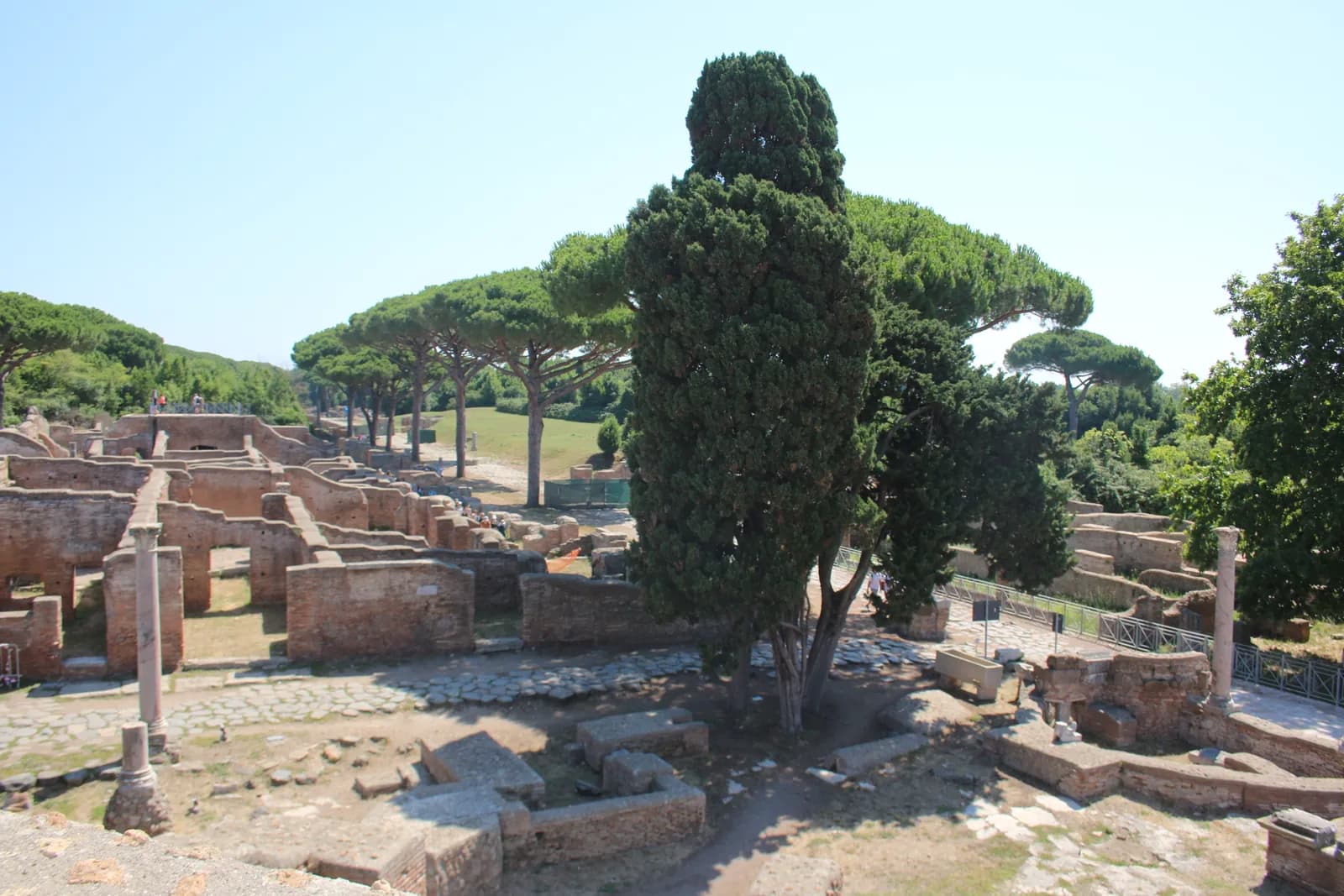
The site and its setting
Ostia stood at the mouth of the Tiber, about twenty-five kilometres downstream from Rome — the point where seaborne cargo transferred to river barges. Silting has since moved the coastline several kilometres, so the site is now inland.
Its purpose was entirely functional: it existed because Rome needed a port and the Tiber mouth was where one had to be.
Foundation
Founded by Ancus Marcius, fourth king of Rome, in the 7th century BCE.
The literary tradition is consistent about Ancus Marcius. Excavation has produced nothing earlier than the fourth century BCE castrum, and the discrepancy is unresolved: either the earlier settlement lies elsewhere or under the water table, or the tradition is a back-projection.
History of the settlement
The earliest structure excavated is a rectangular fortified castrum of the fourth century BCE, laid out on a military plan whose main streets still govern the town's layout.
The town grew with Rome's grain trade. Claudius and then Trajan built artificial harbours to the north at Portus, because the river mouth could not handle the volume, and over time Portus took the shipping while Ostia remained the administrative and residential centre.
Ostia declined from the third century CE with the reduction of Rome's population and the shift of activity to Portus, and was gradually abandoned rather than destroyed — which is why so much stands.
Urban plan
The castrum grid survives as the core, with the decumanus running through the town and later development spreading outward without a single scheme.
The forum holds the Capitolium and a basilica. The theatre backs onto the Piazzale delle Corporazioni, a colonnaded square whose floor mosaics advertise the shipping firms and trades that had offices there, naming their home ports across the Mediterranean.
Most residents lived in insulae — brick-faced concrete apartment blocks of several storeys with shops at street level, staircases to upper flats, and shared courtyards. Ostia's are the best preserved anywhere and are the principal evidence for the type that dominated Rome itself.
Economy and supply
Grain, oil and wine landed here for Rome. The horrea, large warehouse complexes with raised floors and secure courtyards, are among the most substantial structures in the town.
The Piazzale mosaics are a directory of the trade: they name shippers from Carthage, from Narbonne, from Alexandria and elsewhere, and depict the ships and the goods.
Service trades — bakeries with their millstones in place, fullers' workshops, bars with marble counters — survive in a completeness that lets ordinary economic life be read directly.
Cult and sanctuaries
The Capitolium dominates the forum. Alongside it, Ostia preserves an unusual density of the cults an international port attracted: at least eighteen mithraea are known, along with a synagogue near the shore that is among the oldest known in Europe, and temples of Magna Mater and of Egyptian deities.
That mixture is one of the site's most valuable features. It shows the religious life of a working Roman town rather than of a capital or a sanctuary.
The city at war
Ostia's military history is thin, which is part of its interest: it was a working town rather than a fortress. The original castrum was defensive; later walls enclosed a much larger area under Sulla.
Its strategic importance was logistical. Interruption of the grain route through Ostia and Portus threatened Rome directly, which is why control of the sea lanes mattered politically as well as militarily.
Population
Ancient population figures are quoted with a confidence the evidence never supported. Each estimate below carries what it rests on and what it is worth.
The town at its height, 2nd century CE
Commonly estimated at 50,000–60,000
Modern reconstruction from the excavated area and the density of insulae
No ancient figure survives. The estimate rests on assumptions about occupancy of apartment blocks that are themselves derived from Ostia, which makes the reasoning partly circular. It indicates a substantial town and no more.
Monuments
- Evidence level: Documented
1st–2nd century CE
The Piazzale delle Corporazioni
Sixty-odd offices around a portico, each with a floor mosaic naming and illustrating its trade and home port. A commercial directory in stone.
- Evidence level: Documented
Principally 2nd century CE
The insulae
Multi-storey brick-faced apartment blocks, the best-preserved examples of the housing type in which most urban Romans lived.
- Evidence level: Documented
2nd century CE
The Horrea Epagathiana and other warehouses
Secure storage complexes with raised floors, showing how the grain supply was physically handled.
- Evidence level: Documented
Augustan, enlarged c. 196 CE
The theatre
Restored and still used for performance.
- Evidence level: Probable
Origins possibly 1st century CE, with later rebuilding
The synagogue
Near the ancient shoreline, and among the oldest known synagogue buildings in Europe. The dating of its earliest phase is argued.
Archaeology and excavation
Excavated intermittently from the nineteenth century and then on a very large scale between 1938 and 1942, when the regime cleared roughly two-thirds of the town at speed for a planned exposition. That campaign exposed an enormous area and recorded it poorly by modern standards, and much late-antique material was removed to reach the imperial phases.
Ostia's value is that it was abandoned rather than destroyed, and buried by silt. It preserves the ordinary fabric — housing, shops, warehouses, bars, latrines — that catastrophic sites like Pompeii preserve as a moment and that living cities like Rome have lost.
Museum collections
Where the finds are now. Where a holding is contested, the entry says so.
Museo Ostiense · Ostia Antica, Italy
Sculpture, portraits, sarcophagi and mithraic material from the site, displayed on the excavation.
Museo delle Navi · Fiumicino, Italy
Ships and harbour material recovered from Portus, the artificial harbours that succeeded Ostia.
Open questions
Why is there nothing at Ostia earlier than the 4th century BCE?
The tradition attributes the foundation to a seventh-century king. Proposals to reconcile this include an earlier settlement at a different location on the changing river mouth, or one lying below the modern water table and so unexcavated. The alternative is that the attribution to Ancus Marcius is a later construction. Unresolved.
Primary sources
Livy, History of Rome 1.33
The attribution of the foundation to Ancus Marcius.
Strabo, Geography 5.3
On the Tiber mouth, its silting and the difficulty of the harbour.
Ostian guilds, The Piazzale delle Corporazioni mosaics in situ
Sixty-odd inscribed and illustrated trade advertisements naming firms and home ports — a documentary source that is also the floor.
How to read the evidence labels
- Evidence level: Documented
- Supported by a named primary text or by excavated material evidence.
- Evidence level: Probable
- Supported by strong inference that most specialists accept.
- Evidence level: Disputed
- Substantial specialist disagreement exists; competing readings are stated.
- Evidence level: Literary
- Belongs to poetic or mythological construction rather than to history.
- Evidence level: Mythological
- Belongs to shared religious or mythic tradition rather than to any single text.
- Evidence level: Unknown
- The available evidence is insufficient to decide.
These labels describe the status of the evidence, not our confidence in a conclusion. A claim marked Literary is not a claim we doubt; it is a claim about what kind of thing a poem is.