A provincial soldier on the imperial throne
Marcus Ulpius Traianus was born at Italica in southern Spain in 53 CE, the son of a senator who had risen through legionary command to the consulship and the governorship of Syria. The son followed the same path with more success and at more scale. He served as a military tribune in the East under his father; he commanded a legion in the Rhineland under Domitian; he was consul in 91; he was governor of Germania Superior at the moment Nerva, in 97, adopted him as son and heir. Within a year Nerva was dead and Trajan was emperor. He returned to Rome from the German frontier the following year. He ruled for nineteen years and died on campaign in 117. The Senate, two months later, granted him the title Optimus Princeps — the best princeps — which appears on the inscriptions and the coinage of his successors for the remainder of the high empire.
What kind of ruler he was
Trajan's reign is read, by the surviving sources, as the test case for what a principate under a disciplined ruler can do. The administrative reforms (the alimenta programme of state support for the children of impoverished citizens; the careful management of provincial finances visible in the Pliny–Trajan correspondence); the military reach (the two Dacian wars, the Parthian campaign, the brief carrying of Roman authority to Mesopotamia); the building programme (Trajan's Forum, the Markets of Trajan, the Column, the harbours at Portus, the road network through Italy and Asia Minor); the long peace inside the empire that the conquests on the frontiers made possible — all of these are read as the case for what the imperial order, freed of the convulsions of the Julio-Claudians and the Flavian civil wars, could do in working hands.
Pliny the Younger's Panegyricus of 100 CE — a speech to the Senate on Trajan's behalf — is the principal contemporary articulation of the case. The argument is direct: the optimus princeps is one who reigns as if he could be called to account, who governs as if the laws constrained him, who refuses the cult of personality and the open arbitrariness of the Julio-Claudian style. Pliny was a friend and a beneficiary; the panegyric is partisan; it is also the most influential statement of what the high empire's senatorial class thought the imperial office could be at its best.
What kind of imperial order he produced
The empire Trajan administered was the largest in territory the Roman state would ever hold. The conquests of Dacia, accomplished across two wars (101–102, 105–106), brought a substantial gold-bearing province into the imperial economy and provided the slaves and resources that funded the building programme. The Parthian campaign of 113–117 carried Roman authority briefly across the Tigris into Mesopotamia. The frontier under Trajan ran from the Solway Firth to the Persian Gulf. Hadrian, on succeeding, would withdraw from Mesopotamia and consolidate; the high-water mark stood.
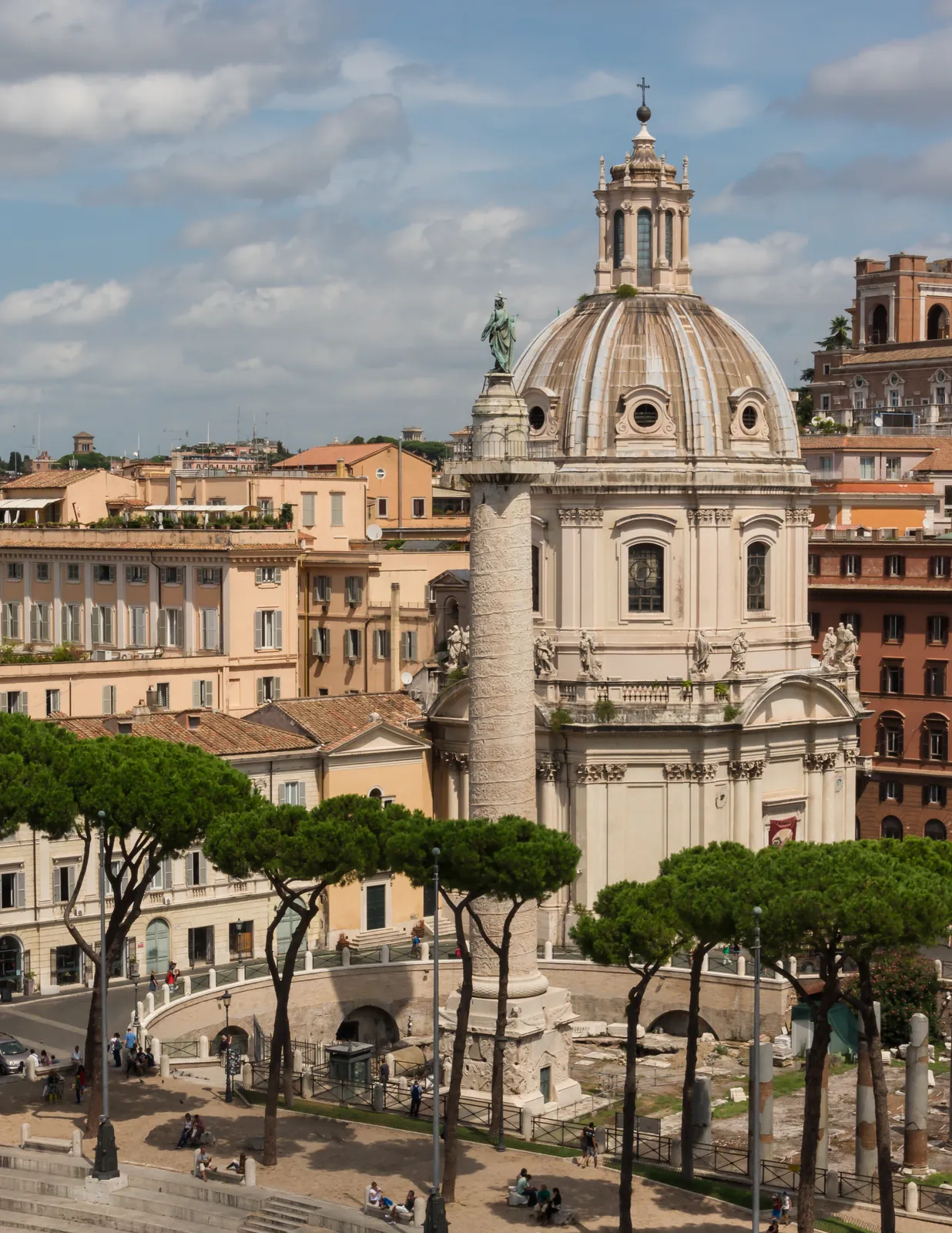
The infrastructure that this expansion built outlasted the territory. Trajan's Column, completed in 113, is the single most influential narrative monument of antiquity — a spiral relief running 200 metres end-to-end, recording the Dacian wars in 155 documentary scenes, and the principal surviving model for the European tradition of public monumental narrative through Bernini's column for St Peter's, Napoleon's Vendôme column, and beyond. Trajan's Forum was the largest forum in Rome and the architectural model for the imperial forum form. The Trajan road system through the Italian peninsula and across Asia Minor was the working infrastructure of the empire for the rest of antiquity.
What later civilizations took from him
The European reception of Trajan is unusual for an emperor. Dante, in Purgatorio X, places him among the just rulers and borrows from a medieval legend that has Gregory the Great praying his soul out of hell — the only pagan emperor the medieval imagination permitted into the Christian heaven. The Renaissance read Trajan as the standing pagan example of a good prince. The Spanish Bourbon dynasty, beginning in the eighteenth century, claimed descent and modelled itself on him. The American founders read Pliny's Panegyricus as part of the standard imperial curriculum on what a republic should not tolerate even from a good ruler — because the lesson the senatorial class drew from Trajan was that even the best principate is a principate, and depends for its working on the character of the one man.
Why the platform reads him
The platform reads Trajan because his reign is the working answer to a question the European political tradition cannot pretend not to care about: can an imperial order, under disciplined personal rule, produce a tolerable political condition for the citizens inside it? The Tacitean answer is that the institutional form has been hollowed out and the substance of political life is gone. The Trajanic answer is that, when the man at the top has the self-restraint of an Augustus and the administrative seriousness of a working soldier, the order can be lived under. Both answers are correct in their own register. The careful reading is that the Trajanic case does not refute the Tacitean one. It shows what is possible under the right specific conditions; the conditions are contingent, and the absence of any of them is what every other century of the high empire then demonstrated.