The site and its setting
Pompeii stood on a spur of old lava above the Sarno plain, near the coast, about ten kilometres from the summit of Vesuvius. The volcanic soil was exceptionally fertile, which is why the region was densely settled and wealthy.
That Vesuvius was a volcano was not generally understood before 79 CE. A severe earthquake in 62 or 63 CE damaged the town heavily, and repairs were still in progress when it was buried.
Foundation
An Oscan settlement, later under Etruscan and Greek influence, becoming a Roman colony in 80 BCE.
The sequence is attested archaeologically and epigraphically. Oscan inscriptions survive in the town, including street-corner directions painted for the defenders during Sulla's siege.
History of the settlement
The town passed through Oscan, Etruscan, Greek and Samnite influence before falling to Rome, and was made a colony for Sullan veterans in 80 BCE after resisting in the Social War.
It was a working town of moderate wealth: agriculture, wine, garum, textiles, and a good deal of small manufacturing.
The eruption buried it under several metres of pumice and then pyroclastic flow. Rescue and looting began almost immediately and continued sporadically; the site was rediscovered in the eighteenth century.
Urban plan
The street grid is irregular in the older quarter and regular in the later expansion, with stepping stones at crossings and deep ruts worn by cart wheels.
The forum holds the temples, the basilica and the market buildings; the amphitheatre sits at the far end of the town, and the theatres in their own quarter.
Houses range from very large peristyle residences to single rooms behind shops, and the mixture along a single street is one of the most important things the site shows: rich and poor were not zoned apart.
Economy and supply
Wine and oil from the surrounding estates, garum, bread from commercial bakeries whose ovens and millstones survive, fulling and dyeing, and a great deal of retail.
The town's commercial life is legible from its walls. Painted electoral notices, rental advertisements, price lists and thousands of graffiti survive because they were plastered over by ash rather than weathered away.
Cult and sanctuaries
The forum temples include the Capitolium and a temple of Apollo. A temple of Isis, rebuilt after the earthquake, is among the best-preserved Isis sanctuaries anywhere.
Household shrines survive throughout the town, which makes Pompeii the principal evidence for domestic Roman religion — the daily practice that literary sources rarely describe.
The Villa of the Mysteries, outside the walls, carries a painted frieze usually read as an initiation into a Dionysiac cult. The reading is standard and the specific interpretation is argued.
The city at war
Pompeii's walls carry the marks of Sulla's siege in 89 BCE, including impact scars from artillery, alongside painted Oscan directions to the defenders.
The amphitheatre was the scene of a riot between Pompeians and Nucerians in 59 CE that was serious enough for the Senate to ban games there for ten years. Tacitus reports it, and a wall painting in the town depicts it.
Population
Ancient population figures are quoted with a confidence the evidence never supported. Each estimate below carries what it rests on and what it is worth.
The town at the time of the eruption
Commonly estimated at 11,000–15,000
Modern reconstruction from the walled area, the number of houses and theatre and amphitheatre capacity
No ancient figure survives. The estimate is unusually well founded compared with most ancient cities, because the entire walled area is known and the housing stock can be counted, but occupancy per house remains an assumption.
Those killed
Around 1,100 bodies recovered within the excavated area
Excavation record
A count of what has been found, not of the dead. Much of the town is unexcavated, many residents fled, and many died outside the walls — several hundred were found at the shore at Herculaneum. The total death toll of the eruption is unknown.
Monuments
- Evidence level: Documented
Successive phases to 79 CE
The Forum
Still under repair from the earthquake when the eruption came, which is itself informative about the town's condition.
- Evidence level: Documented
c. 70 BCE
The Amphitheatre
The earliest surviving permanent stone amphitheatre known, predating the Colosseum by a century and a half.
- Evidence level: Documented
2nd century BCE, with later phases
The House of the Faun
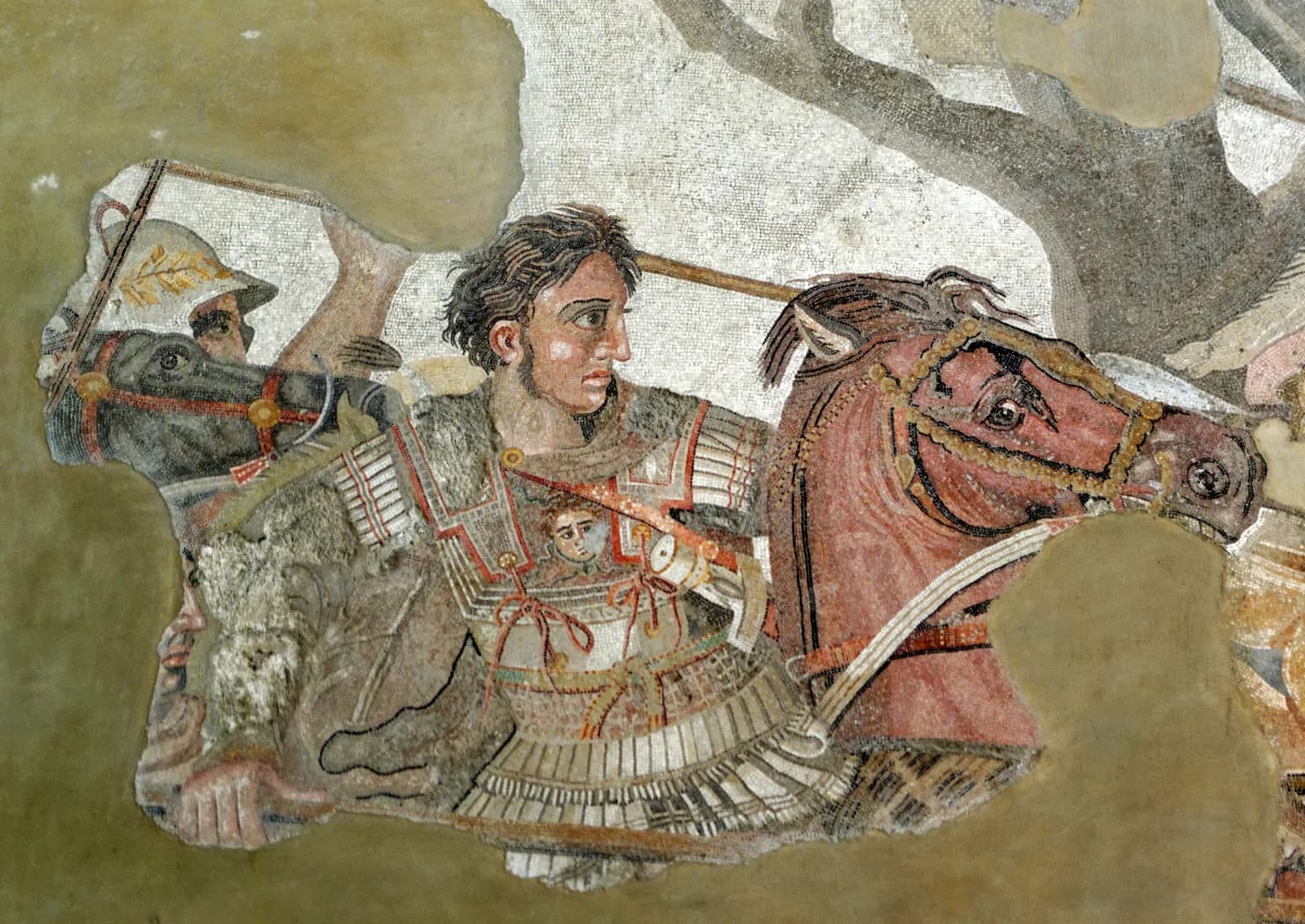
One of the largest houses in the town. Its floor carried the Alexander Mosaic, now in Naples, which is the principal image of Alexander in battle to survive from antiquity.
- Evidence level: Documented
2nd century BCE, frescoes c. 60–50 BCE
The Villa of the Mysteries
A suburban villa whose megalography frieze is among the best-preserved large-scale Roman painting.
- Evidence level: Documented
Rebuilt after the earthquake of 62/63 CE
The Temple of Isis
Among the best-preserved sanctuaries of Isis in the Roman world, and an early modern rediscovery that influenced European taste.
Archaeology and excavation
Excavation began in 1748 under Bourbon patronage as treasure-hunting, and became systematic under Giuseppe Fiorelli from 1863, who divided the town into regions and blocks — the system still in use — and developed the technique of pouring plaster into voids left by decayed bodies to produce the casts. Twentieth-century campaigns exposed large areas; conservation of what was exposed has been a persistent failure, with collapses continuing into the present century. Roughly a third of the town remains deliberately unexcavated as a reserve for future methods.
Pompeii's unique value is that it preserves a moment: meals, furniture, graffiti, unfinished repairs. Its unique danger is the temptation to read that moment as typical. It was one prosperous town in one fertile region on one day, and its housing, its diet and its wall-painting are not automatically representative of the empire.
Museum collections
Where the finds are now. Where a holding is contested, the entry says so.
Museo Archeologico Nazionale di Napoli · Naples, Italy
The great majority of the movable finds: the Alexander Mosaic, the bronzes from the Villa of the Papyri at Herculaneum, wall paintings removed from the houses, silver, and the Farnese collection.
Most of the paintings and mosaics visible at Pompeii today are reproductions; the originals were removed to Naples, which is why the site and the museum have to be read together.
Antiquarium of Pompeii · Pompei, Italy
Material displayed on site, including casts and objects from recent excavation.
Open questions
When in 79 CE did the eruption happen?
Pliny the Younger's letter, in the manuscripts as transmitted, gives 24 August. Against that: the victims' clothing, the autumn fruit and nuts found, the braziers in use, and a charcoal inscription uncovered in 2018 that appears to be dated to mid-October. Many specialists now favour an autumn date and treat the August reading as a manuscript corruption. It is not settled.
What does the Villa of the Mysteries frieze depict?
The standard reading is a Dionysiac initiation, possibly of a bride. Alternatives have proposed a theatrical subject or a sequence of ritual scenes without a single narrative. No text identifies it.
Primary sources
Pliny the Younger, Letters 6.16 and 6.20
The eyewitness account of the eruption written to Tacitus roughly twenty-five years later, describing the death of Pliny the Elder and the writer's own escape.
Tacitus, Annals 14.17
The riot in the amphitheatre in 59 CE and the Senate's response.
The inhabitants, The graffiti and painted inscriptions of Pompeii CIL IV
Several thousand texts on walls — electoral notices, prices, insults, verse — preserved by burial. An unparalleled record of ordinary written Latin.
How to read the evidence labels
- Evidence level: Documented
- Supported by a named primary text or by excavated material evidence.
- Evidence level: Probable
- Supported by strong inference that most specialists accept.
- Evidence level: Disputed
- Substantial specialist disagreement exists; competing readings are stated.
- Evidence level: Literary
- Belongs to poetic or mythological construction rather than to history.
- Evidence level: Mythological
- Belongs to shared religious or mythic tradition rather than to any single text.
- Evidence level: Unknown
- The available evidence is insufficient to decide.
These labels describe the status of the evidence, not our confidence in a conclusion. A claim marked Literary is not a claim we doubt; it is a claim about what kind of thing a poem is.