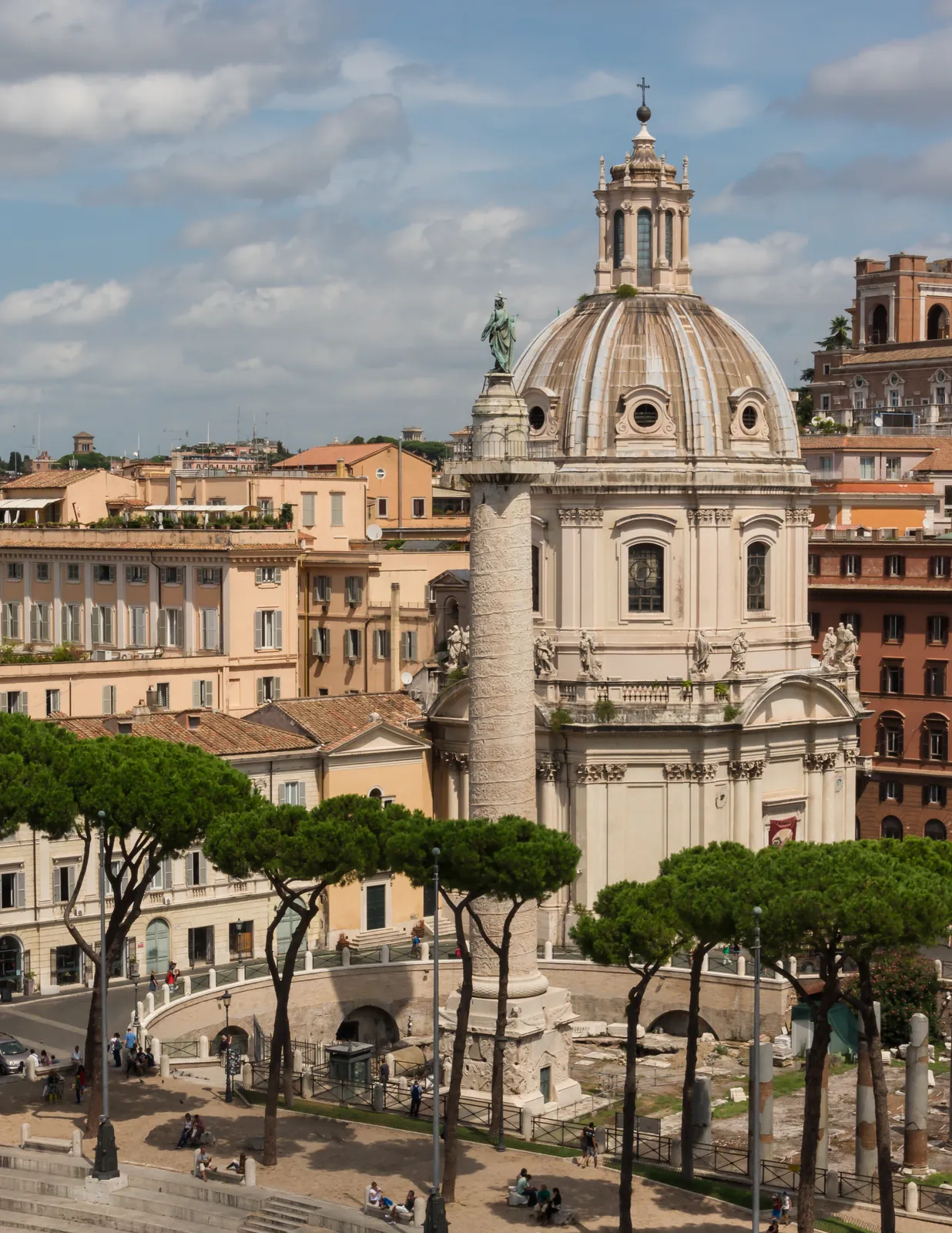
What it is
Trajan's Column — the Dacian Wars frieze, the inscription about the height of the hill removed, the tomb in the base, and why the fullest Roman war narrative is also the least verifiable.
Built Dedicated 113 CE; the statue on top replaced in 1588. The principal date, dedicated 113 CE, is fixed.
101–102 and 105–106 CE
The Dacian Wars
Two campaigns across the Danube ending in the annexation of Dacia. Trajan's own account, the Dacica, is lost apart from a few words.
dedicated 113 CE
The column
Dedicated by the Senate and People in the forum built from the spoils, between the Greek and Latin libraries.
117 CE
The burial
Trajan died in Cilicia and his ashes were placed in a chamber in the base. Burial inside the sacred boundary of the city was forbidden, and the exception had to be voted.
1588
St Peter on the summit
Sixtus V replaced the lost statue of Trajan with a bronze St Peter, which is what stands there now.
Who ordered it built
Each attribution carries what supports it. Ancient buildings are routinely credited to people on the authority of writers centuries later, and that is not the same claim as an inscription on the building.
- Evidence level: Documented
Dedicated by
The Senate and People of Rome
The dedicatory inscription on the pedestal.
- Evidence level: Documented
Commissioned by
Trajan
The column stands in his forum, is funded from his Dacian spoils, and holds his ashes; the inscription is addressed to him.
- Evidence level: Probable
Architect
Apollodorus of Damascus
Cassius Dio 69.4 names Apollodorus as the designer of Trajan's forum, odeum and gymnasium. The column is not named, and the attribution rests on his responsibility for the complex it stands in.
What it was for
A commemorative column carrying a continuous relief of the two Dacian wars, surmounted by a statue of the emperor, standing in the courtyard between the two libraries of his forum.
It became a tomb four years later, when Trajan's ashes were placed in the pedestal chamber. Burial within the pomerium was forbidden, and the exception had to be voted.
The inscription states a third purpose that is easy to miss: to show how high a hill and how much ground were cleared away for these works. The column is, on its own account, a measuring stick.
How it was built
Nineteen drums of Luna marble, each hollowed for the spiral stair before being set, so that the staircase was cut through the blocks and not built inside a shell. The joints run through the carved frieze and are almost invisible.
The frieze was carved after erection, working from the top down or in registers — the evidence of the tool marks and of the joints is argued — and the bands increase in height as they rise, which partly compensates for the viewing angle and does not solve it.
The pedestal contains a vaulted chamber, reached by a door, which received the ashes.
Materials
- Evidence level: Documented
Luna marble
The shaft, in nineteen drums, and the pedestal
- Evidence level: Documented
Bronze
The original statue of Trajan on the summit, lost by the medieval period
Measured
Every figure states what it rests on. A modern survey, an ancient text, a conversion from an ancient unit and a modern estimate are four different kinds of statement and are not interchangeable.
Height of the column
about 29.8 m; about 35 m including pedestal and statue base
Modern survey. The column proper is close to 100 Roman feet, which is what the inscription's claim about the hill is generally taken to mean.
Length of the frieze
about 190 m, in 23 spiral bands
Modern measurement of the carved band, unwound.
Figures carved
roughly 2,600
Modern counts from casts. Published figures differ by a hundred or more depending on what counts as a figure.
Internal stair
185 steps, lit by 43 slit windows
Direct count and survey within the shaft.
What it meant
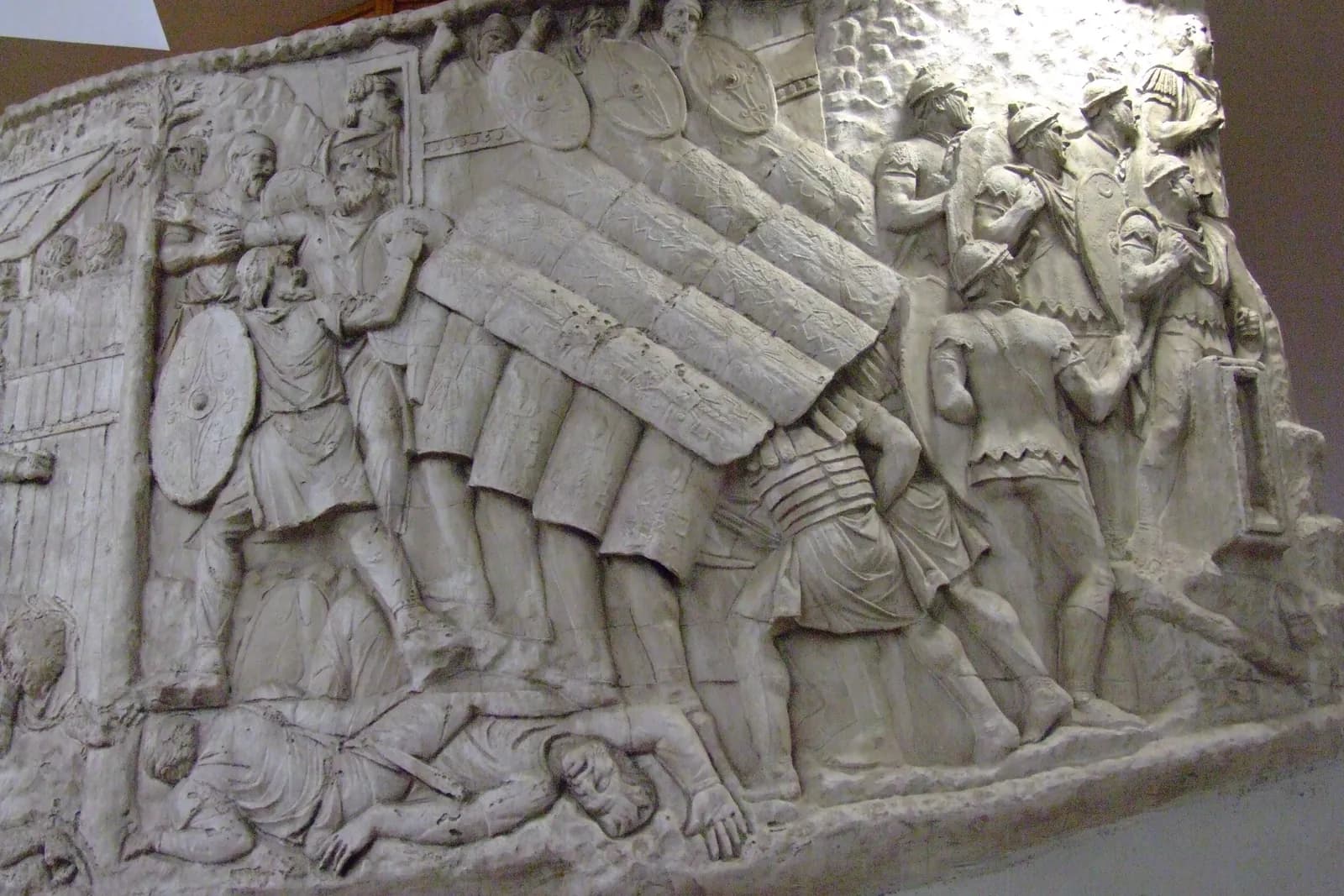
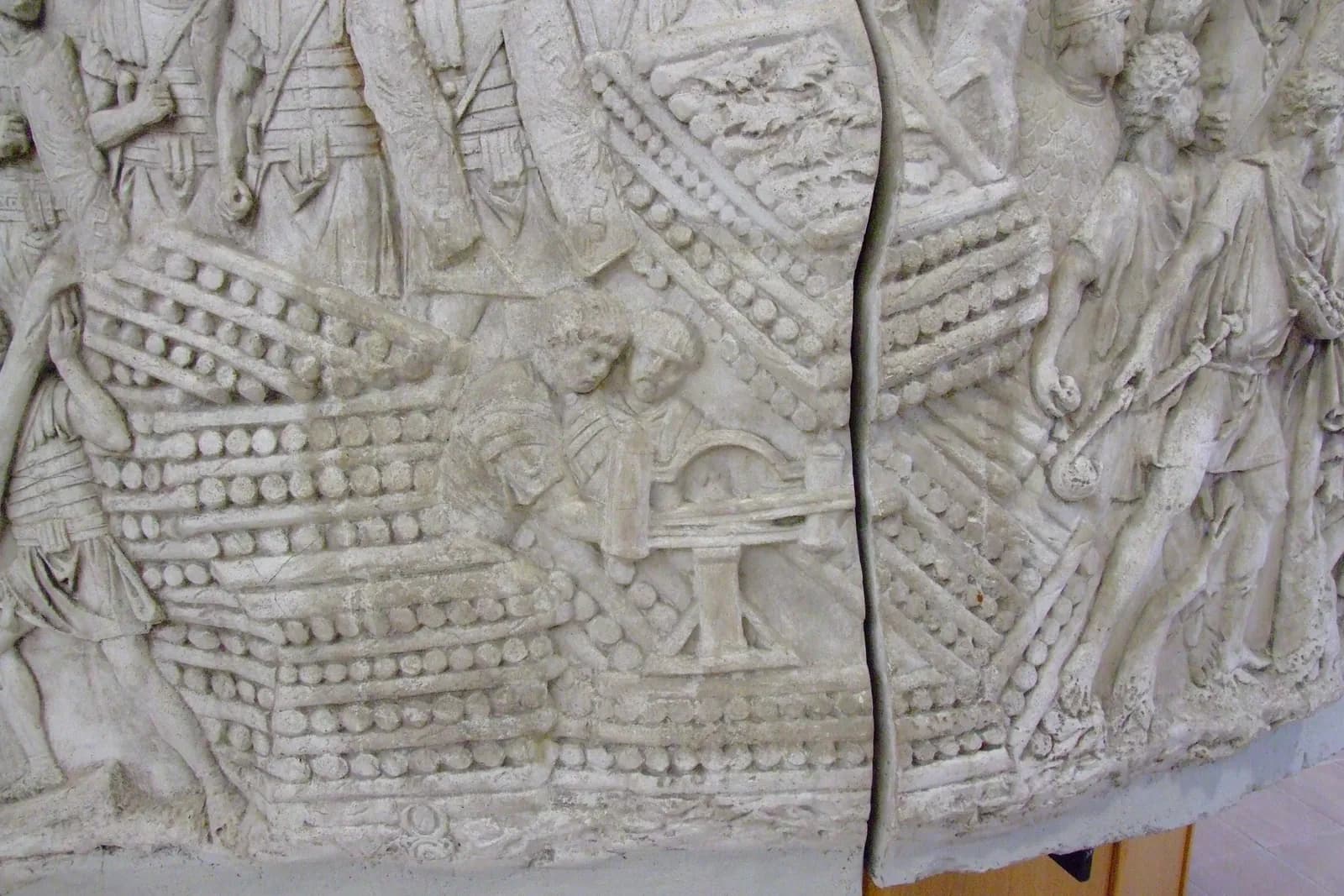
The column is the fullest surviving Roman account of a war and it is the emperor's account. Trajan appears some sixty times, always composed; the army builds, marches, sacrifices and fights in that order of emphasis; the Dacians are individualised and dignified in defeat, which flatters the victory. It is a monument, not a report.
That matters because the alternative sources are gone. Trajan's own commentaries survive in one fragment; Cassius Dio's books on the wars survive in a Byzantine summary. The best-illustrated Roman war is the one whose written record has been lost, and the images have had to carry a weight they were never designed for.
The final scene is the deportation of the Dacian population, and the column does not present it as a tragedy. Reading it as one is a modern response to an ancient monument that is doing something else.
After antiquity
Survived the medieval period standing, protected by a papal decree in 1162 that made damaging it a capital offence — the column was already understood as a monument to be preserved.
The ashes and the statue were gone by then. Sixtus V put St Peter on top in 1588 as part of a programme of Christianising ancient columns.
Plaster casts were taken in the nineteenth century for the Musée des Monuments Français and for the Victoria and Albert Museum, and those casts are now in better condition than the original surface, which has suffered badly from urban pollution.
Condition today
Standing
Standing complete on its pedestal with its frieze, in an excavated hollow well below modern street level. The bronze on top is sixteenth-century.
Excavation of the forum around the column has established its position between the libraries and the level of the ancient courtyard, which is several metres below the modern street.
The claim in the inscription about the height of ground removed has been tested by excavation on the Quirinal side. The quantity of rock actually cut away is argued, and some scholars now hold that the saddle between the Capitoline and the Quirinal was lower than the inscription implies and that the sentence refers to the whole complex rather than a single cut.
Scattered fragments
What has left the building, and where it is now. Where a holding is contested, the museum page says so.
- Evidence level: Documented
Nineteenth-century plaster casts of the entire frieze, taken when the surface was in better condition
Museo della Civiltà Romana, Rome; the Victoria and Albert Museum, London; and other collections
Written about in antiquity
Cassius Dio, Roman History 68.6–14
Cassius Dio on the Dacian wars, surviving mainly in the epitome of Xiphilinus. Thin, late and abbreviated, and still the principal narrative source.
The dedicatory inscription CIL VI 960
The Senate and People to Trajan, and the statement that the column shows how high a hill and how much ground was cleared for these works. The single most argued sentence about the site.
Still argued
Could anyone read the frieze?
The upper bands are more than twenty metres up and the spiral turns away from any fixed viewpoint. Proposals include viewing from the library balconies, reading the lower registers only, treating the column as a symbol rather than a text, and a lost painted scheme that made it legible. Nothing settles it, and the difficulty is real: the most detailed Roman narrative relief is mostly invisible.
How much of the hill was actually removed?
Taken literally the inscription implies about thirty metres of rock cut away for the forum. Excavation on the Quirinal slope has produced results read both as confirming a major cut and as showing that the saddle was already low. The reading of the Latin is also argued — whether the height refers to the hill removed or to the works themselves.
How to read the evidence labels
- Evidence level: Documented
- Supported by a named primary text or by excavated material evidence.
- Evidence level: Probable
- Supported by strong inference that most specialists accept.
- Evidence level: Disputed
- Substantial specialist disagreement exists; competing readings are stated.
- Evidence level: Literary
- Belongs to poetic or mythological construction rather than to history.
- Evidence level: Mythological
- Belongs to shared religious or mythic tradition rather than to any single text.
- Evidence level: Unknown
- The available evidence is insufficient to decide.
These labels describe the status of the evidence, not our confidence in a conclusion. A claim marked Literary is not a claim we doubt; it is a claim about what kind of thing a poem is.