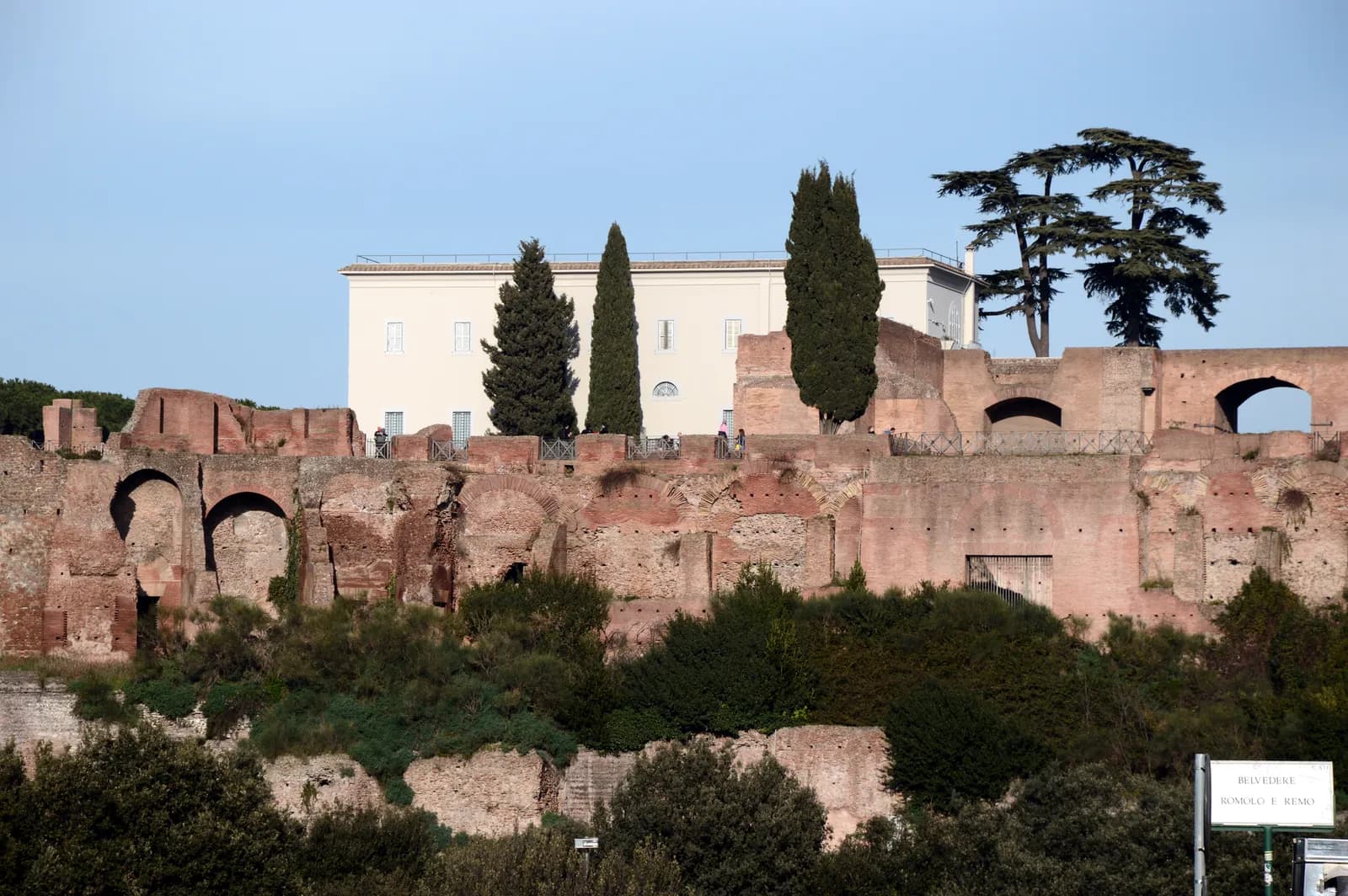
Where the site is
A roughly square hill of about ten hectares rising some forty metres above the Forum on one side and the Circus Maximus valley on the other. Defensible, dry, close to the river crossing and small enough to be a single community. It is where the earliest substantial occupation of the site of Rome has been found.
- Ancient region
- Latium
- Modern country
- Italy
- Position
- 41.889° N, 12.487° E — The Domus Flavia
- Given to three decimal places, about a hundred metres. It locates the named feature, not the extent of the site.
What survives
On the south-west spur, cuttings in the tufa: the postholes and drainage gullies of Iron Age huts, protected under cover. They are unimpressive to look at and they are the oldest structural evidence for Rome.
Beneath the later palace, two decorated houses conventionally called the House of Augustus and the House of Livia keep Second Style wall paintings of very high quality in situ — architectural perspectives, garlands and small landscapes, on the walls of rooms of quite ordinary size.
Above them the imperial palace survives as brick and concrete on a huge scale: the Domus Flavia's audience hall and basilica, the Domus Augustana's courtyards, the sunken garden usually called the stadium, and the substructures holding the whole platform up. The Farnese Gardens sit on the north side, over the Domus Tiberiana.
Occupation and chronology
Dates below are stored as signed years and rendered with the precision they actually carry. c. 750 BCE is approximate; c. 1600 CE is approximate.
8th century BCE
The huts
Postholes, drainage channels and floor cuttings of oval huts on the south-west spur. The dating is secure; the identification of any one of them with Romulus is not archaeology but a Roman tradition about a hut the Romans themselves maintained as a relic.
5th–1st centuries BCE
The Republican hill
A fashionable residential quarter — Cicero, Hortensius, Catiline and Clodius all lived here — and the site of the temple of Magna Mater, brought to Rome in 204 BCE.
36 BCE – 14 CE
Augustus
Augustus bought property here and built a house presented as modest, immediately beside the temple of Apollo he vowed and the hut of Romulus. The juxtaposition was the argument.
1st–4th centuries CE
The palace
Tiberius, Nero, and above all Domitian's architect Rabirius turned the hill into a single continuous residence with public halls, private wings and a sunken garden. Palatium becomes the word for the thing.
16th century CE
Gardens over ruins
The Farnese laid out terraced gardens over the buried Domus Tiberiana — among the first botanical gardens in Europe, and a substantial obstacle to excavating what is underneath.
History of excavation
Who recovered the evidence, when, and by what method. Where an excavation destroyed as much as it found, the entry says so.
- Evidence level: Documented
1720s–1730s
The Farnese excavations under Francesco Bianchini
Digging in the family's own gardens, uncovering parts of the Flavian palace. Bianchini's plan is the earliest useful record.
- Evidence level: Documented
1861–1870
Pietro Rosa for Napoleon III
Large-scale clearance of the Farnese property, which the French emperor had bought. Fast and destructive of later levels, but it exposed the palace plan.
- Evidence level: Documented
1907–1913 and 1948–1950s
Giacomo Boni, then Ferdinando Castagnoli and Sante Puglisi
The Iron Age huts on the Cermalus were identified and dated, providing the earliest secure occupation evidence on the hill.
- Evidence level: Documented
1961–1980s
Gianfilippo Carettoni
Excavation of the Augustan houses and their painted rooms, and the temple of Apollo Palatinus. The frescoes were consolidated and eventually opened to visitors in rotation.
- Evidence level: Documented
1985–2000s
Andrea Carandini and the north-slope project
Excavation on the slope towards the Forum which produced a fortification wall and gate dated to around 730–720 BCE. Carandini published it as the wall of Romulus. The wall is a finding; the attribution is a claim.
Principal structures
The evidence level answers how we know what a structure looked like, not whether it existed.
- Evidence level: Documented
8th century BCE
The Iron Age hut floors
Rock-cut postholes and channels for oval huts of wattle and thatch. The plan matches the hut-shaped cinerary urns found in the Forum cemetery, which is a rare case of a burial custom illustrating a building type.
- Evidence level: Documented
c. 36–28 BCE
The House of Augustus
A house of ordinary size with extraordinary painting, joined directly to the precinct of the temple of Apollo. Suetonius says Augustus slept in the same small room for forty years; the archaeology is consistent with a deliberately restrained private scale attached to a grand public one.
- Evidence level: Documented
191 BCE, rebuilt 111 BCE and under Augustus
The Temple of Magna Mater
Podium and steps. The cult of Cybele was brought from Asia Minor during the Hannibalic war and installed on the most Roman hill in Rome, under restrictions that kept its priesthood non-Roman.
- Evidence level: Documented
81–92 CE
The Domus Flavia and Domus Augustana
Domitian's palace by the architect Rabirius: an axial sequence of audience hall, peristyle and dining room for public business, and a lower multi-storey wing around courtyards for private life. The separation of the two is the plan's whole idea.
- Evidence level: Documented
1st century CE
The substructures
Vaulted concrete platforms carrying the palace out over the slopes, the least visible and most technically ambitious part of the complex.
Finds and where they went
Almost nothing recovered from these sites is still on them. Where an object has a full provenance record on this platform, it is linked.
- Evidence level: Documented
The Second Style frescoes
Wall paintings from the Augustan houses, including the Room of the Masks and the so-called Room of the Pine Festoons. Among the finest surviving Roman wall painting, and in position rather than detached.
In position, Palatine
- Evidence level: Documented
Architectural terracottas
Painted terracotta plaques from the Apollo precinct and the Augustan buildings, with figured scenes. They preserve the colour of a phase of Roman architecture that is otherwise known only in stripped stone.
- Evidence level: Documented
Sculpture from the palace
Portrait and ideal sculpture recovered from the sixteenth century onward and dispersed into the Farnese collection, much of which went to Naples in the eighteenth century.
Ancient testimony
What ancient authors say about the place, and how far it can be trusted.
Livy, From the Founding of the City 1.6–7
Livy on the augury contest between Romulus and Remus, taken on the Palatine and the Aventine, and the founding of the settlement on this hill.
Suetonius, The Twelve Caesars Augustus 72
Suetonius on Augustus's house: a small bedroom used for forty years, plain furniture, and none of the marble and mosaic of his successors. Written a century later, and self-consciously a moral contrast.
Tacitus, Annals 15.38–39
Tacitus on the fire of 64 CE, which began in the shops at the Circus end of the Palatine and destroyed much of the hill's earlier fabric.
How the site has been interpreted
The Palatine is where Roman political self-presentation can be read as a stratigraphy. Augustus placed his house against a temple he had vowed, within sight of a hut the city maintained as Romulus's, on the hill where the foundation augury was said to have been taken. None of those associations is accidental and all of them are legible in the ground plan.
It is also where the vocabulary of European monarchy was made. Domitian's building was so completely identified with the person of the emperor that the name of the hill became the word for the residence of a ruler, in Latin and then in every language that borrowed from it.
The hut floors deserve to be taken on their own terms rather than as a footnote to the legend. They show a village of perhaps a few hundred people on a defensible hill above a river crossing in the eighth century BCE — which is exactly the sort of place the later city grew out of, and nothing like the city the foundation stories describe.
Unresolved
Is the north-slope wall the wall of Romulus?
Carandini's excavation produced a genuine fortification wall and gate dated by associated pottery to around 730–720 BCE, which is close to the traditional foundation date of 753. He argued that the tradition therefore preserves a real event. Critics reply that a mid-eighth-century wall is what one would expect on that hill regardless, that the traditional date was itself calculated by Roman antiquarians rather than remembered, and that a coincidence of dates is not corroboration of a narrative. The wall is not disputed; the inference is.
Whose houses are the Augustan houses?
The identification of one building as the house of Augustus rests on its position beside the temple of Apollo and on Suetonius's description; the House of Livia is named from a lead pipe stamped with the name Iulia Augusta found nearby. Both attributions are reasonable and neither is proven, and recent work has proposed that the two are parts of one complex rather than separate residences.
How to read the evidence labels
- Evidence level: Documented
- Supported by a named primary text or by excavated material evidence.
- Evidence level: Probable
- Supported by strong inference that most specialists accept.
- Evidence level: Disputed
- Substantial specialist disagreement exists; competing readings are stated.
- Evidence level: Literary
- Belongs to poetic or mythological construction rather than to history.
- Evidence level: Mythological
- Belongs to shared religious or mythic tradition rather than to any single text.
- Evidence level: Unknown
- The available evidence is insufficient to decide.
These labels describe the status of the evidence, not our confidence in a conclusion. A claim marked Literary is not a claim we doubt; it is a claim about what kind of thing a poem is.