The site and its setting
Corinth controls the isthmus joining the Peloponnese to central Greece, and with it both the land route north–south and the sea route east–west. It had two harbours: Lechaion on the Corinthian Gulf and Kenchreai on the Saronic.
Above the city rises Acrocorinth, a limestone massif with a spring on its summit, which is among the strongest natural fortresses in Greece and was held and refortified continuously into the Ottoman period.
Foundation
Founded by Sisyphus, and later home of Medea and Jason.
The mythological associations are dense and belong to the tradition. Archaeologically the site shows occupation from the Neolithic and a substantial settlement from the Geometric period.
History of the settlement
Archaic Corinth was a major commercial and colonising power, founding Syracuse and Corcyra, and producing the pottery that dominated Mediterranean export markets in the seventh century. The tyranny of Cypselus and Periander belongs to this period.
In 146 BCE the Roman commander Lucius Mummius destroyed the city at the end of the Achaean War, killing or enslaving the population and shipping its art to Rome. Polybius, who was present in the aftermath, describes Roman soldiers using looted paintings as dice boards.
Julius Caesar refounded it in 44 BCE as Colonia Laus Iulia Corinthiensis, settled largely with freedmen. It became the capital of the province of Achaea and a substantial Roman city, which is why most of what stands today is Roman rather than Greek.
Urban plan
The Greek city grew around the Temple of Apollo and the springs. The Roman colony was laid out on a grid over it, with a large forum on the site of the earlier Greek agora, basilicas, and a monumental road running north to the port at Lechaion.
The Peirene fountain, fed by a system of underground channels and reservoirs, was rebuilt repeatedly across a millennium and is one of the best places anywhere to see the successive phases of a single ancient structure.
Economy and supply
Corinth's wealth came from transit. Goods and, in some periods, whole ships crossed the isthmus rather than sailing round the Peloponnese, and the city taxed the traffic.
The diolkos, a paved trackway with grooves cut for wheeled cradles, ran across the isthmus and is partly excavated. Whether it carried warships regularly, only light vessels, or principally cargo is argued.
Corinthian bronze was famous in antiquity and commanded extraordinary prices under Rome, and Corinthian pottery dominated seventh-century export.
Cult and sanctuaries
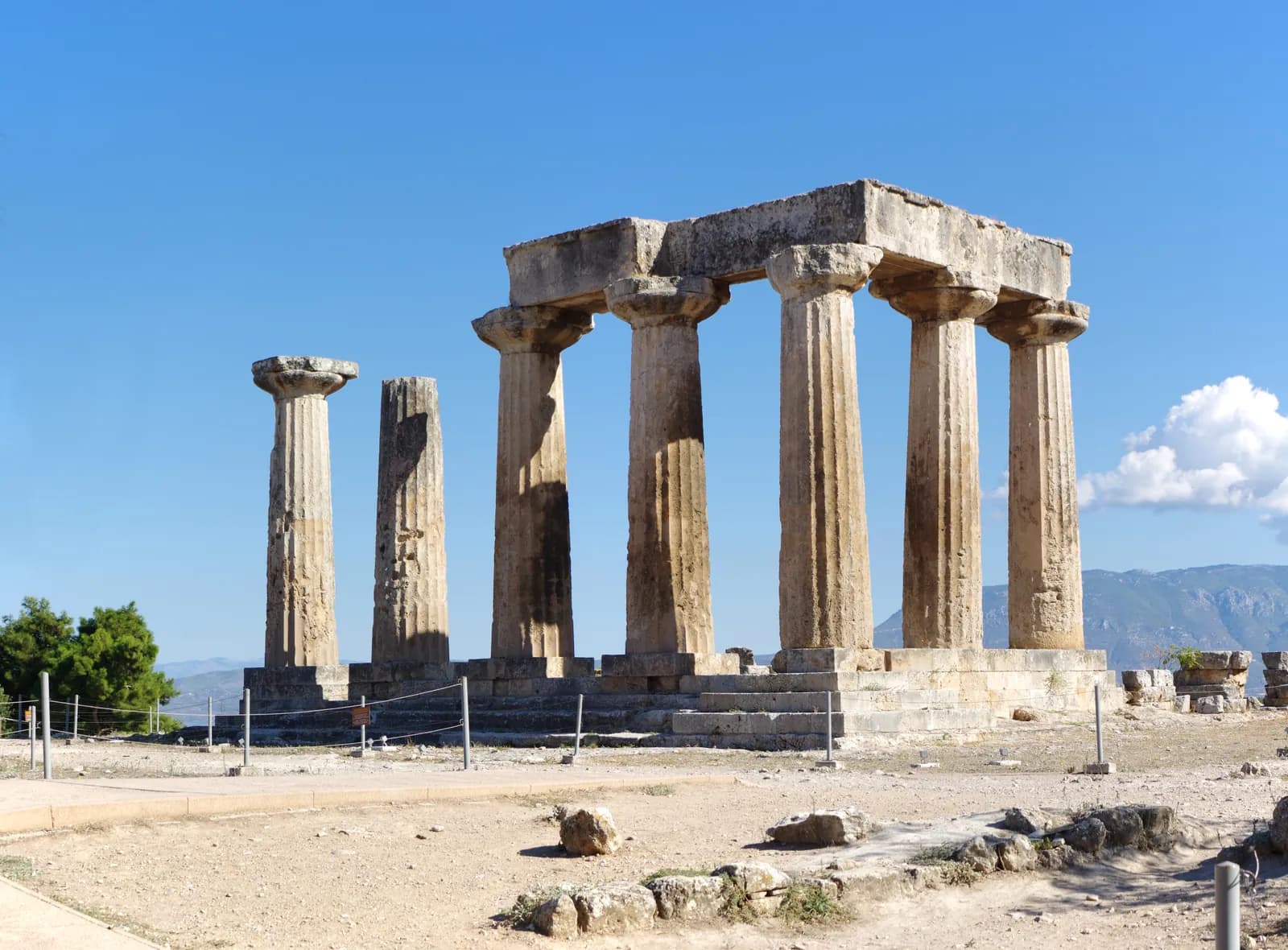
The Temple of Apollo, of the mid-sixth century BCE, is one of the earliest Doric temples in stone and several of its monolithic columns still stand.
The sanctuary of Demeter and Kore on the slopes of Acrocorinth produced large quantities of votive material and dining rooms for ritual meals.
The Isthmian Games, one of the four panhellenic festivals, were held at the sanctuary of Poseidon a few kilometres away and were administered by Corinth.
The city at war
Acrocorinth is the military fact of the city. Its possession was strategically decisive for control of the Peloponnese, and Philip II garrisoned it as one of the 'fetters of Greece'.
Corinth's fleet was among the strongest in archaic and classical Greece, and the quarrel with its own colony Corcyra was one of the immediate causes of the Peloponnesian War.
Population
Ancient population figures are quoted with a confidence the evidence never supported. Each estimate below carries what it rests on and what it is worth.
The classical Greek city
No reliable figure
No ancient count survives
Estimates in the modern literature derive from the walled area and assumed densities, a method that produces very wide ranges and is not independently checkable.
The Roman colony at its height
Frequently estimated in the tens of thousands
Modern reconstruction from the built area and the scale of public buildings
The Roman city was clearly large and prosperous. The specific figures quoted in popular accounts have no ancient basis.
Monuments
- Evidence level: Documented
c. 560 BCE
Temple of Apollo
Archaic Doric, with monolithic columns still standing — among the oldest substantial stone temples in Greece.
- Evidence level: Documented
Successive phases from the archaic period into the Roman
The Peirene fountain
A spring house rebuilt over a millennium, and an unusually legible stratigraphy of a single structure.
- Evidence level: Documented
Fortified from the archaic period through to the Ottoman
Acrocorinth
The citadel, with successive circuits of walls and a sanctuary of Aphrodite on the summit.
- Evidence level: Documented
Probably late 7th or early 6th century BCE
The diolkos
A paved trackway across the isthmus with cut grooves, partly excavated. Its function is agreed; the range of vessels it carried is not.
Archaeology and excavation
Excavated by the American School of Classical Studies since 1896 — one of the longest continuously running excavations in Greece, which is why the site's stratigraphy and its Roman phases are unusually well published.
Corinth is the standard teaching site for the transition from Greek to Roman urbanism, because the destruction of 146 BCE and the refoundation of 44 BCE give a sharply dated break in the sequence.
Museum collections
Where the finds are now. Where a holding is contested, the entry says so.
Archaeological Museum of Ancient Corinth · Ancient Corinth, Greece
Finds from the excavations across all periods, including Corinthian pottery, Roman sculpture and material from the Asklepieion.
Isthmia Archaeological Museum · Isthmia, Greece
Material from the sanctuary of Poseidon and the Isthmian Games.
Open questions
What did the diolkos actually carry?
Proposals range from regular transport of warships to a facility mainly for cargo transferred between vessels, with the trackway used for the goods rather than the hulls. The engineering constraints and the surviving grooves are the evidence, and they do not settle it.
Was the site genuinely abandoned between 146 and 44 BCE?
The literary tradition describes total destruction and a century of desolation. Excavation has recovered material from the interval, indicating some continued activity. How much is argued, and the answer bears on how sharp the Greek–Roman break really is.
Primary sources
Pausanias, Description of Greece 2.1-5
The fullest ancient description of the city and Acrocorinth.
Polybius, Histories 39
An eyewitness to the aftermath of the destruction of 146 BCE.
Strabo, Geography 8.6
On the isthmus, the harbours and the city's commercial position.
How to read the evidence labels
- Evidence level: Documented
- Supported by a named primary text or by excavated material evidence.
- Evidence level: Probable
- Supported by strong inference that most specialists accept.
- Evidence level: Disputed
- Substantial specialist disagreement exists; competing readings are stated.
- Evidence level: Literary
- Belongs to poetic or mythological construction rather than to history.
- Evidence level: Mythological
- Belongs to shared religious or mythic tradition rather than to any single text.
- Evidence level: Unknown
- The available evidence is insufficient to decide.
These labels describe the status of the evidence, not our confidence in a conclusion. A claim marked Literary is not a claim we doubt; it is a claim about what kind of thing a poem is.