Where the site is
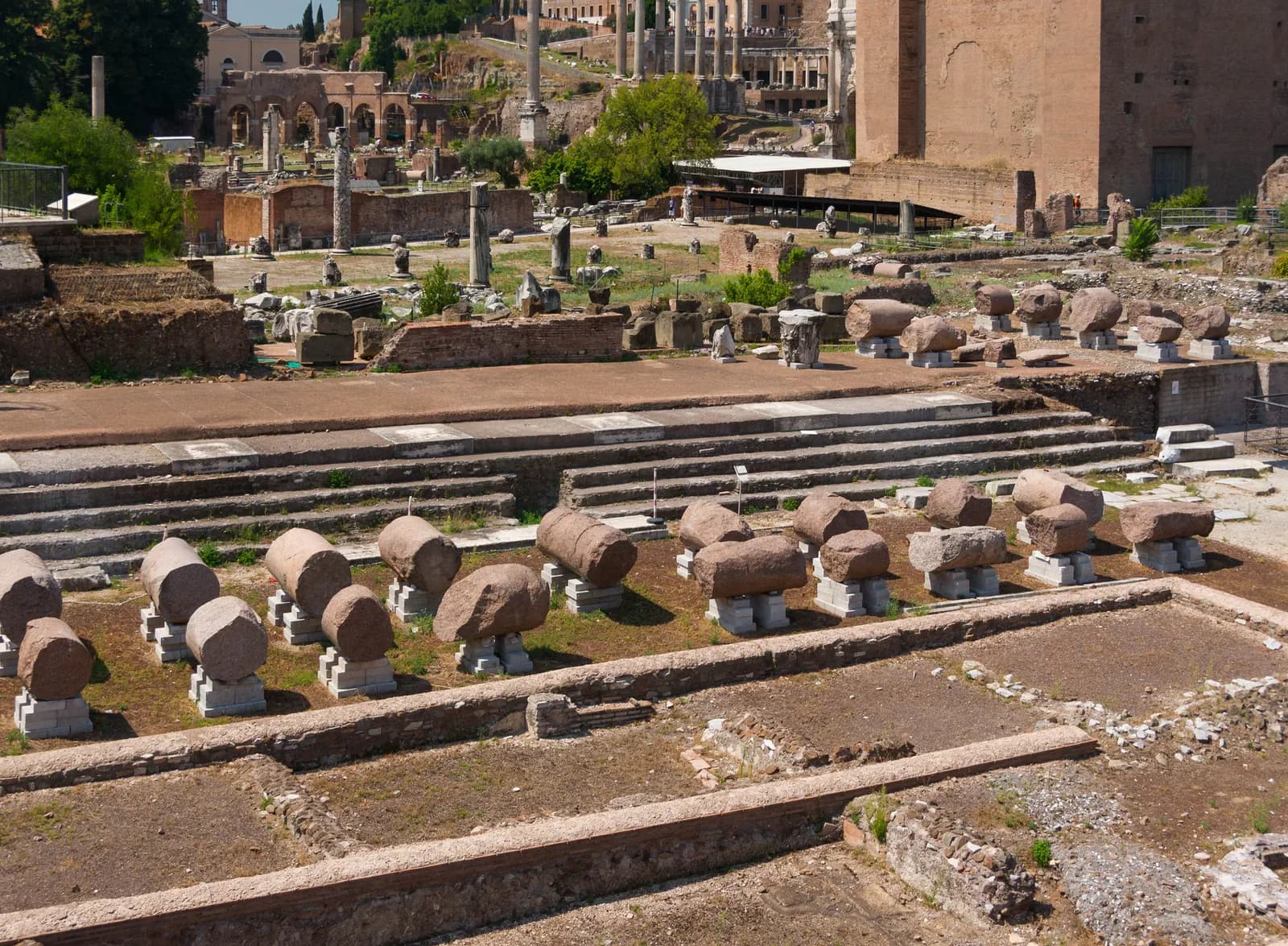
A low, damp valley between the Capitoline, Palatine and Velian hills, with a stream running through it. It was a burial ground before it was a square, and it became usable only once it was drained by the channel later monumentalised as the Cloaca Maxima. Every route through early Rome converged there, which is why it became the meeting place rather than the market of a particular quarter.
- Ancient region
- Latium
- Modern country
- Italy
- Position
- 41.893° N, 12.485° E — The Curia Julia
- Given to three decimal places, about a hundred metres. It locates the named feature, not the extent of the site.
What survives
The square is now a hollow several metres below the modern street, because the excavations of the nineteenth and twentieth centuries removed the accumulated fill down to the imperial pavement and in places well below it.
Three buildings stand more or less whole, and all three survive for the same reason: they were converted to Christian use. The Curia Julia is the senate house, restored to its Diocletianic form when the church built inside it was stripped out in the 1930s. The Temple of Antoninus and Faustina keeps its full portico because a church was built between the columns. The round Temple of Romulus keeps its bronze doors and their working lock.
Everything else is foundations, column stumps and three standing arches — Septimius Severus at one end, Titus at the other, and in the middle the Column of Phocas, put up in 608 CE and the last monument ever erected in the Forum.
Occupation and chronology
Dates below are stored as signed years and rendered with the precision they actually carry. c. 1000 BCE is approximate; 608 CE is fixed.
c. 1000–800 BCE
The cemetery
Cremation and inhumation burials found by Boni beneath the later pavement. The valley was outside the settlements on the hills, which is where the dead went.
c. 600 BCE
The square
Drainage, the first paving and the first public buildings. The traditional attribution of the drainage to the Tarquins is a literary tradition that the archaeological date does not contradict.
5th–1st centuries BCE
The Republican forum
Temples, the speaker's platform, the senate house, the basilicas, and a square progressively too small for the business done in it.
1st century BCE – 4th century CE
The imperial forum
Caesar and his successors built new fora alongside rather than in it, and the old square became increasingly commemorative: arches, honorific columns, and a temple to the deified Caesar on the spot where he was cremated.
7th–18th centuries CE
Field and quarry
Silted, grazed, and mined for marble and lime. Several buildings survive only because they were converted into churches; the rest supplied stone for Renaissance Rome.
History of excavation
Who recovered the evidence, when, and by what method. Where an excavation destroyed as much as it found, the entry says so.
- Evidence level: Documented
1803
Carlo Fea
Clearance around the Arch of Septimius Severus, the first modern excavation in the Forum, undertaken partly to establish how deep the ancient level actually was.
- Evidence level: Documented
1870s
Pietro Rosa and the new Italian state
Systematic clearance under the Kingdom of Italy. Fast, and driven by a national interest in exposing Republican Rome.
- Evidence level: Documented
1898–1925
Giacomo Boni
The turning point. Boni dug in stratigraphic layers, recorded sections, used photography from a balloon and published what he found in sequence rather than by monument. He located the Iron Age cemetery and, in 1899, the Lapis Niger. Roman archaeology as a discipline dates from this excavation.
- Evidence level: Documented
1924–1940s
The Fascist regime
Clearance and display for political effect, culminating in the Via dell'Impero of 1932, driven across the Imperial Fora for parades. It destroyed a substantial area of medieval and Renaissance Rome and buried a large part of the fora under a road, where much of it remains.
- Evidence level: Documented
1980s–present
Andrea Carandini, Clementina Panella and others
Targeted re-excavation of the earliest levels along the Sacra Via and the north slope of the Palatine, aimed specifically at the archaic period and at testing the literary foundation narratives.
Principal structures
The evidence level answers how we know what a structure looked like, not whether it existed.
- Evidence level: Documented
begun 44 BCE, rebuilt c. 283–303 CE
The Curia Julia
The senate house, standing to full height with its opus sectile floor. What stands is Diocletian's rebuilding after the fire of 283, restored in the twentieth century by removing the church of Sant'Adriano from around it.
- Evidence level: Documented
Republican; rebuilt by Caesar 44 BCE
The Rostra
The speakers' platform, named for the ships' rams taken at Antium in 338 BCE and fixed to its front. The Caesarian platform survives as a curved concrete and tufa mass at the west end.
- Evidence level: Documented
traditionally 497 BCE; standing columns 4th century CE
The Temple of Saturn
Eight columns and an architrave. Beneath it was the aerarium, the state treasury — so the Republic's public money sat in the podium of a temple, which is a fact worth more than most descriptions of Roman finance.
- Evidence level: Documented
rebuilt many times; visible remains 2nd–3rd centuries CE
The Temple of Vesta and the House of the Vestals
A round temple that held no cult statue but a fire, beside a large courtyard house for the six priestesses who kept it. Partly re-erected in the twentieth century.
- Evidence level: Documented
54 BCE and 179 BCE, both rebuilt
The Basilica Julia and the Basilica Aemilia
The two great covered halls where courts sat and business was done. Foundations and paving, with game boards scratched into the Basilica Julia's steps by people waiting.
- Evidence level: Documented
after 81 CE
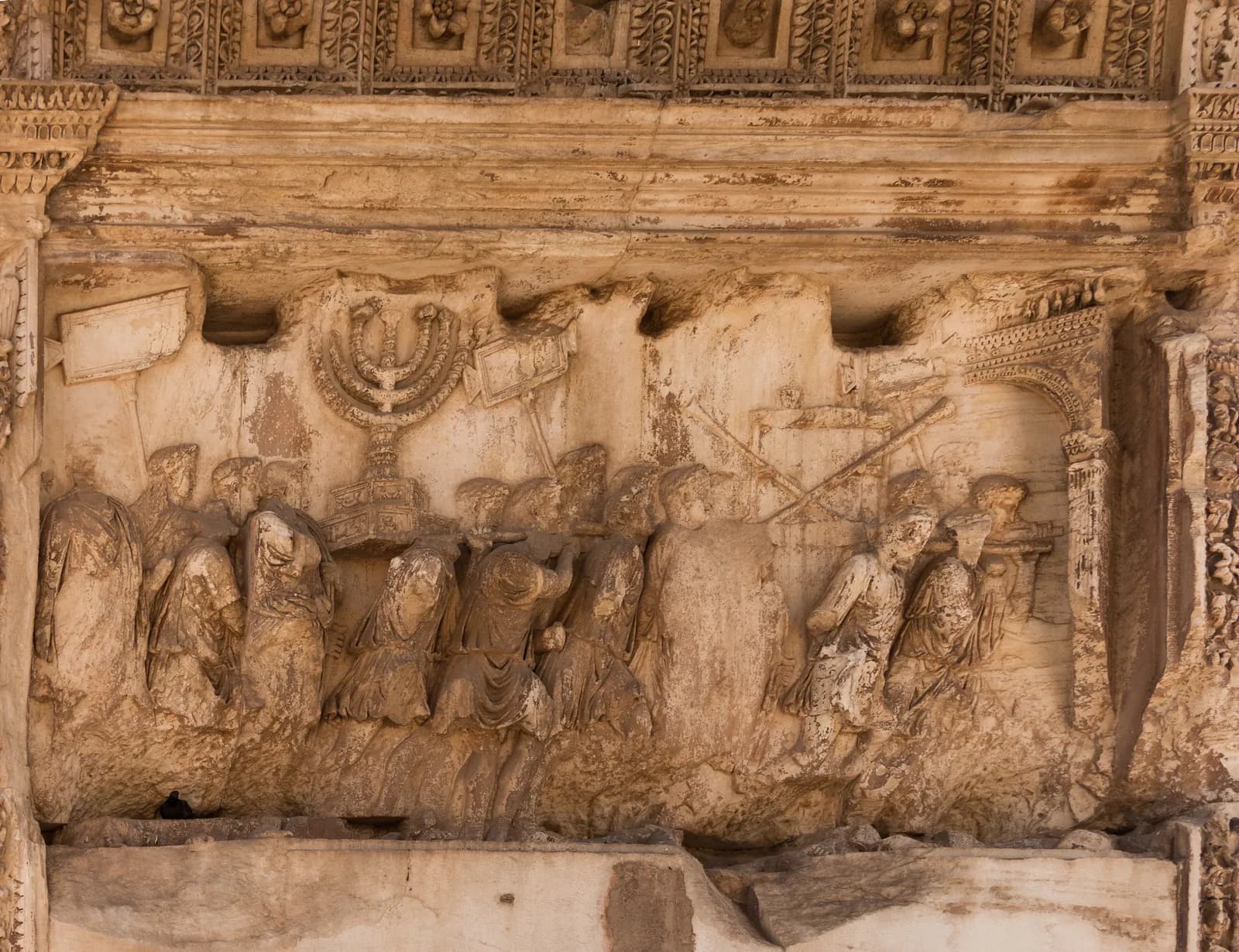
The Arch of Titus
Standing on the Velia, carrying the relief of the spoils of the Jerusalem temple carried in triumph. Heavily restored by Giuseppe Valadier in 1821 in travertine, deliberately plainer than the original marble so the restoration reads as restoration.
- Evidence level: Documented
c. 308–312 CE
The Basilica of Maxentius
Three enormous concrete vaults of the north aisle still stand. The colossal seated statue of Constantine was found in its west apse in 1486.
Finds and where they went
Almost nothing recovered from these sites is still on them. Where an object has a full provenance record on this platform, it is linked.
- Evidence level: Documented
The Lapis Niger
A black marble pavement laid over a much older shrine, containing a tufa cippus inscribed in archaic Latin, written boustrophedon, of the sixth century BCE. It is the oldest Latin inscription from Rome. It is broken and only partly intelligible; it contains a word for king and what appears to be a curse on anyone who violates the place.
In position, under the Forum pavement
- Evidence level: Documented
The Sepulcretum burials
The Iron Age cemetery Boni found beneath the square: cremation urns in the form of huts, and inhumations. Direct material evidence for occupation of the site of Rome in the period the foundation legends address.
Antiquarium Forense and the Museo Nazionale Romano
- Evidence level: Documented
The colossal Constantine
Head, hand, foot and other fragments of a seated acrolithic statue some twelve metres high, found in 1486 in the Basilica of Maxentius and moved to the Capitoline courtyard. It was identified as Commodus for around four centuries.
- Evidence level: Documented
Inscribed public documents
The Forum was where the Roman state published itself: laws, treaties, calendars, honours, and the consular lists. A great many of the inscriptions on which Roman chronology depends came from this square or its immediate surroundings.
Ancient testimony
What ancient authors say about the place, and how far it can be trusted.
Livy, From the Founding of the City 1.12–13, 1.36, 1.56
Livy on the Forum's origins: the battle in the marsh, the augural traditions, and the drainage works attributed to the Tarquins. A first-century BCE reconstruction of events six centuries earlier, and the frame every excavator here has had to argue with.
Plutarch, Life of Caesar 66–68
Plutarch on the assassination and its aftermath, including the burning of the body in the Forum by the crowd — the event commemorated by the temple whose podium is still there.
Suetonius, The Twelve Caesars Augustus 28–29
Suetonius on Augustus's building programme and his claim to have found Rome brick and left it marble. A statement about the Forum and its surroundings, and a piece of self-presentation.
How the site has been interpreted
The Forum is the clearest available demonstration that Roman public life had no purpose-built home. The senate met in a hall that was also a temple precinct, the assemblies voted in the open, the courts sat in commercial basilicas, the treasury was in a temple podium and the state archive was in another. Roman institutions were procedures attached to places rather than buildings designed for functions, which is why the constitutional history and the topography have to be read together.
Boni's excavation matters beyond Rome. Before him the Forum was dug monument by monument, to expose known buildings named in texts; he dug it as deposit, in layers, and thereby found things no text mentioned — the cemetery, the archaic shrine, the sequence of pavements. The shift from illustrating literature to reading stratigraphy is the single most important methodological change in the archaeology of Italy, and it happened here.
The Forum's later history is not decline but reuse, and the distinction matters. Marble was burned for lime and columns were taken for churches because they were the most valuable building material available in a city that had stopped importing stone. The buildings that survive are precisely the ones that acquired a new function, which is a general rule of survival and not a Roman peculiarity.
What was done here in the 1930s is a warning about excavation as politics. A regime that wanted a visible imperial ancestry cleared, straightened and displayed the ruins that suited it and paved over the ones that did not, and the resulting arrangement — including which fora are visible today — still shapes what a visitor thinks Roman Rome looked like.
Unresolved
What does the Lapis Niger inscription say?
The stone is broken at the top and the archaic Latin is difficult. Readings agree on a form of the word for king and on a sacral prohibition; they differ on almost everything else, including whether the king in question is a political monarch or the rex sacrorum, the priest who inherited the king's religious duties after the monarchy ended. The inscription is the earliest documentary evidence for Rome's own institutions and it cannot be securely translated.
How early is the paved square?
Boni's sequence, refined by later work, puts the first paving somewhere in the later seventh or the sixth century BCE. Carandini has argued for dates and identifications that align closely with the literary tradition of the regal period; other excavators regard the correspondence as forced and the dating as too precise for the evidence. The general chronology is agreed; the attempt to attach it to named kings is not.
How to read the evidence labels
- Evidence level: Documented
- Supported by a named primary text or by excavated material evidence.
- Evidence level: Probable
- Supported by strong inference that most specialists accept.
- Evidence level: Disputed
- Substantial specialist disagreement exists; competing readings are stated.
- Evidence level: Literary
- Belongs to poetic or mythological construction rather than to history.
- Evidence level: Mythological
- Belongs to shared religious or mythic tradition rather than to any single text.
- Evidence level: Unknown
- The available evidence is insufficient to decide.
These labels describe the status of the evidence, not our confidence in a conclusion. A claim marked Literary is not a claim we doubt; it is a claim about what kind of thing a poem is.