Where the site is
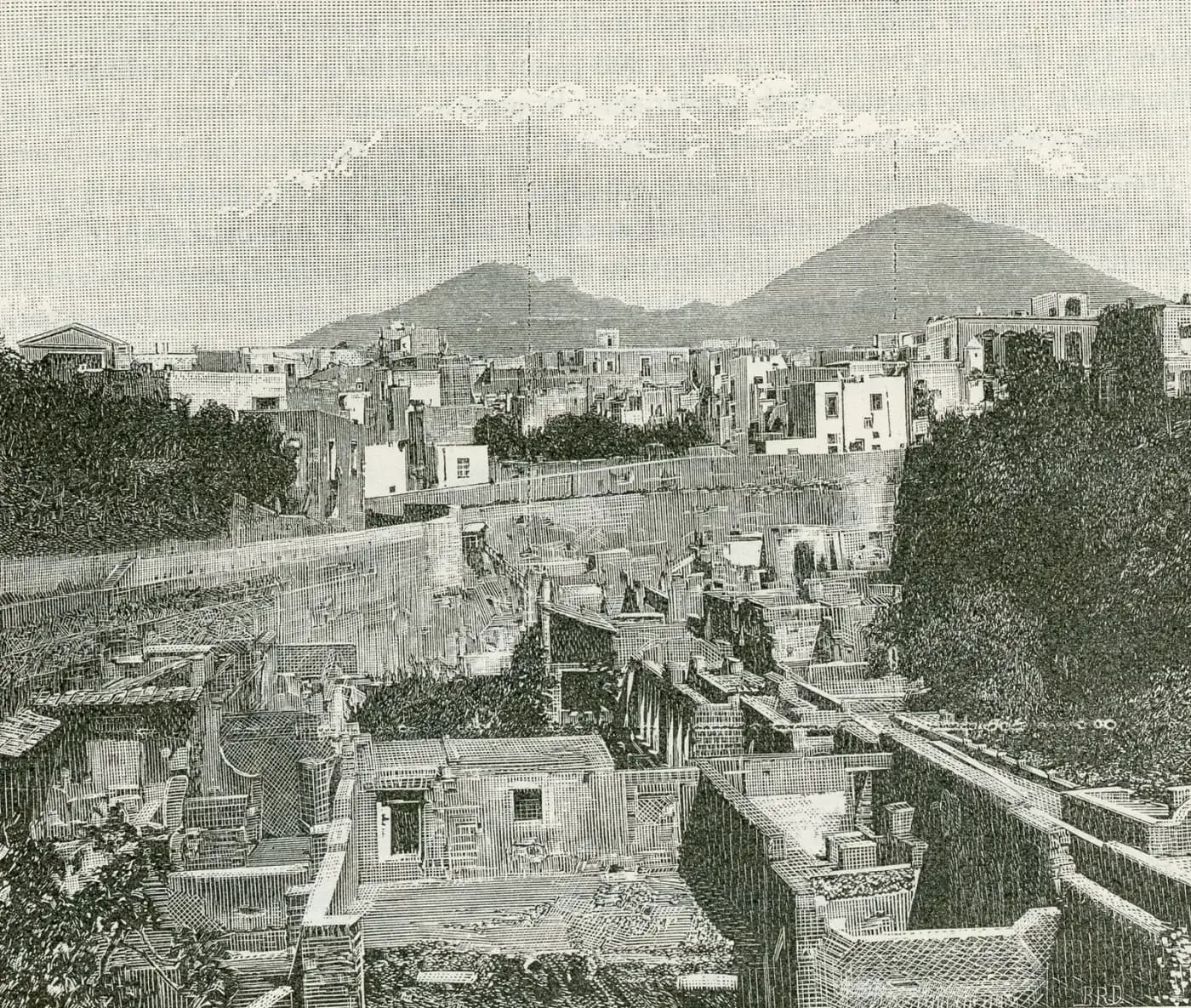
On a spur above the sea about seven kilometres west of Vesuvius, with the ancient shoreline running along the foot of the town. Smaller and wealthier than Pompeii, with fewer workshops and more sea-facing houses. The modern town of Ercolano sits directly on top of it, which is the reason most of the site will not be excavated.
- Ancient region
- Campania
- Modern country
- Italy
- Position
- 40.806° N, 14.348° E — The excavated insulae of the town
- Given to three decimal places, about a hundred metres. It locates the named feature, not the extent of the site.
What survives
Four insulae and parts of others, excavated in the open, standing to first-floor level and in places to the roof. Because the burial medium was not ash falling from above but a series of ground-hugging flows that filled the town from below, upper floors, balconies and roof timbers survived instead of collapsing.
The organic material is the reason the site matters. Carbonised beams, doors, a folding bed, a baby's cradle still able to rock, a wooden partition screen, ropes, fishing net, loaves of bread with the baker's stamp, figs, and in one house a wooden shrine to the household gods. No other Roman site preserves this range.
Along the ancient shoreline is a row of vaulted chambers, the boat sheds, which contained the remains of around three hundred people who had gathered there. Until 1980 the accepted view was that the town had been successfully evacuated.
Occupation and chronology
Dates below are stored as signed years and rendered with the precision they actually carry. c. 500 BCE is approximate; 79 CE is fixed.
6th–3rd centuries BCE
Pre-Roman town
Oscan and then Samnite occupation, known mainly from the street grid and from material under the Roman levels rather than from open excavation.
89 BCE – 62 CE
Roman municipium
Roman after the Social War. A modest town of a few thousand with expensive seafront property, including at least one villa of senatorial scale.
62 CE
The earthquake
Damage still under repair seventeen years later, visible throughout the excavated area, exactly as at Pompeii.
79 CE
The eruption
Buried by successive pyroclastic density currents and the deposits between them, to a depth of some twenty metres. The material was hot enough to carbonise organic matter and dense enough to fill the buildings without flattening them.
History of excavation
Who recovered the evidence, when, and by what method. Where an excavation destroyed as much as it found, the entry says so.
- Evidence level: Documented
1709
Prince d'Elbeuf's well
A well shaft struck the stage of the theatre. What followed was quarrying for marble and statues, sold and dispersed across Europe, with no record of where anything came from.
- Evidence level: Documented
1738–1765
Rocque Joaquin de Alcubierre for Charles of Bourbon
Tunnelling through the solidified deposit by lamplight, following walls and removing what could be sold or displayed. Destructive, undocumented by later standards, and responsible for the discovery of the theatre, the basilica and the Villa of the Papyri.
- Evidence level: Documented
1750–1765
Karl Weber
A Swiss engineer who insisted on plotting the tunnels and recording findspots on plan. His drawings of the Villa of the Papyri are why the building can still be discussed as a building rather than as a list of objects.
- Evidence level: Documented
1927–1961
Amedeo Maiuri
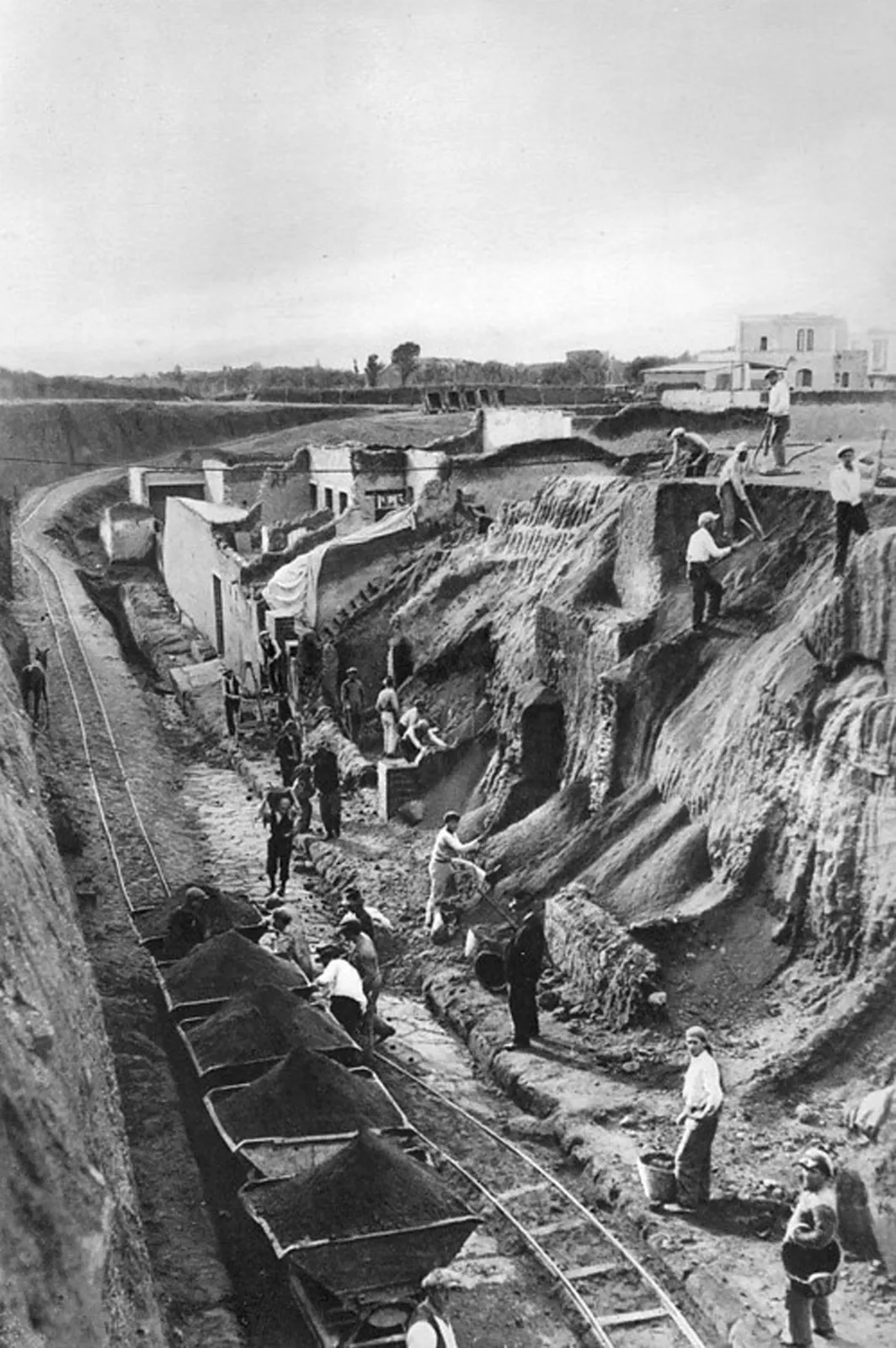
Open-air excavation of the insulae now visible, under Fascist patronage and on a scale that has not been attempted since. Maiuri also began the practice of leaving finds in the houses where they were found.
- Evidence level: Documented
1980–1990s
Giuseppe Maggi and the shoreline excavation
The boat sheds and their skeletons, followed by the osteological study begun by Sara Bisel. It changed the understanding of the eruption's effect on the population and produced one of the largest studied skeletal populations from the Roman world.
- Evidence level: Documented
2001–present
The Herculaneum Conservation Project
A long-term conservation partnership rather than an excavation, addressing water, drainage and structural decay across the whole site. It is frequently cited as the model for stabilising an over-exposed archaeological site instead of digging more of it.
Principal structures
The evidence level answers how we know what a structure looked like, not whether it existed.
- Evidence level: Probable
1st century BCE, remodelled 1st century CE
The Villa of the Papyri
A seafront villa of exceptional size, known chiefly from the Bourbon tunnels and Weber's plan; only small parts have been excavated in the open. Its layout is the basis of the reconstruction built as the Getty Villa in California.
- Evidence level: Documented
1st century CE
The boat sheds
Vaulted chambers opening onto the ancient beach, used for boat storage and, in 79 CE, as shelter.
- Evidence level: Documented
1st century CE
The College of the Augustales
A hall for the freedmen's association attached to the imperial cult, with paintings of Hercules in place and an inscription recording the brothers who paid for it.
- Evidence level: Documented
1st century CE
The Suburban Baths
Preserved to the ceiling, with the wooden door of one room, the marble benches and the stucco still in position. Roman bathing architecture is nowhere else this complete.
- Evidence level: Documented
1st century CE
The House of the Wooden Partition
A house whose atrium keeps its carbonised wooden folding screen standing in the position it was left in.
Finds and where they went
Almost nothing recovered from these sites is still on them. Where an object has a full provenance record on this platform, it is linked.
- Evidence level: Documented
The Herculaneum papyri
Around eleven hundred carbonised scrolls from the Villa of the Papyri, found in the 1750s. The identifiable content is largely Epicurean philosophy, much of it by Philodemus of Gadara, which makes this the only library of the ancient world to survive as a library rather than through copying.
Officina dei Papiri, Biblioteca Nazionale, Naples
- Evidence level: Documented
The villa bronzes
The Dancers, the Seated Hermes, the Drunken Satyr, and a series of portrait busts, all from the Villa of the Papyri. Among the finest bronzes to survive from antiquity, and removed by tunnelling with almost no record of context.
- Evidence level: Documented
The boat-shed skeletons
The remains of around three hundred people, studied for age, diet, stature, disease and occupation. One of the very few large Roman skeletal populations that died together rather than being buried over generations, which removes the usual sampling problem.
Stored and studied on site
- Evidence level: Documented
Carbonised organic material
Furniture, doors, roof beams, food, textiles, rope and a wooden household shrine. Ordinary objects that survive nowhere else, and which document the parts of Roman domestic life that decay.
In position and in the site stores
Ancient testimony
What ancient authors say about the place, and how far it can be trusted.
Pliny the Younger, Letters 6.16, 6.20
Pliny the Younger's two letters to Tacitus describing the eruption, his uncle's death at Stabiae and his own escape from Misenum. The only eyewitness account, written some twenty-five years after the event and addressed to a historian who had asked for it.
Cassius Dio, Roman History 66.21–23
Cassius Dio's account of the eruption, written a century and a half later and drawing on the tradition rather than on witnesses. Useful mainly as a measure of how the event was remembered.
How the site has been interpreted
Herculaneum has always been read against Pompeii and the contrast is genuinely informative. Pompeii was buried by falling pumice, which gave people hours and collapsed roofs; Herculaneum was hit by flows that arrived faster, filled the buildings and carbonised rather than burned. The result is fewer bodies in the streets, far more surviving wood, and a town preserved to a greater height.
The papyri are the site's largest unfinished business. The scrolls cannot be unrolled without destroying them; Antonio Piaggio's eighteenth-century machine opened some at the cost of others; and the modern approach has been imaging rather than opening. High-resolution X-ray tomography combined with machine learning has now recovered continuous text from scrolls that have never been opened, and the work is ongoing rather than finished. If the unexcavated part of the villa holds further shelves, as Weber's plan suggests it may, the recoverable Greek and Latin corpus could change.
The skeletons ended a comfortable assumption. For two centuries the absence of bodies in the excavated town was read as evidence of a successful evacuation, and by extension as evidence that ancient populations could respond effectively to warning. The shoreline shows that a substantial number of people were still there, gathered at the water's edge, when the first flow arrived.
Roughly three quarters of the town is still under Ercolano and is very unlikely to be excavated. That is a limit on knowledge and, given the condition of what has been exposed, arguably a protection.
Unresolved
How did the people in the boat sheds die?
The original interpretation was near-instantaneous death from thermal shock at several hundred degrees, supported by the posture of the remains and by cracking in the bone and teeth. Subsequent work has argued for lower temperatures and asphyxiation, with thermal effects following, and has debated a claimed instance of vitrified brain tissue. The reconstruction of temperature from skeletal evidence is difficult and the question is active.
What date was the eruption?
The manuscripts of Pliny's letter give 24 August, and that date is traditional. Autumn fruit, heavier clothing, a wine harvest in progress and a charcoal inscription at Pompeii dated to mid-October have all been cited for a later date, most often 24 October. The textual and the material evidence disagree, and the manuscript tradition of the letter is itself variable.
How to read the evidence labels
- Evidence level: Documented
- Supported by a named primary text or by excavated material evidence.
- Evidence level: Probable
- Supported by strong inference that most specialists accept.
- Evidence level: Disputed
- Substantial specialist disagreement exists; competing readings are stated.
- Evidence level: Literary
- Belongs to poetic or mythological construction rather than to history.
- Evidence level: Mythological
- Belongs to shared religious or mythic tradition rather than to any single text.
- Evidence level: Unknown
- The available evidence is insufficient to decide.
These labels describe the status of the evidence, not our confidence in a conclusion. A claim marked Literary is not a claim we doubt; it is a claim about what kind of thing a poem is.