The Greek house turns inward on a courtyard, with rooms opening off it and little to see from the street. The andron, a dining room for male guests, is often the only decorated space, which tells you what a house was expected to display.
The Roman atrium house adds an axial sequence — entrance, atrium with a roof opening and basin, tablinum, and often a peristyle garden beyond — designed so that a visitor at the door sees straight through. That axis is social architecture: the morning reception of clients happened along it.
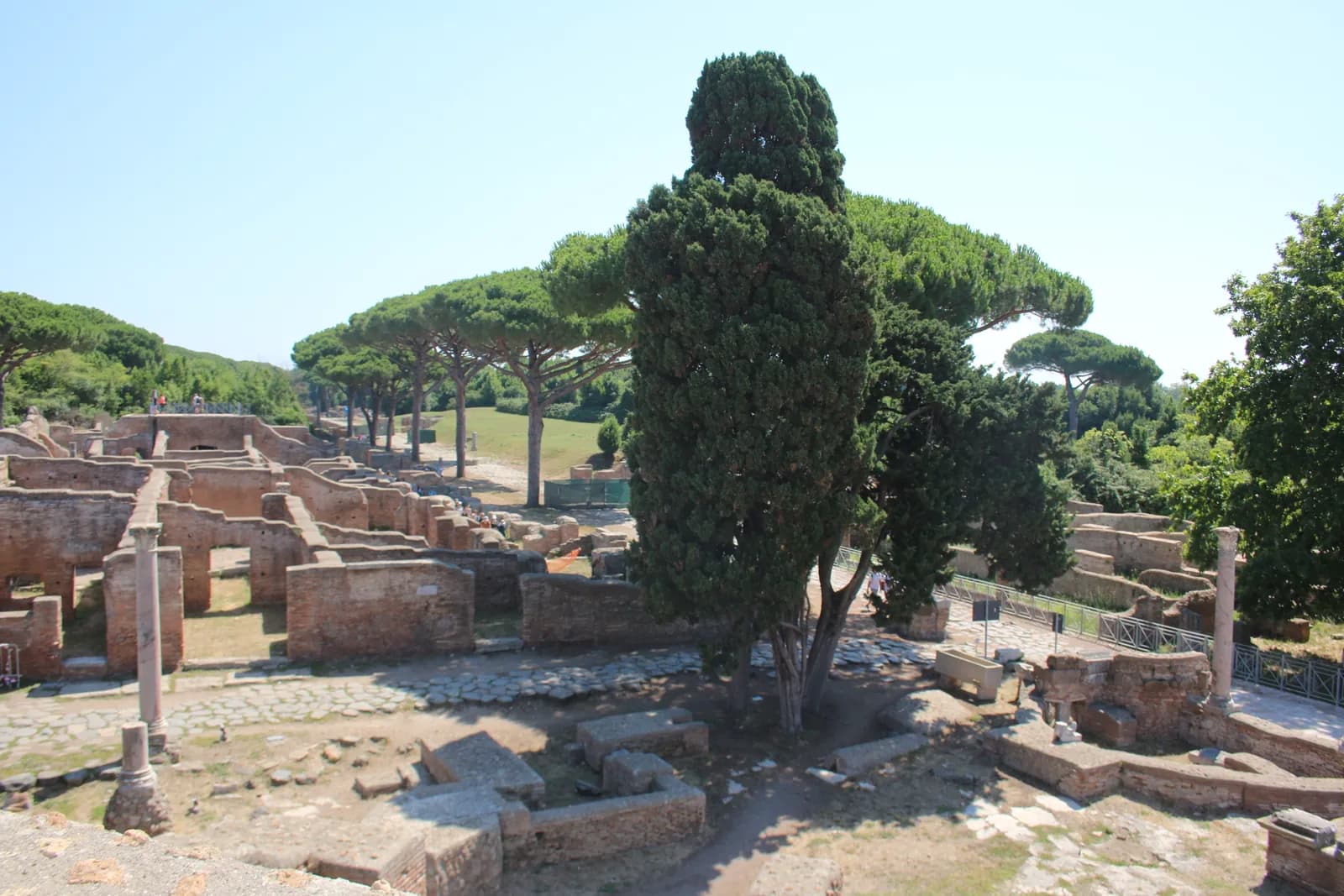
But the atrium house is the housing of the propertied. Most urban Romans lived in insulae: multi-storey blocks with shops at street level and flats above, reached by stairs, with the poorest tenants highest up. Rome's own examples are largely inaccessible under the modern city, which is why Ostia is the principal evidence for how the urban majority was housed.
What the evidence supports
Ostia supplies the best evidence for the insula.
Standing brick-faced blocks of several storeys, with shops, staircases and light wells intact, of a type known at Rome largely from fragments and from the Severan marble plan.
The atrium house was not the typical dwelling.
Follows from the density of urban populations against the footprint such houses require. The proportion is not recoverable precisely.
Rich and poor housing stood on the same streets.
At Pompeii, large houses and single rooms behind shops adjoin along a single frontage. Roman cities were not zoned by wealth in the modern sense.
Terms
- atrium
- The hall with a roof opening (compluvium) over a basin (impluvium).
- insula
- A city block, and by extension the apartment building filling it.
- andron
- The Greek dining room for male guests, often the only decorated room.
Examples
The evidence level on each answers how we know what the building looked like, not whether it existed.
- Evidence level: Documented
Pompeii · 2nd century BCE with later phases
The House of the Faun
One of the largest houses in the town, with two atria and two peristyles. Its floor carried the Alexander Mosaic. Excavated and standing to wall height, with its plan complete.
- Evidence level: Documented
Ostia · Principally 2nd century CE
The insulae of Ostia
Brick-faced apartment blocks standing several storeys, the best-preserved examples of the type anywhere. Standing several storeys high, excavated.
- Evidence level: Probable
Athens · Classical
Houses on the north slope of the Areopagus
Excavated courtyard houses, modest in scale, which is a useful corrective to assumptions drawn from public architecture.
Primary sources
Vitruvius, On Architecture 6
House design, room proportions and what Vitruvius thinks different social ranks require.
Juvenal, Satires 3
A hostile account of life in a Roman apartment block, including fire and collapse.
How to read the evidence labels
- Evidence level: Documented
- Supported by a named primary text or by excavated material evidence.
- Evidence level: Probable
- Supported by strong inference that most specialists accept.
- Evidence level: Disputed
- Substantial specialist disagreement exists; competing readings are stated.
- Evidence level: Literary
- Belongs to poetic or mythological construction rather than to history.
- Evidence level: Mythological
- Belongs to shared religious or mythic tradition rather than to any single text.
- Evidence level: Unknown
- The available evidence is insufficient to decide.
These labels describe the status of the evidence, not our confidence in a conclusion. A claim marked Literary is not a claim we doubt; it is a claim about what kind of thing a poem is.