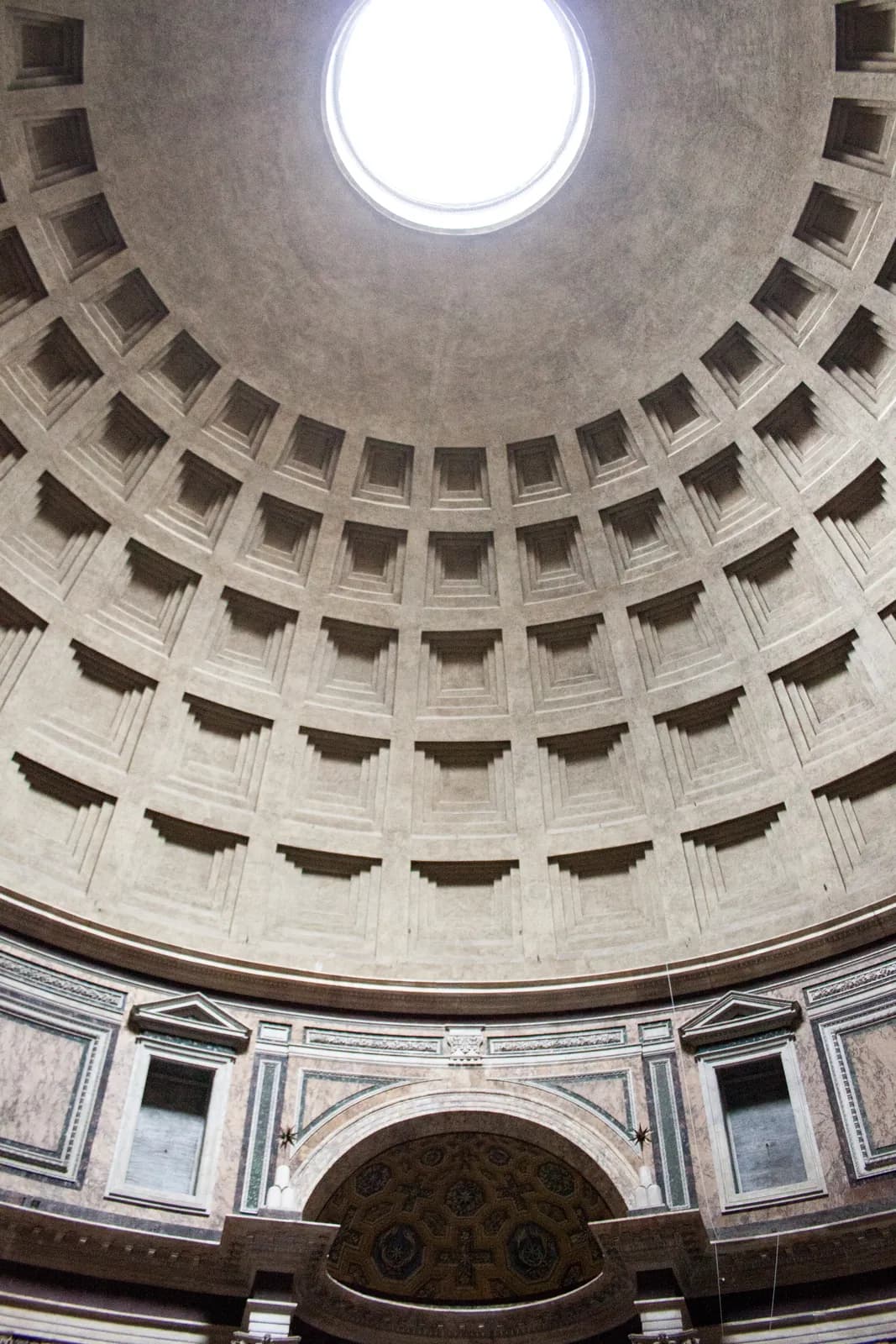
Roman concrete is not modern concrete. It is a mortar of lime and volcanic ash packed around rubble aggregate, built up in horizontal courses behind a facing of brick or small stones, rather than poured into forms around steel.
The volcanic ash is the active ingredient. Pozzolana from the Bay of Naples reacts with lime to produce a mortar that cures without air, which is why Roman harbour moles could be built out into open water — a capability no other ancient builder had.
The Pantheon shows what it made possible: an unreinforced dome of 43 metres span, still the largest of its kind, with the aggregate graded from heavy basalt at the base to light pumice at the crown and the thickness reducing as it rises. Recent analysis has proposed that lime clasts in the mortar allow cracks to reseal when water reaches them, which would help explain the survival rate; the mechanism is recently argued and not yet settled.
What the evidence supports
Roman marine concrete cures underwater.
Described by Vitruvius and Pliny, and confirmed by analysis of cores drilled from surviving Roman harbour structures.
The Pantheon dome grades its aggregate by weight.
Heavy basalt low, light pumice at the crown, with thickness reducing upward. Confirmed by examination of the fabric.
The self-healing mechanism is recently proposed.
Work published in the 2020s attributes durability partly to lime clasts that reseal cracks. It is a serious proposal in active discussion, not an established explanation.
Terms
- opus caementicium
- The concrete itself: mortar and rubble aggregate.
- pozzolana
- Volcanic ash, named from Pozzuoli, that makes the mortar hydraulic.
- opus reticulatum
- A facing of small pyramidal stones set diagonally, giving a net pattern.
Examples
The evidence level on each answers how we know what the building looked like, not whether it existed.
- Evidence level: Documented
Rome · Hadrianic, c. 126 CE
The Pantheon
The largest unreinforced concrete dome ever built, still standing and still roofed, because it became a church in the seventh century.
- Evidence level: Documented
Rome · Begun c. 308 CE
The Basilica of Maxentius
Concrete vaults of enormous span; three bays survive.
- Evidence level: Documented
Italy and Judaea · 1st century BCE – 2nd century CE
The harbour works at Portus and Caesarea
Marine concrete moles, sampled by drilling in modern research programmes. Surviving underwater and sampled by drilled cores.
Primary sources
Vitruvius, On Architecture 2.4-6
Sand, lime and pozzolana, and how they behave.
Pliny the Elder, Natural History 35-36
Building materials, including the volcanic dust that sets in water.
How to read the evidence labels
- Evidence level: Documented
- Supported by a named primary text or by excavated material evidence.
- Evidence level: Probable
- Supported by strong inference that most specialists accept.
- Evidence level: Disputed
- Substantial specialist disagreement exists; competing readings are stated.
- Evidence level: Literary
- Belongs to poetic or mythological construction rather than to history.
- Evidence level: Mythological
- Belongs to shared religious or mythic tradition rather than to any single text.
- Evidence level: Unknown
- The available evidence is insufficient to decide.
These labels describe the status of the evidence, not our confidence in a conclusion. A claim marked Literary is not a claim we doubt; it is a claim about what kind of thing a poem is.