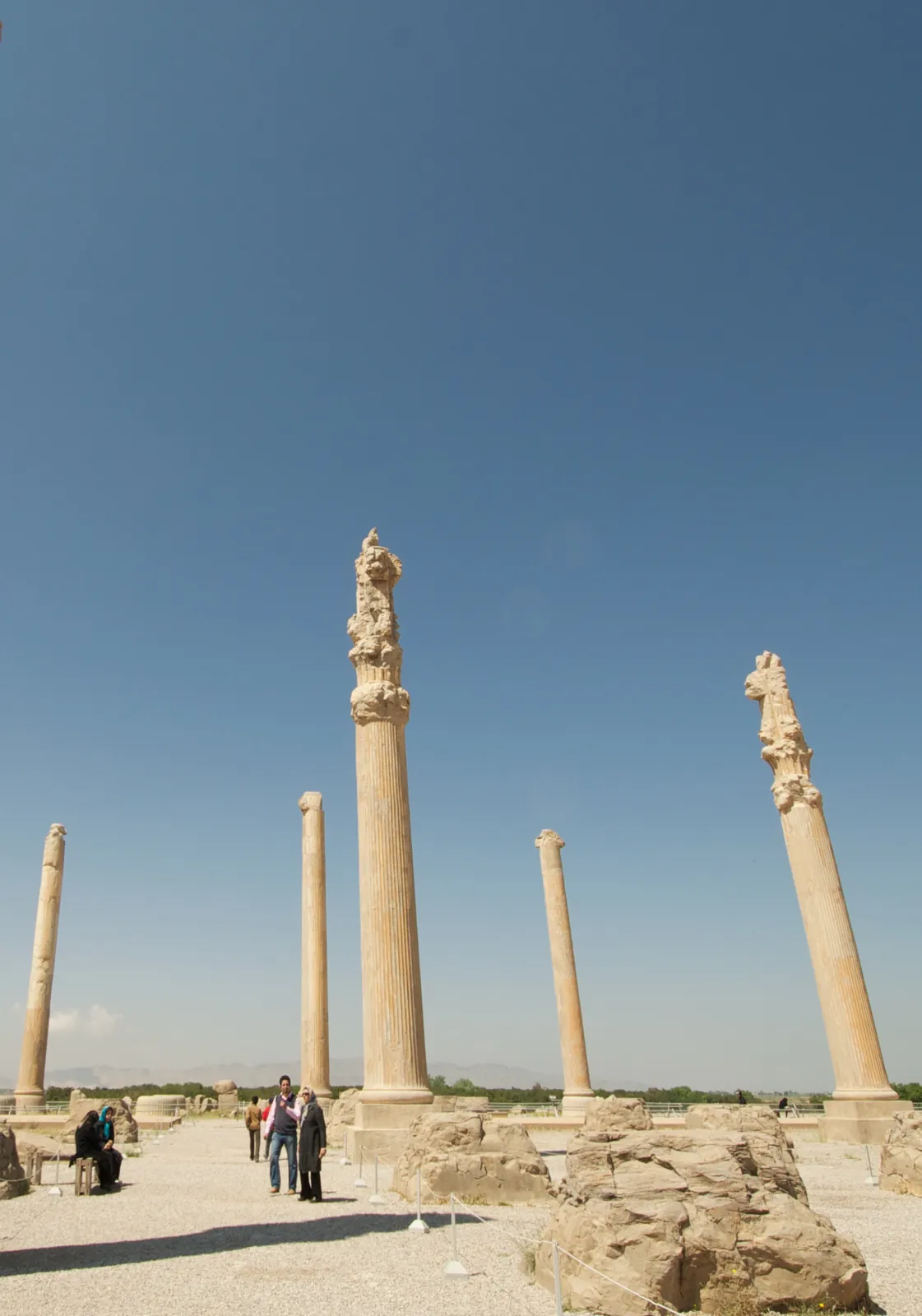
The site and its setting
Persepolis stands on a partly artificial stone terrace against the Kuh-e Rahmat in the plain of Marv Dasht in Fars, the Persian homeland — remote from the empire's administrative centres at Susa and Babylon, and reached by a formal approach.
The choice of site is itself the statement: a dynastic and ceremonial capital in the heartland rather than a working capital at the centre of communications.
Foundation
Begun by Darius I as a new dynastic centre.
Attested by the royal building inscriptions on the terrace itself, which name the king and the work.
History of the settlement
Darius I began the terrace around 518 BCE; Xerxes and Artaxerxes I continued it. Work was still in progress when the empire fell.
Alexander took the site in 330 BCE and burned the palaces. The Greek sources differ on whether this was a deliberate act of policy — vengeance for the burning of the Athenian Acropolis — or a drunken impulse at a banquet, and Arrian records Parmenion advising against it.
The terrace was never rebuilt. Its ruins remained visible, and the site became a symbol of Persian antiquity long before it was excavated.
Urban plan
Persepolis is not a city in the ordinary sense. It is a walled terrace carrying palaces, halls and treasury buildings, with a settlement below it that is far less well known.
The approach runs up a monumental double staircase to the Gate of All Nations built by Xerxes, and then to the Apadana, the great audience hall on its own platform, and the Hall of a Hundred Columns.
The Tachara of Darius and the Hadish of Xerxes are smaller palaces; the treasury lies to the south-east. Royal tombs are cut into the cliff behind, with the earlier ones at Naqsh-e Rustam a few kilometres away.
Economy and supply
The terrace consumed rather than produced, but the administration that supplied it is documented in extraordinary detail. The Persepolis Fortification Tablets, an Elamite-language archive found in the fortification wall, record rations, travel authorisations and disbursements across the region.
That archive is the best evidence anywhere for how the Achaemenid empire actually administered itself, and it corrects the Greek picture in significant ways — for example by showing women, including workers and members of the royal family, receiving rations and holding property.
Cult and sanctuaries
The reliefs show the king under the winged figure conventionally read as a representation of divine favour, and religious practice at the site is not richly documented.
What the terrace does document is ideology rather than cult: the Apadana staircase reliefs show delegations from the empire's peoples bringing gifts, arranged in an order that presents the empire as a willing and harmonious assembly rather than a conquest.
The city at war
Persepolis was fortified but not a fortress in a strategic sense; its walls served the terrace rather than a frontier.
Its destruction in 330 BCE was a political act rather than a military necessity: the site had already surrendered.
Population
Ancient population figures are quoted with a confidence the evidence never supported. Each estimate below carries what it rests on and what it is worth.
Resident population
Not recoverable
No ancient count; the lower settlement is only partly investigated
The terrace housed a court and an administration rather than a citizen population, and the settlement below it has not been excavated on a scale that would allow an estimate.
Monuments
- Evidence level: Documented
Begun under Darius I, completed under Xerxes
The Apadana
The audience hall, whose staircase reliefs of tribute delegations are the principal visual source for the peoples of the empire and their equipment.
- Evidence level: Documented
Xerxes I
The Gate of All Nations
The ceremonial entrance, with colossal human-headed bulls and a trilingual inscription of Xerxes.
- Evidence level: Documented
Begun under Xerxes, completed under Artaxerxes I
The Hall of a Hundred Columns
The throne hall, and one of the largest roofed spaces of the ancient world.
- Evidence level: Documented
From Darius I onward
The royal tombs at Naqsh-e Rustam
Rock-cut cruciform tombs a few kilometres from the terrace, with Darius's carrying a long trilingual inscription.
Archaeology and excavation
Excavated systematically by the Oriental Institute of the University of Chicago from 1931, under Ernst Herzfeld and then Erich Schmidt. The Fortification Tablets were recovered in 1933 and were loaned to Chicago for study, a loan that later became the subject of protracted legal proceedings in the United States before the tablets began returning to Iran.
The fire that destroyed the palaces baked the clay tablets in the fortification wall and carbonised timbers, preserving both. The archive exists because the site burned.
Museum collections
Where the finds are now. Where a holding is contested, the entry says so.
National Museum of Iran · Tehran, Iran
Sculpture, reliefs, tablets and finds from the site.
Persepolis site museum · Marv Dasht, Iran
Material displayed in the Harem of Xerxes, restored as a museum.
Oriental Institute (Institute for the Study of Ancient Cultures) · Chicago, United States
The Persepolis Fortification Archive, studied and published there; tablets have been returning to Iran in stages.
The loan and its long legal history are part of the object's modern record and are stated rather than omitted.
British Museum · London
Achaemenid material including reliefs and the Oxus Treasure.
Open questions
Why did Alexander burn Persepolis?
Arrian presents a deliberate policy of retribution for Xerxes' burning of Athens, with Parmenion advising against it. Diodorus, Curtius and Plutarch preserve a version in which the fire began at a drunken banquet at the instigation of the courtesan Thais. The accounts cannot be reconciled; excavation confirms an intense fire and cannot supply a motive.
What do the Apadana delegations represent?
Read as tribute-bearers, as gift-bringers at a New Year festival, or as an idealised timeless statement of imperial order rather than a depiction of any actual event. The reliefs carry no inscription identifying the occasion.
Primary sources
Arrian, Anabasis of Alexander 3.18
The capture and the burning, with Parmenion's objection.
Diodorus Siculus, Library of History 17.70-72
The alternative tradition of the banquet and Thais.
Achaemenid administration, Persepolis Fortification Tablets administrative archive
Elamite records of rations, travel and disbursement — the empire's own administrative voice, independent of the Greek tradition.
Darius I and Xerxes I, The royal inscriptions of the terrace DPa, XPa and others
Trilingual building inscriptions naming the kings and their works.
How to read the evidence labels
- Evidence level: Documented
- Supported by a named primary text or by excavated material evidence.
- Evidence level: Probable
- Supported by strong inference that most specialists accept.
- Evidence level: Disputed
- Substantial specialist disagreement exists; competing readings are stated.
- Evidence level: Literary
- Belongs to poetic or mythological construction rather than to history.
- Evidence level: Mythological
- Belongs to shared religious or mythic tradition rather than to any single text.
- Evidence level: Unknown
- The available evidence is insufficient to decide.
These labels describe the status of the evidence, not our confidence in a conclusion. A claim marked Literary is not a claim we doubt; it is a claim about what kind of thing a poem is.