civilization
The first ancient world-empire — founded by Cyrus, systematised by Darius, stretching from the Aegean to the Indus for two centuries. The civilization that invented the durable multi-ethnic imperial order, and the durable counterpoint to the Greek and Roman experiments.
civilization
How the Achaemenid empire actually worked — the satrapies, the tribute economy, the standardised coinage, the Royal Road and imperial post, the multilingual chancery. A study of the administrative machinery that turned conquest into a governable continental state.
civilization
The first ancient world-empire to administer a Mediterranean-to-Indus expanse on principles that endured for two hundred years — and the civilization the Greek tradition kept reading because it was the durable imperial order against which Greek political life defined itself.
philosopher
Founder of the Achaemenid Empire and the first ruler to govern a multi-ethnic world-empire by accommodation rather than terror — the figure in whom the European tradition first read empire as a form compatible with justice, and the model of kingship Xenophon made canonical.
philosopher
The Achaemenid king whose invasion of Greece in 480 BCE became the Greek tradition's defining image of imperial overreach — and whose reign, read from the Persian side, is a study in the logistics of projecting force beyond an empire's natural reach and the bias of the sources that record it.
theme
The provincial governorships through which the Achaemenid empire administered a continent — semi-autonomous regions under royal appointees, balanced by parallel military and secretarial officials, and the ancient world's first durable solution to governing more territory than any centre could hold directly.
theme
The 2,700-kilometre highway from Sardis to Susa and the relay-post system that ran along it — the Achaemenid empire's nervous system, and the ancient world's clearest demonstration that holding a continent depends less on armies than on the speed at which information and authority can travel.
theme
How an empire moves information across a continent — the roads, relays, couriers, multilingual chanceries and broadcast inscriptions through which the Achaemenid king learned what his provinces were doing and made his will known to them. The precondition of governing distance.
theme
How the Achaemenid king grounded his right to rule diverse peoples — by the favour of Ahuramazda, by the defeat of the Lie, and by presenting conquest as the restoration of a rightful order. The ancient world's most developed ideology of legitimate universal monarchy.
theme
The central problem the Persians were first to solve — how to govern far more territory and people than any centre can oversee directly. The trade-offs between delegation and control, uniformity and accommodation, reach and reliability that every large state must negotiate.
book
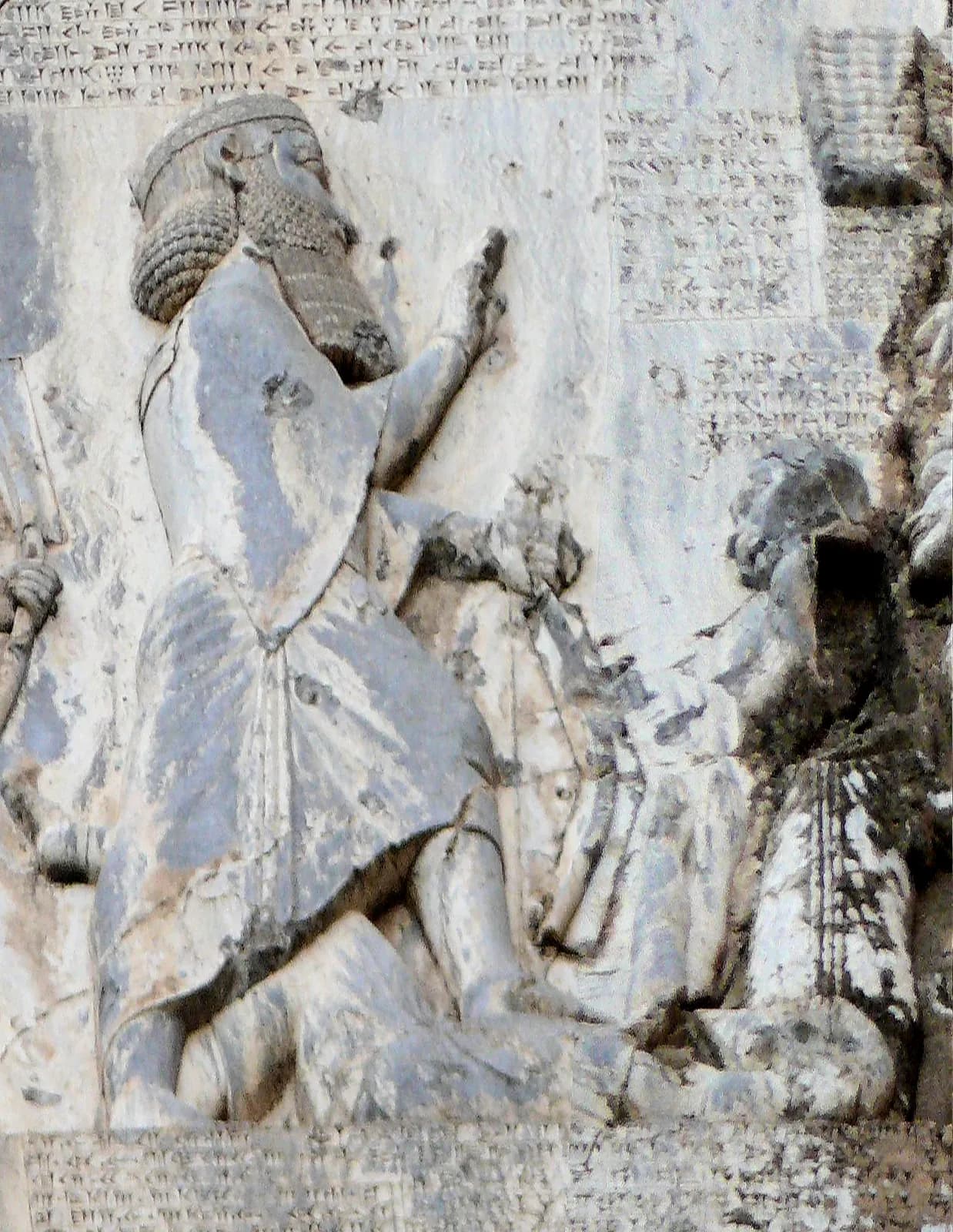
Darius I's vast trilingual relief carved high on a cliff in western Iran — the Achaemenid empire's official account of how Darius seized and held the throne, the key that unlocked cuneiform for modern scholarship, and a working study in imperial legitimation and communication.
book
Herodotus's enquiry into the wars between Greece and Persia — the earliest work of history in the Western tradition, the fullest narrative source for the Achaemenid empire, and a text the platform reads both for what it preserves about Persia and for the Greek lens through which it sees it.
essay
An interpretive reading of Darius I as the archetype of the administrator-king — the ruler whose statecraft consisted in designing the satrapies, coinage, roads and chancery that turned the Persian conquests into a governable and transferable system.
essay
A mechanism-focused reading of the Achaemenid Royal Road and relay post as the empire's communication system — and of the general principle that the reach of an imperial authority is set by the speed at which information and command can travel.
essay
A mechanism-focused reading of how the Achaemenid empire actually governed a continent — the working balance of satrapal delegation, central oversight, tolerated local order and fast communication that made governance at scale possible.
civilization
The western frontier of the Achaemenid empire and its long entanglement with the Greek world — the Ionian cities, the great invasions, the diplomacy of the fourth century, and Alexander's conquest. Where Persia meets the Greek sources that both preserve and distort it.
philosopher
The Macedonian king whose thirteen-year conquest of the Achaemenid world remade the political and cultural map of the eastern Mediterranean and Iran — and whose afterlife in the European tradition has not stopped being read as the working case of unprecedented personal power.
philosopher
The Achaemenid king of the long, stable middle reign — who ended the open wars with Greece, governed the empire by diplomacy and money rather than invasion, and under whom the biblical missions of Ezra and Nehemiah unfolded. The case study in empire managed rather than expanded.
philosopher
The Athenian commander credited with the victory at Marathon in 490 BCE, whose career before and after the battle complicates the patriotic version of it considerably.
theme
How ancient world-empires governed peoples of radically different languages, religions and laws — the Persian policy of rule through tolerated local order, its Hellenistic and Roman successors, and the recurring question of whether an empire is held together better by uniformity or by accommodation.
theme
The edges where empire meets what it cannot absorb — the Persian frontiers in Scythia, the Aegean and the mountain interior, the difference between a conquered province and an ungoverned margin, and the recurring discovery that every empire has a limit it cannot profitably cross.
theme
The unglamorous machinery of supply, provisioning and movement on which every ancient empire actually ran — first organised at continental scale by the Achaemenid Persians, and the hidden variable that decided what an empire could conquer, hold and feed.
theme
The work of making durable offices, procedures and bodies that outlive the persons who hold them — how founders convert personal authority into impersonal structure, and why that conversion is the test of a founding.
theme
The governing apparatus of standing offices, records, taxation and a trained official class that lets an order rule at scale and survive its rulers — from the Achaemenid satrapies to the Qin and Han bureaucracy.
essay
An interpretive reading of why durable orders are built on impersonal institutions rather than personal authority, contrasting Alexander's empire that died with him against the Achaemenid, Roman and Chinese apparatuses that did not.
essay
An interpretive reading of how the ancient world invented the administrative state — standing offices, records, taxation and a trained official class — in Achaemenid Persia and Qin–Han China, and what the invention made possible and cost.
essay
An interpretive reading of the Achaemenid achievement as the invention of empire itself — the move from conquest as a personal feat to empire as a standing, transferable system of administration, legitimacy and communication.
essay
A mechanism-focused reading of logistics as the hidden determinant of imperial power — why the capacity to supply, move and sustain force, first organised at scale by the Persians, set the actual limits of what ancient empires could conquer and hold.