The most misread king
No Achaemenid is more vividly portrayed and more thoroughly misunderstood than Xerxes. He is the villain of Herodotus's Histories and of Aeschylus's Persians — the proud despot who whipped the Hellespont for wrecking his bridges, wept at the brevity of human life, and led an innumerable host to ruin against free Greeks. The platform reads Xerxes precisely as the test case for Persia through Greek eyes: almost everything the Western tradition knows about him comes from the people he failed to conquer, and disentangling the king from the caricature is the central problem.
The invasion as a logistics story
Read from the Persian side, the invasion of Greece in 480 BCE is less a parable of hubris than a study in imperial logistics. The scale of preparation — years of stockpiling, the bridging of the Hellespont, the canal cut through the Athos peninsula to spare the fleet the cape that had wrecked an earlier expedition — was a genuine feat of imperial organisation, the most ambitious projection of force the ancient world had attempted. And it failed for logistical reasons as much as military ones: a vast army could not be fed for long on Greek soil, and once the fleet was broken at Salamis the supply line collapsed and the land army had to withdraw. The platform reads Thermopylae, Salamis and Plataea not as proof that Persia was weak but as the point where the empire met the limit of what it could supply across the Aegean — the lesson of frontiers and borderlands.
The builder and the king at home
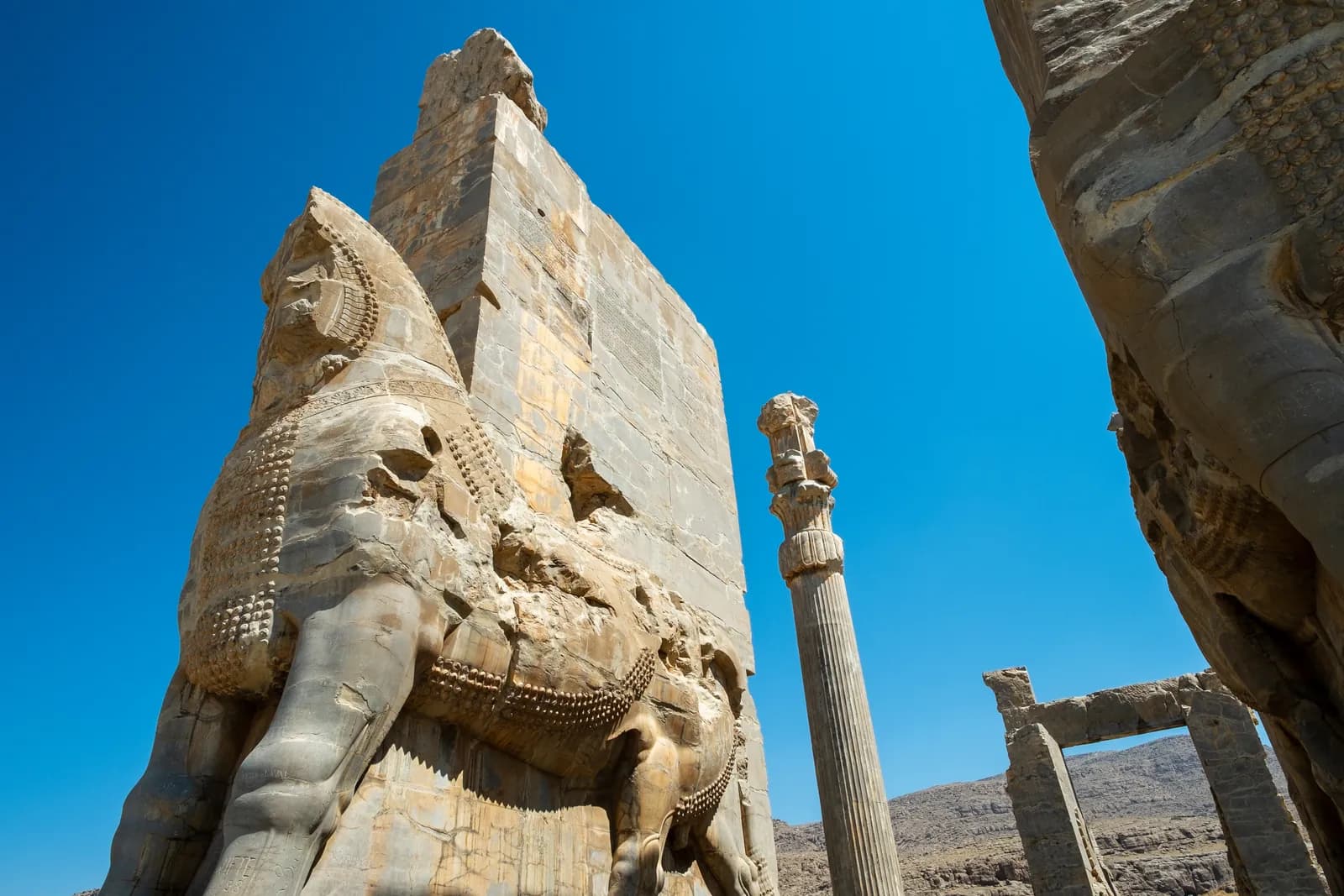
The Greek narrative crowds out the rest of a long reign. At home Xerxes was a major builder: he completed the great works his father Darius had begun at Persepolis — the Apadana audience hall, the Gate of All Nations, the Hall of a Hundred Columns — leaving the ceremonial capital substantially in the form that survives. His reign also saw assertions of religious and royal ideology (the so-called "daiva inscription," in which the king proclaims his suppression of the worship of false gods), which the platform reads under kingship and legitimacy as a statement of the king's role as upholder of right worship. For most of the empire, away from the Aegean frontier, Xerxes's reign was a continuation of the stable Achaemenid order Darius had built.
Continuity and the succession problem
Xerxes was assassinated in a palace conspiracy in 465 BCE, and his reign exposes the recurring Achaemenid weakness the platform reads across the imperial layer — the court intrigue and contested succession that no Persian institution ever fully solved, the same structural fault that would later trouble Rome. The empire itself, however, was not shaken by the Greek failure; it remained the dominant power of the ancient Near East for another century and a half.
Why the platform reads him
The platform reads Xerxes because he is the figure on whom the whole problem of using Greek sources for Persia comes to a point. He is the empire's most famous failure and its most caricatured king, and reading him honestly — as the organiser of an extraordinary logistical undertaking that broke on the real limits of imperial reach, rather than as the stock tyrant of Greek drama — is the discipline the entire Persian layer requires.