The site and its setting
Susa lies in the Khuzestan plain in south-western Iran, between the Karkheh and Dez rivers — lowland, hot, agriculturally rich, and geographically closer to Mesopotamia than to the Persian highlands.
That position explains its role: it was the administrative capital because it sat where the empire's business was, while Persepolis in the highlands served ceremonial and dynastic purposes.
Foundation
One of the oldest continuously occupied urban sites in the world, founded in the Chalcolithic period.
Attested by a long excavated stratigraphic sequence beginning in the fifth millennium BCE, long before any Persian presence.
History of the settlement
Susa was a principal city of Elam for three millennia before the Persians, alternately independent of and subject to Mesopotamian powers, and was sacked by Ashurbanipal in the seventh century BCE.
Under Darius I it became a chief residence of the Achaemenid kings, with a palace complex on a new platform. Greek writers treat it as the Persian capital, which is how it appears in the Persian Wars narrative.
It was taken by Alexander in 331 BCE, and continued under the Seleucids, Parthians and Sasanians before declining in the medieval period.
Urban plan
The site consists of several mounds: the Acropolis, the Apadana mound with the Achaemenid palace, the Royal City, and the Artisans' City.
Darius's palace follows a Mesopotamian courtyard plan rather than the terrace-and-hall arrangement of Persepolis, with an Apadana audience hall added on the Persepolitan model.
Economy and supply
Susa was an administrative centre, and the Royal Road that Herodotus describes ran from Sardis to Susa with staging posts and relays — roughly 2,700 kilometres, covered by the royal courier system in about a week according to his account.
Its position gave access to both Mesopotamian and Iranian networks, and the glazed brick and metalwork produced there were of very high quality.
Cult and sanctuaries
Elamite religious life at Susa is documented over millennia, with the god Inshushinak as city deity.
Under the Achaemenids the site's religious character is less visible than its administrative one, which is characteristic of the evidence rather than necessarily of the practice.
The city at war
Susa's fall usually meant the fall of the region. Ashurbanipal's sack in the seventh century BCE was recorded in Assyrian reliefs as a comprehensive destruction.
It surrendered to Alexander without a fight in 331 BCE, along with an enormous treasury.
Population
Ancient population figures are quoted with a confidence the evidence never supported. Each estimate below carries what it rests on and what it is worth.
The Achaemenid city
No reliable figure
No ancient count survives
The mounds give an extent but not an occupancy. Estimates in the literature are derived from area and assumed density and are not independently supported.
Monuments
- Evidence level: Documented
Begun c. 521 BCE
The palace of Darius and its foundation charter
The charter, DSf, lists the materials and the peoples who supplied and worked them — cedar from Lebanon, gold from Sardis and Bactria, ivory from Nubia and India, stonecutters from Ionia and Sardis, brickmakers from Babylon. It is one of the most informative documents to survive from any ancient building project.
- Evidence level: Documented
Darius I, restored under Artaxerxes II
The Apadana of Susa
A columned audience hall on the Persepolitan model.
- Evidence level: Documented
Achaemenid
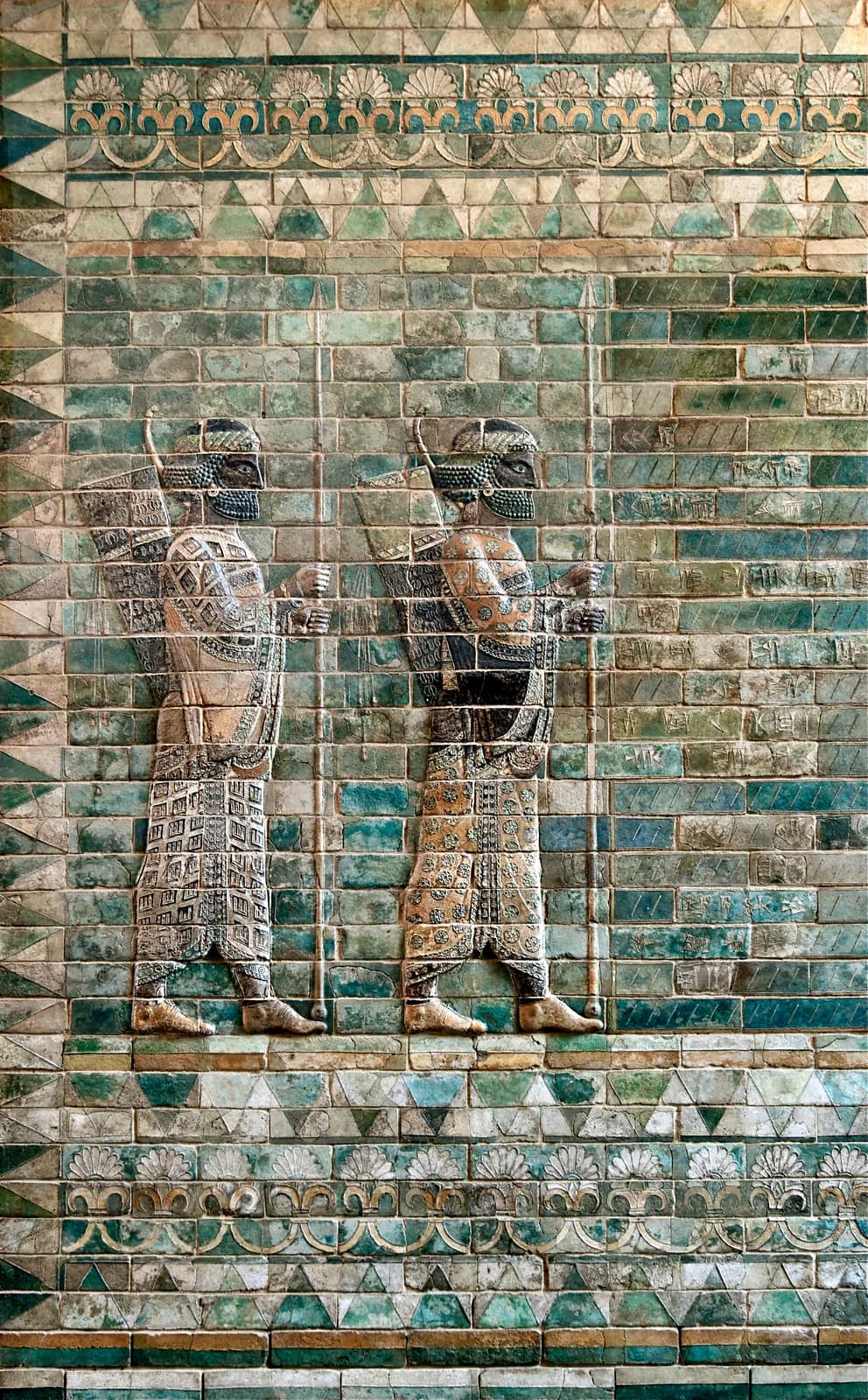
The glazed brick friezes
Moulded and glazed brick panels of guardsmen, lions and griffins from the palace, now principally in the Louvre.
Archaeology and excavation
Excavated by French missions from 1884 — Marcel and Jane Dieulafoy, then Jacques de Morgan, later Roman Ghirshman — under a concession that permitted the export of finds, which is why so much Susa material is in Paris. Methods in the earliest campaigns were destructive by later standards, particularly de Morgan's deep trenching of the Acropolis.
Susa produced objects that were not made there. The stele of Hammurabi and other Mesopotamian monuments were carried off as booty by the Elamite king Shutruk-Nahhunte in the twelfth century BCE and found at Susa in 1901 — an ancient act of plunder that determined where a Babylonian law code would be excavated three thousand years later.
Museum collections
Where the finds are now. Where a holding is contested, the entry says so.
Louvre · Paris, France
The Code of Hammurabi stele; the glazed brick archer and lion friezes from Darius's palace; a capital from the Apadana; and extensive Elamite material.
The scale of the Louvre's holdings results from the terms of the nineteenth-century French concession, which permitted export. That history is part of the objects' record.
National Museum of Iran · Tehran, Iran
Susa material retained in Iran, including Elamite and Achaemenid finds.
Susa site museum · Shush, Iran
Local display of finds from the mounds.
Open questions
Was Susa or Persepolis 'the capital'?
The question is badly framed. The Achaemenid court moved between Susa, Persepolis, Babylon and Ecbatana seasonally, and the functions differed: Susa was where administration was done, Persepolis where the dynasty represented itself. Greek sources naming a single capital are simplifying a mobile kingship.
Primary sources
Herodotus, Histories 5.52-54, 8.98
The Royal Road from Sardis to Susa, its staging posts, and the speed of the royal courier system.
Darius I, Foundation charter of the palace at Susa DSf
Darius's own account of the materials and craftsmen assembled from across the empire.
Arrian, Anabasis of Alexander 3.16
The surrender of the city and its treasury.
How to read the evidence labels
- Evidence level: Documented
- Supported by a named primary text or by excavated material evidence.
- Evidence level: Probable
- Supported by strong inference that most specialists accept.
- Evidence level: Disputed
- Substantial specialist disagreement exists; competing readings are stated.
- Evidence level: Literary
- Belongs to poetic or mythological construction rather than to history.
- Evidence level: Mythological
- Belongs to shared religious or mythic tradition rather than to any single text.
- Evidence level: Unknown
- The available evidence is insufficient to decide.
These labels describe the status of the evidence, not our confidence in a conclusion. A claim marked Literary is not a claim we doubt; it is a claim about what kind of thing a poem is.