The founder of a form
Cyrus II — Cyrus the Great — did not merely found a dynasty; he founded a form of empire. Between roughly 559 and 530 BCE he united the Persians and Medes, overthrew the Lydian kingdom of Croesus, and took Babylon, assembling the largest political body the ancient world had yet seen, from the Aegean to the edge of the Iranian plateau. The platform reads Cyrus not as a conqueror among conquerors but as the originator of the Achaemenid method of rule — the way of governing many peoples that Darius would systematise and that made Persia the first durable world-empire.
The two Cyruses, and why both matter
Two Cyruses live in the sources, and the platform reads both. The historical Cyrus is recoverable from Herodotus's Histories, from the Babylonian chronicles, and above all from his own Cyrus Cylinder. The philosophical Cyrus is the idealised ruler of Xenophon's Cyropaedia, a Greek study of how a leader is formed that departs freely from the historical record. The platform keeps them distinct: the Cylinder shows how Cyrus actually legitimated his rule to conquered Babylonians, while the Cyropaedia shows how the Greek tradition wished to imagine him. The gap between the two is itself the subject of Persia through Greek eyes.
The administrative innovation: rule by restoration
Cyrus's decisive innovation was a method, not a battle. Rather than govern conquered peoples by terror and deportation in the Assyrian manner, he ruled by accommodation — leaving local law, cult and elites in place and presenting himself as the restorer of each people's own order. The Cyrus Cylinder has him return the gods of Babylon to their temples and the deported peoples to their homes; the biblical tradition records the parallel act, his authorisation of the Judaean exiles' return to Jerusalem and the rebuilding of the Temple (Ezra 1; Isaiah 45, where he is called the Lord's "anointed"). The platform reads this under empire and diversity: Cyrus discovered that a multi-ethnic empire is more cheaply and durably held by binding subjects in through their own institutions than by crushing them, and that discovery is the foundation the whole Achaemenid order rested on.
Legitimacy, law, and the relationship to empire
Cyrus's claim to rule was grounded in kingship and legitimacy of a distinctive kind: he ruled, in each land, as the agent of that land's own divine and legal order — Marduk's chosen in Babylon, Yahweh's instrument in the Hebrew prophets' reading. He left local legal systems intact rather than imposing a single imperial code, which made Persian rule a layer above local life rather than its replacement. He thereby created the imperial role — the King of Kings standing over many preserved orders — that his successors would inherit. The empire as a stable, governable, multi-national structure begins as his personal method and becomes, under Darius, an institution.
Continuity: the model that outlived the man
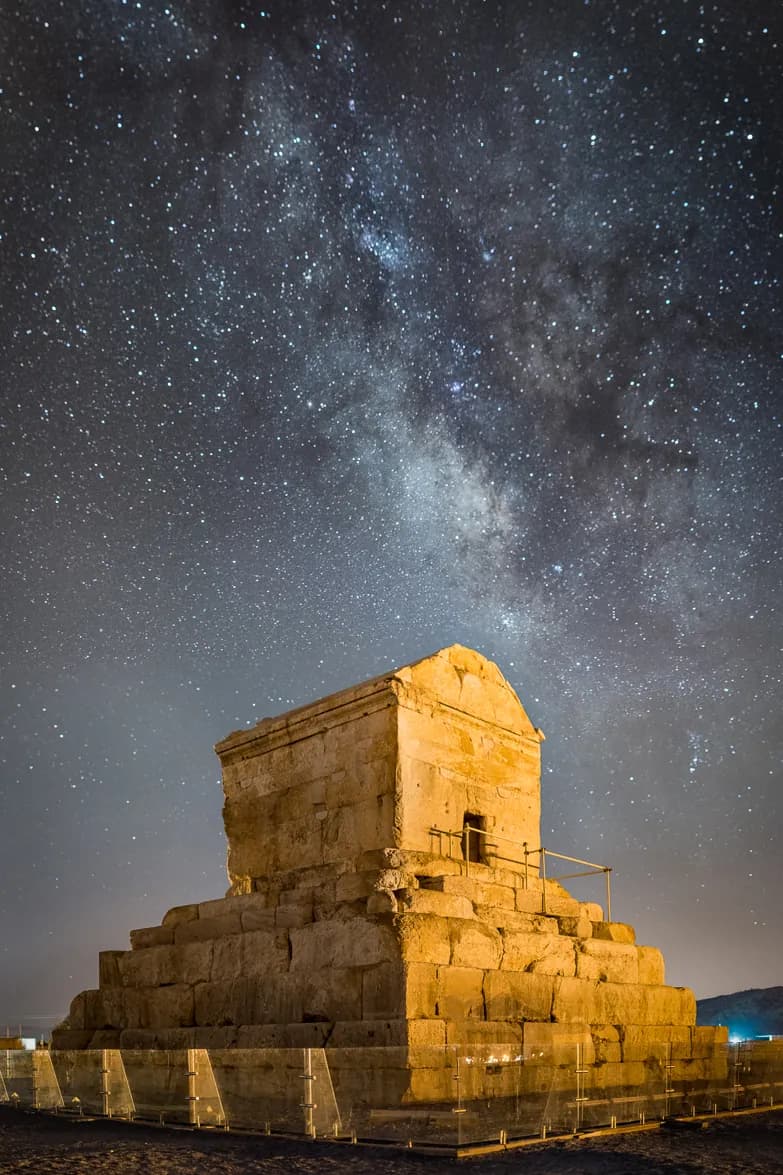
Cyrus died around 530 BCE, campaigning on the empire's northeastern frontier, and was buried in the still-standing tomb at Pasargadae. What he left was more durable than any conquest: the template of imperial governance that Cambyses, Darius and the long Achaemenid line built on, that Alexander adopted on taking the empire, and that the Hellenistic, Parthian and Sasanian states elaborated for another thousand years. The platform reads Cyrus under founding alongside the lawgiver-founders Lycurgus, Solon and Numa — but where they founded cities, Cyrus founded an empire, and a way of running one.
Cyrus among the founders and lawgivers
Set beside the lawgiver-founders of this cluster, Cyrus marks a distinct type. Lycurgus, Solon and Numa founded the constitutions of cities; Hammurabi gave a kingdom a published code of justice; Cyrus founded an empire and, more durably, a method of ruling one. His act of political legitimacy — ruling each conquered people as the restorer of its own gods and laws rather than as the imposer of his — is the same kind of move the great lawgivers made, translated to imperial scale: it converted naked conquest into an order that subjects could experience as rightful. And where the city-founders bound their work by withdrawing, Cyrus bound his by building institutions — the satrapal and tributary framework his son and Darius would systematise — so that the empire could survive the death of any king. The platform reads this as the imperial answer to the founders' problem: not the perfect law set down once, but the governing apparatus made to outlast its maker. The contrast with the conqueror who built no such apparatus is the subject of Cyrus vs Alexander.
Why the platform reads him
The platform reads Cyrus because he is its central case for empire as a political form the classical tradition could regard with admiration rather than contempt. He is the figure through whom the European tradition first asked whether a world-empire could be just — whether the rule of one man over many peoples could be a form of order rather than mere domination. Xenophon answered yes and built the Cyropaedia around it; the Hebrew prophets answered yes in their own register; the suspicious strain of the Greek tradition answered no. That the question is still live is why Cyrus matters.