What it is
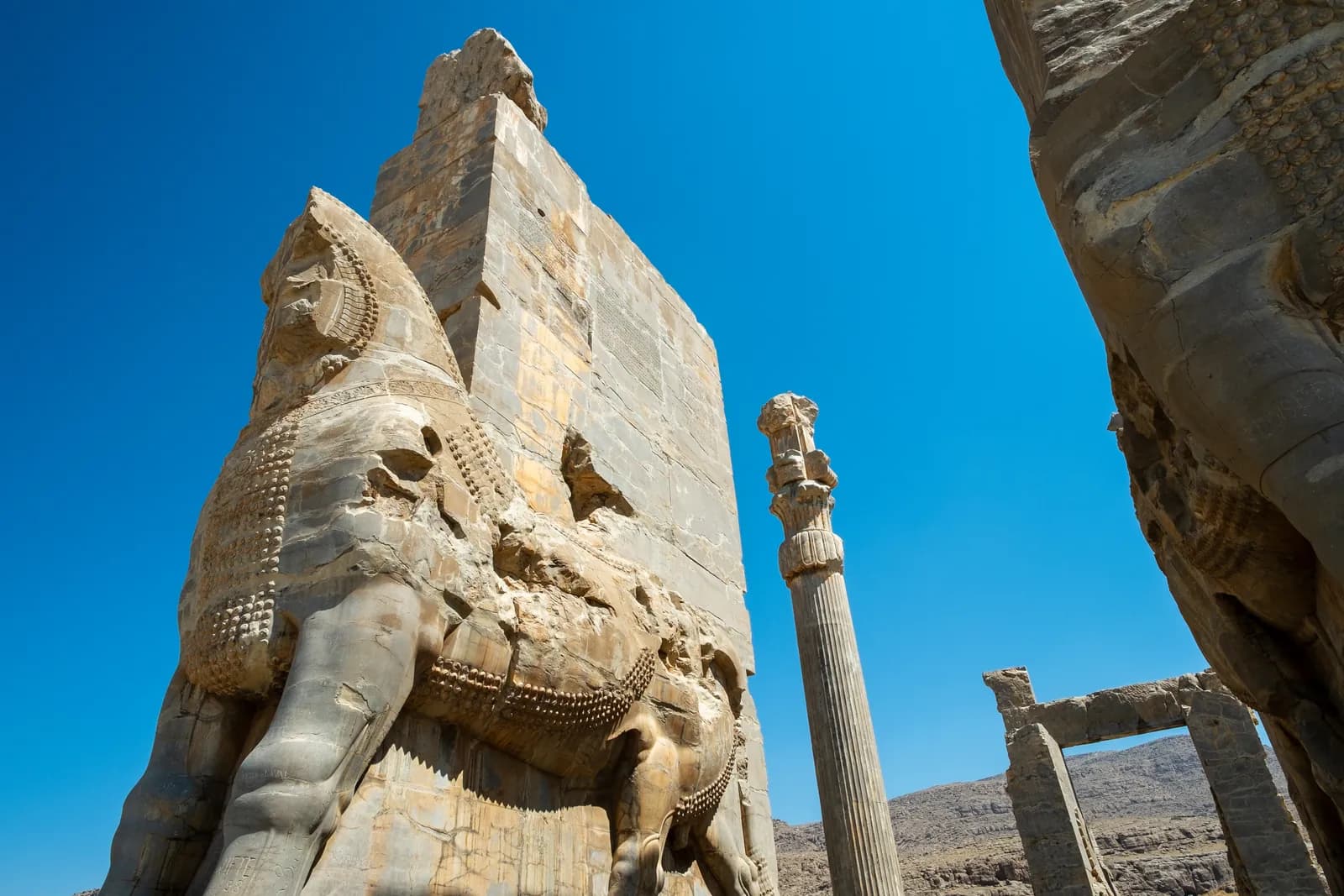
The Gate of All Nations at Persepolis — Xerxes' trilingual inscription, the colossi, the single approach it controlled, and the graffiti of the explorers.
Built Built under Xerxes I, c. 480–470 BCE. The principal date, c. 480–470 BCE, is range endpoint.
c. 480–470 BCE
Construction
Xerxes' own inscription on the gate records that he made it, by the favour of Ahuramazda.
330 BCE
The fire
Burned with the rest of the terrace. The stone colossi and doorframes survived because they are stone.
17th–19th centuries
Travellers' graffiti
European visitors carved their names into the colossi and the jambs, among them members of exploring expeditions and diplomatic missions. The graffiti are now themselves a documented layer of the monument.
Who ordered it built
Each attribution carries what supports it. Ancient buildings are routinely credited to people on the authority of writers centuries later, and that is not the same claim as an inscription on the building.
- Evidence level: Documented
Commissioned by
Xerxes I
The trilingual inscription XPa, cut three times on the gate in Old Persian, Elamite and Babylonian: Xerxes the king says that by the favour of Ahuramazda he made this gateway of all lands.
What it was for
The single controlled entrance to the terrace. Everything arriving at Persepolis passed up the double stairway, through this hall, and out towards the Apadana or eastward along the processional route.
The hall itself is a waiting room with stone benches along the walls, which is a mundane and revealing detail: delegations were held here.
How it was built
A square hall with three doorways — west for the approach, east towards the processional way, south towards the Apadana — each framed in monolithic stone jambs that still stand because they are single blocks.
The western pair of colossi are bulls; the eastern pair are human-headed winged bulls of the type the Assyrians had used for four centuries at Nimrud, Khorsabad and Nineveh. The borrowing is deliberate and is one of the clearest instances of Achaemenid architecture quoting Mesopotamian precedent.
Materials
- Evidence level: Documented
Grey limestone
The colossi, doorframes and column bases
- Evidence level: Documented
Mudbrick
The walls, now lost
Measured
Every figure states what it rests on. A modern survey, an ancient text, a conversion from an ancient unit and a modern estimate are four different kinds of statement and are not interchangeable.
The hall
about 25 × 25 m
Modern survey of the standing doorframes and the wall foundations.
Columns
four, about 16 m tall
Modern survey of the surviving shafts and bases.
The colossi
about 5.5 m high
Modern survey of the standing figures.
What it meant
The name is the inscription's own: a gateway of all lands. An empire that governed by acknowledging its constituent peoples put that claim on the door everyone entered by, in three languages, none of which most visitors could read.
That the Assyrian guardian figure was adopted wholesale matters. The Achaemenids did not invent an imperial visual language; they assembled one out of Assyrian, Elamite, Egyptian, Lydian and Ionian material, and the gate is where the Assyrian component is most obvious.
Xerxes' inscription attributes the work to the favour of Ahuramazda, as Achaemenid royal inscriptions consistently do. That formula is evidence for what the kings said about their authority; it is weaker evidence for the content of their religion, and it should not be read as a Zoroastrian creed.
After antiquity
Standing as a ruin since 330 BCE. From the seventeenth century European travellers carved their names on the colossi and the jambs — the practice was not then regarded as vandalism, and the inscriptions record who reached Persepolis and when.
Excavated and consolidated by Herzfeld and Schmidt in the 1930s.
Condition today
Standing ruin
The doorframes and the four colossi stand; the columns survive in part; the mudbrick walls are gone. The graffiti remain and are conserved as part of the monument.
Excavation established the hall's plan, the stone benches along the walls, and the relationship of the three doorways to the terrace's circulation.
The colossi's damage is old: the heads of the eastern pair were broken in antiquity, and the faces of the western bulls are lost.
Written about in antiquity
Xerxes I, The gate inscription XPa
Xerxes, in three languages: that Ahuramazda gave him this kingdom, and that he made this gateway of all lands, and that much else of what was built at Persepolis he and his father built.
Herodotus, Histories 7.11, 7.61–99
Herodotus on Xerxes and on the catalogue of peoples in his army — a Greek list of the same empire the gate names, compiled for a different purpose.
Still argued
Which peoples are meant by all lands?
The Old Persian, Elamite and Babylonian versions of Achaemenid land-lists differ from each other and from one reign to the next, and the lists on the tomb of Darius, the Apadana reliefs and the Susa foundation text do not match. Whether the differences record real administrative change or reflect different rhetorical purposes is argued.
How to read the evidence labels
- Evidence level: Documented
- Supported by a named primary text or by excavated material evidence.
- Evidence level: Probable
- Supported by strong inference that most specialists accept.
- Evidence level: Disputed
- Substantial specialist disagreement exists; competing readings are stated.
- Evidence level: Literary
- Belongs to poetic or mythological construction rather than to history.
- Evidence level: Mythological
- Belongs to shared religious or mythic tradition rather than to any single text.
- Evidence level: Unknown
- The available evidence is insufficient to decide.
These labels describe the status of the evidence, not our confidence in a conclusion. A claim marked Literary is not a claim we doubt; it is a claim about what kind of thing a poem is.