The site and its setting
Memphis stood at the apex of the Delta, where the Nile valley opens out — the natural control point between Upper and Lower Egypt, and the reason it functioned as the administrative capital even when the royal residence was elsewhere.
Its necropolis ran for tens of kilometres along the desert edge above the floodplain, from Abu Rawash through Giza and Abusir to Saqqara and Dahshur.
Foundation
Founded by Menes, the king who united Upper and Lower Egypt, who diverted the Nile to make room for it.
Herodotus reports the story. Menes as a single unifying king is a tradition rather than a securely identified individual, and the Nile-diversion detail is not supported. What is documented is a major settlement at the junction of the two lands from the Early Dynastic period.
History of the settlement
Memphis was the capital of the Old Kingdom and remained the administrative centre through most of Egyptian history, even under dynasties resident at Thebes or in the Delta.
It retained importance under the Persians, the Ptolemies and Rome, and the Ptolemies were crowned there. Its decline followed the rise of Alexandria and, later, of Fustat and Cairo — much of its stone was carried off to build the latter.
Urban plan
The plan is largely unrecoverable. The city was built of mudbrick on the floodplain, has been buried by Nile silt, is under cultivation and a high water table, and was systematically quarried for stone.
What can be traced is the great temple enclosure of Ptah, Hut-ka-Ptah, and scattered palace and temple remains at Mit Rahina.
Economy and supply
The city was the administrative and redistributive centre of the Egyptian state, and a port on the Nile handling traffic between the valley and the Delta.
It supported the necropolis: the pyramid complexes at Giza, Saqqara and Dahshur required continuous labour, supply and, once built, permanent mortuary establishments with their own estates.
Cult and sanctuaries
Ptah, the creator god of Memphis and patron of craftsmen, had one of the largest temple complexes in Egypt here. The Greek name for the country derives, on one long-standing etymology, from a Greek rendering of Hut-ka-Ptah, 'the estate of the ka of Ptah'.
The Apis bull, a living animal identified as a manifestation of Ptah, was kept at Memphis and buried in the Serapeum at Saqqara, an underground gallery of colossal granite sarcophagi rediscovered by Auguste Mariette in 1851.
The city at war
The 'White Walls' of the earliest name suggest a fortified enclosure, and Memphis's position made it the strategic key to Egypt: Cambyses took it in 525 BCE, and its fall meant the fall of the country.
Alexander took it without a fight in 332 BCE and sacrificed to Apis, which was a deliberate political act distinguishing him from the Persians.
Population
Ancient population figures are quoted with a confidence the evidence never supported. Each estimate below carries what it rests on and what it is worth.
The city in the Old Kingdom or later
No reliable figure
No ancient count survives and the settlement cannot be delimited archaeologically
Memphis is frequently described as among the largest cities in the world in the third millennium BCE, and estimates of tens of thousands appear in the literature. They rest on assumptions about an urban extent that has not been established. This is a case where the honest answer is that the size of one of the ancient world's most important cities is not known.
Monuments
- Evidence level: Documented
Old Kingdom onward, with major New Kingdom additions
The temple enclosure of Ptah
Once among the largest temple complexes in Egypt; only fragments and colossi remain in situ.
- Evidence level: Documented
19th Dynasty
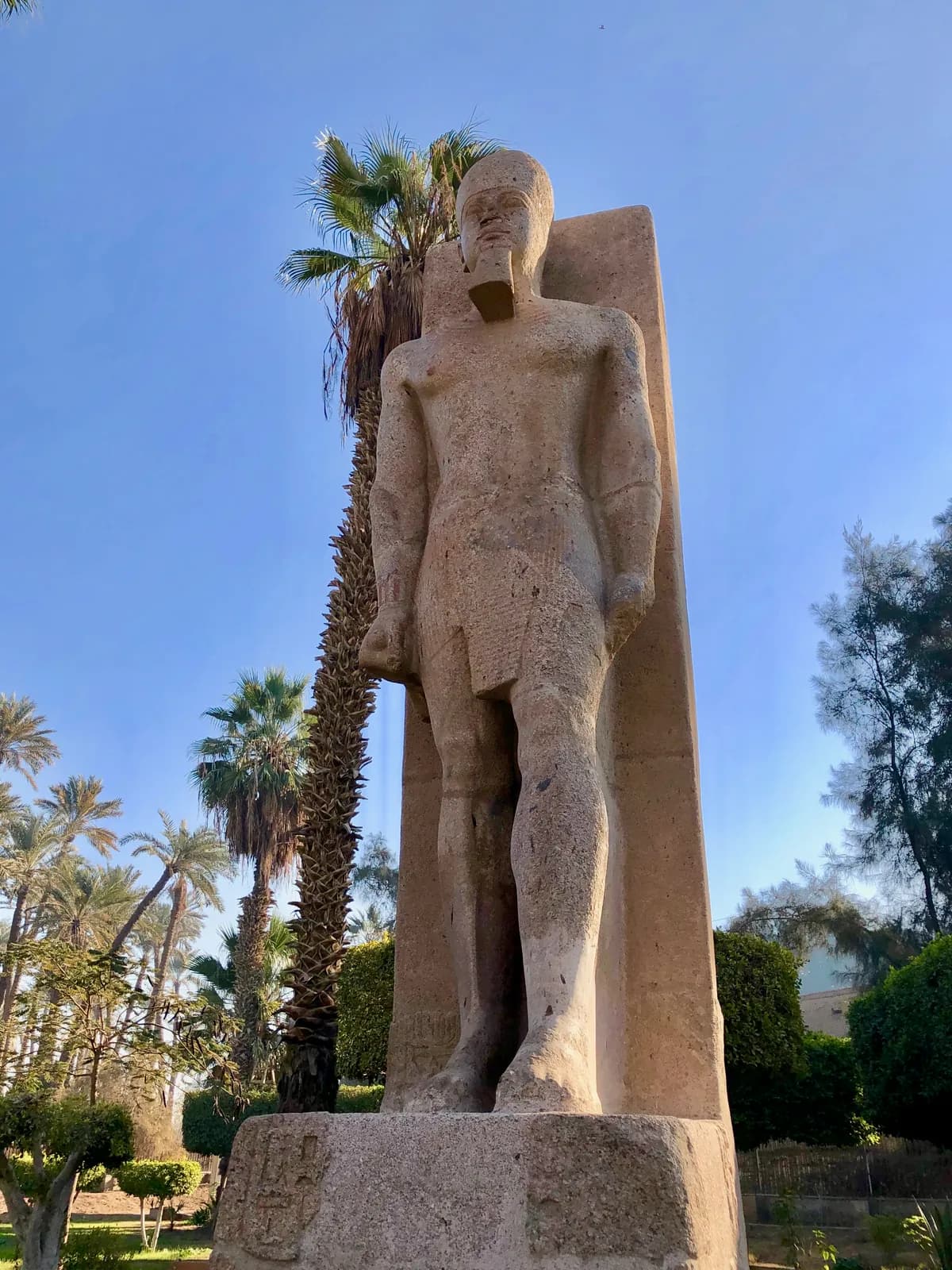
The colossal statue of Ramesses II
A fallen limestone colossus at Mit Rahina, displayed lying down in a purpose-built shelter.
- Evidence level: Documented
c. 2670 BCE, Third Dynasty
The Step Pyramid of Djoser
At Saqqara, attributed to the architect Imhotep, and the earliest large-scale cut-stone building known. The attribution rests on an inscription naming Imhotep on a statue base of Djoser.
- Evidence level: Documented
New Kingdom onward, monumental galleries from the 26th Dynasty
The Serapeum of Saqqara
Underground burial galleries of the Apis bulls, with colossal granite sarcophagi, rediscovered in 1851.
- Evidence level: Documented
Fourth Dynasty, c. 2600–2500 BCE
The Giza pyramids
Part of the Memphite necropolis, built for kings whose administrative capital was Memphis.
Archaeology and excavation
The necropolis has been excavated intensively since the nineteenth century — Mariette at the Serapeum, and continuous work at Saqqara and Giza to the present. The city itself has been worked far less, principally at Mit Rahina, because the conditions are hostile: high water table, deep silt, modern cultivation and villages.
Memphis is the sharpest illustration of a systematic bias in Egyptian archaeology. Tombs and temples were built of stone on the desert edge and survive; cities were built of mudbrick on the floodplain and do not. What we know about ancient Egypt is disproportionately what Egyptians built for the dead.
Museum collections
Where the finds are now. Where a holding is contested, the entry says so.
Mit Rahina open-air museum · Mit Rahina, Egypt
The Ramesses II colossus, an alabaster sphinx, and sculpture from the site.
Egyptian Museum / Grand Egyptian Museum · Cairo and Giza, Egypt
The national collections, including Memphite and Saqqara material.
Imhotep Museum · Saqqara, Egypt
Finds from the Saqqara necropolis displayed at the site.
Open questions
How large was Memphis, and where exactly did it lie?
The settlement's extent and its shifts over three millennia are not established. The Nile has moved, the water table has risen, and the mudbrick city has largely dissolved. Reconstructions differ substantially and none is confirmed.
Primary sources
Herodotus, Histories 2.99, 2.112, 3.27-29
The foundation tradition, the temple precincts, and the Persian conquest.
Strabo, Geography 17.1.31-32
A description of the city and the necropolis under Rome.
Egyptian court records, The Palermo Stone and the royal annals fragmentary
Early Egyptian records of reigns and events, relevant to the Memphite state.
How to read the evidence labels
- Evidence level: Documented
- Supported by a named primary text or by excavated material evidence.
- Evidence level: Probable
- Supported by strong inference that most specialists accept.
- Evidence level: Disputed
- Substantial specialist disagreement exists; competing readings are stated.
- Evidence level: Literary
- Belongs to poetic or mythological construction rather than to history.
- Evidence level: Mythological
- Belongs to shared religious or mythic tradition rather than to any single text.
- Evidence level: Unknown
- The available evidence is insufficient to decide.
These labels describe the status of the evidence, not our confidence in a conclusion. A claim marked Literary is not a claim we doubt; it is a claim about what kind of thing a poem is.