Where the site is
A granite island barely five kilometres long at the centre of the Cyclades, with almost no fresh water, no farmland worth the name and no defensible position. Every reason for its importance is religious or commercial: it sat at the crossing of the Aegean sea routes and it was holy, and for several centuries those two facts reinforced each other.
- Ancient region
- The Cyclades
- Modern country
- Greece
- Position
- 37.398° N, 25.269° E — The Sanctuary of Apollo
- Given to three decimal places, about a hundred metres. It locates the named feature, not the extent of the site.
What survives
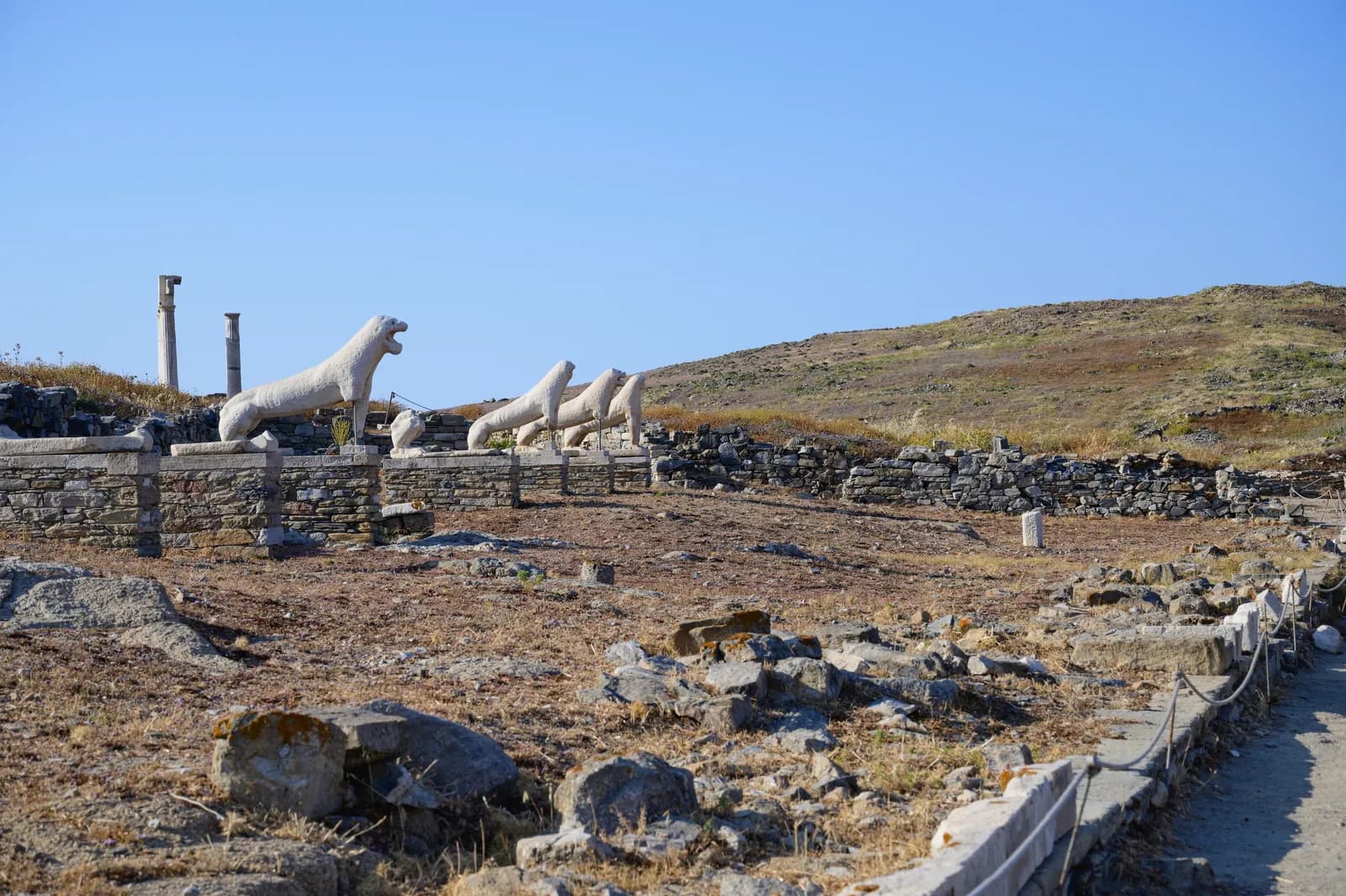
The sanctuary of Apollo with its temples, treasuries, altars and stoas reduced to foundations and column stumps, and beside it the row of archaic marble lions from Naxos — the ones on the terrace are replicas, the originals having been moved indoors after a century of salt weathering.
South and east of the sanctuary is the town: streets, drains, cisterns, shops and houses of the second century BCE standing to a metre or more, several with their floor mosaics in place and their peristyle courts legible. The theatre quarter is the most completely excavated Hellenistic domestic district anywhere.
Also on the island are sanctuaries of gods who were not Greek — Egyptian Serapis and Isis, Syrian deities, and a building generally identified as a synagogue — which is a direct consequence of what the free port did to the population.
Occupation and chronology
Dates below are stored as signed years and rendered with the precision they actually carry. c. 900 BCE is approximate; 69 BCE is fixed.
9th–6th centuries BCE
The Ionian sanctuary
A gathering place for the island Greeks, with a festival the Homeric Hymn to Apollo already describes. Naxos and then Athens competed to patronise it.
478–454 BCE
The Delian League
The alliance formed against Persia kept its treasury in the sanctuary until Athens moved it to the Acropolis. The move is the point at which an alliance becomes an empire, and it is dated by the tribute records.
314–166 BCE
Independence
Delos ran its own affairs and its own sanctuary accounts, which survive inscribed in great quantity and are among the best economic documents from the Greek world.
166–88 BCE
The free port
Rome gave the island to Athens and declared it a duty-free port, in order to break the trade of Rhodes. The population multiplied, Italian and eastern merchant communities settled, and the slave trade became enormous.
88 and 69 BCE
The sacks
Attacked during the Mithridatic wars and again by pirates. The island never recovered, which is why a commercial town of the second century BCE survives largely undisturbed.
History of excavation
Who recovered the evidence, when, and by what method. Where an excavation destroyed as much as it found, the entry says so.
- Evidence level: Documented
1873–present
The French School at Athens
A hundred and fifty years of continuous excavation and publication. The scale of the exposure is why Delos functions as the type-site for Hellenistic urban life.
- Evidence level: Documented
1904–1914
Théophile Homolle and the great campaign
The decade in which most of the town was uncovered, funded by a private endowment. Rapid, and by later standards under-recorded.
- Evidence level: Documented
1925
Drainage of the Sacred Lake
The lake beside which Leto was said to have given birth was drained as a malaria control measure and has not been refilled. Its bed is marked by a modern wall.
Principal structures
The evidence level answers how we know what a structure looked like, not whether it existed.
- Evidence level: Documented
c. 600 BCE
The Terrace of the Lions
Naxian marble lions flanking the processional way to the sanctuary. Between five and sixteen originally; nine survive in various states, and one stands at the Venetian Arsenal, taken in the early modern period.
- Evidence level: Documented
begun 478 BCE, unfinished
The Temple of the Delians
The great Doric temple begun after the Persian wars and left incomplete when the league treasury moved to Athens. The unfinished state is itself the historical evidence.
- Evidence level: Documented
c. 300 BCE
The theatre and its cistern
Seating for several thousand on a waterless island, with a vast vaulted cistern beneath the terrace collecting the run-off. The cistern is the more remarkable engineering.
- Evidence level: Documented
2nd century BCE
The House of the Masks and the House of Dionysos
Peristyle houses with figured floor mosaics in place, including a Dionysos on a panther. Domestic architecture of a mercantile elite, preserved because the town was abandoned rather than rebuilt.
- Evidence level: Documented
3rd–2nd centuries BCE
The Serapeia
Three separate sanctuaries of Egyptian gods, one of which preserves an inscribed foundation account by the priest whose family brought the cult from Memphis — a rare first-person record of how a cult travelled.
Finds and where they went
Almost nothing recovered from these sites is still on them. Where an object has a full provenance record on this platform, it is linked.
- Evidence level: Documented
The sanctuary accounts
Hundreds of inscriptions recording the temple's income, loans, rents, repairs and inventories, year by year. They are the densest surviving financial record of any Greek institution.
Delos Archaeological Museum and the epigraphic corpora
- Evidence level: Documented
Archaic Naxian sculpture
The lions, and fragments of a colossal kouros of Apollo whose base survives in place. Pieces of the colossus are on the island and one hand is in the British Museum.
- Evidence level: Documented
Hellenistic portrait sculpture
Including the so-called pseudo-athlete from the House of the Diadoumenos, an idealised nude body carrying an unflinching individual portrait head — the visual signature of the Italian merchant class on the island.
Ancient testimony
What ancient authors say about the place, and how far it can be trusted.
Thucydides, History of the Peloponnesian War 3.104
The purification of 426 BCE, the removal of the graves to Rheneia, the revival of the festival, and a quotation of the Homeric Hymn to Apollo as evidence for the antiquity of the gathering. Thucydides doing archaeology.
Herodotus, Histories 6.97
Datis anchors off Delos in 490 BCE and refuses to harm the island, burning three hundred talents of frankincense on the altar. Persian policy towards a Greek sanctuary, recorded by a Greek.
Strabo, Geography 14.5.2
Strabo on Delos as a slave market able to receive and dispatch ten thousand in a day. A proverbial figure rather than a count, and it is quoted as one here.
How the site has been interpreted
Delos is the clearest case in Greek archaeology of religion, politics and money occupying the same square metres. The sanctuary's neutrality made it a safe deposit, the deposit made it politically valuable, Athens took the deposit, and six centuries later Rome made the same island a tax-free market because it was already a place where everyone came.
The purification of 426 BCE is the sharpest single fact about the site. On Athenian instruction all the graves on the island were dug up and moved to neighbouring Rheneia, and thereafter nobody was permitted to be born or to die on Delos. It is a documented, dated act of ritual policy carried out at state scale, and the emptied graves were found where Thucydides said they were put.
The town is where the island earns its place in economic history. Hellenistic domestic architecture is usually known from fragments; here there are whole blocks, with shops, storerooms and the amphora evidence of what moved through them. Strabo's line about ten thousand slaves changing hands in a day is a rhetorical figure and should not be quoted as a statistic, but the market's scale is not in doubt.
Unresolved
How large was the population at its peak?
Estimates for the free-port period run from around ten thousand to upwards of twenty-five thousand, derived from the excavated housing area and assumed densities. No ancient figure exists for the resident population. The number is an inference from floor space and should be treated as one.
When did the league treasury actually move?
The conventional date of 454 BCE rests on the beginning of the Athenian tribute quota lists, which record the sixtieth part paid to Athena at Athens. That is strong evidence that the money was at Athens by then, and weaker evidence about the moment or the motive of the decision. Plutarch's account of the debate is much later.
How to read the evidence labels
- Evidence level: Documented
- Supported by a named primary text or by excavated material evidence.
- Evidence level: Probable
- Supported by strong inference that most specialists accept.
- Evidence level: Disputed
- Substantial specialist disagreement exists; competing readings are stated.
- Evidence level: Literary
- Belongs to poetic or mythological construction rather than to history.
- Evidence level: Mythological
- Belongs to shared religious or mythic tradition rather than to any single text.
- Evidence level: Unknown
- The available evidence is insufficient to decide.
These labels describe the status of the evidence, not our confidence in a conclusion. A claim marked Literary is not a claim we doubt; it is a claim about what kind of thing a poem is.