Where the site is
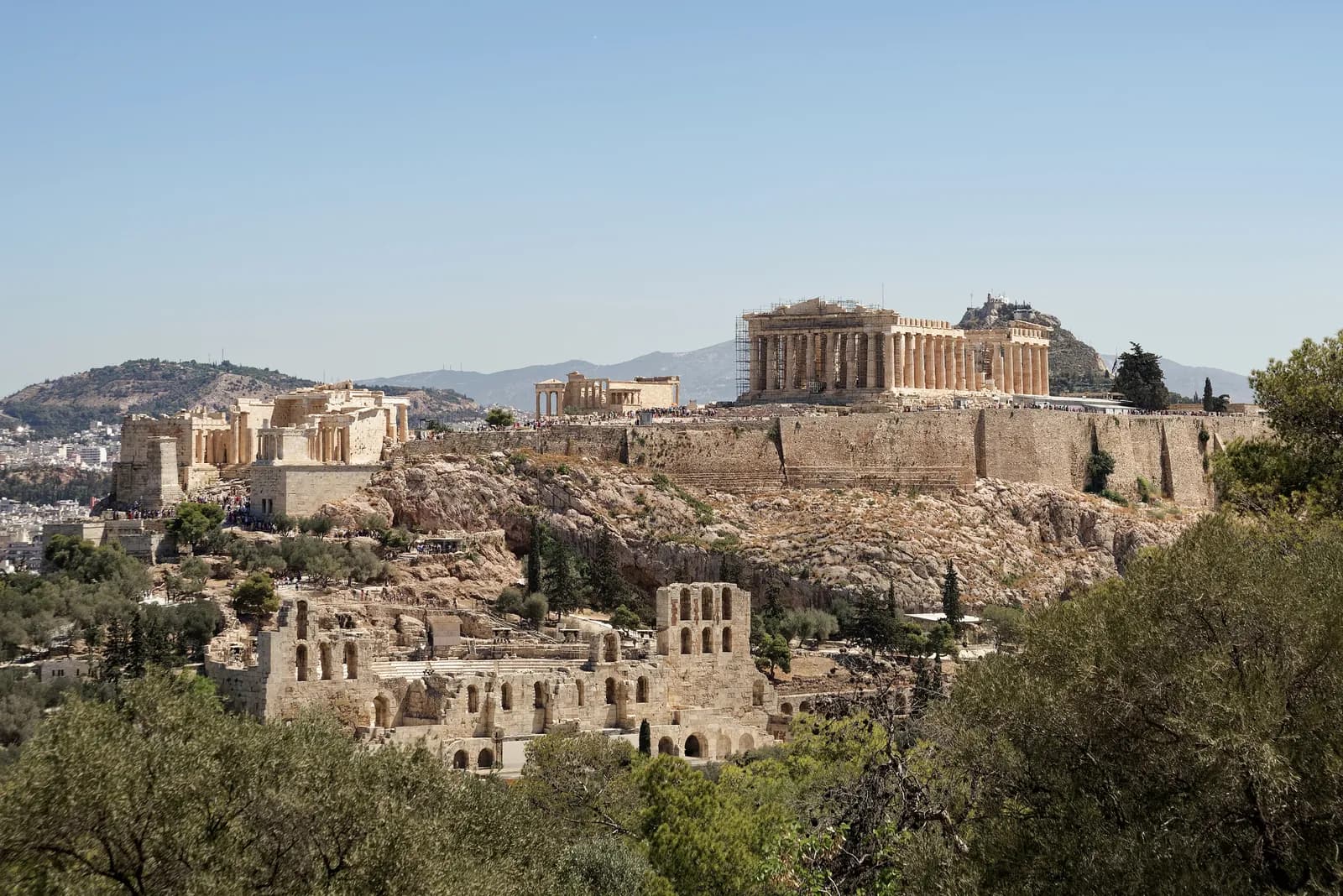
A limestone outcrop rising about seventy metres above the plain of Athens, with steep sides on three flanks and a single practicable approach from the west. It has springs on its north slope and a defensible summit of roughly three hectares, which is why it was occupied in the Bronze Age and why it kept being fought over long after it stopped being a fortress.
- Ancient region
- Attica
- Modern country
- Greece
- Position
- 37.972° N, 23.727° E — The Parthenon
- Given to three decimal places, about a hundred metres. It locates the named feature, not the extent of the site.
What survives
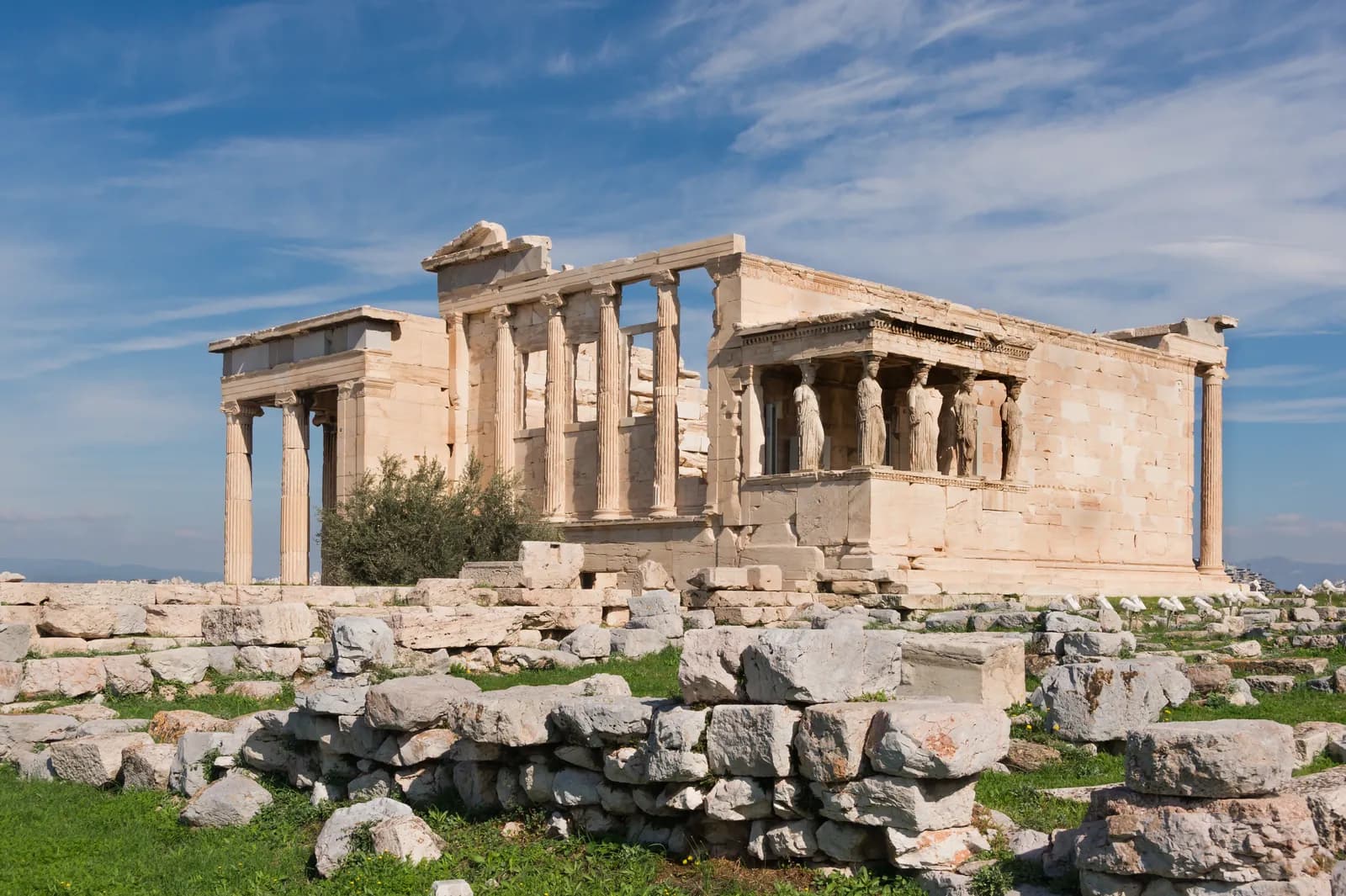
Four buildings of the fifth century BCE stand: the Parthenon, roofless and missing its centre; the Propylaia; the small Ionic temple of Athena Nike on its bastion; and the Erechtheion with its porch of caryatids, five of which are casts and one of which is in London.
Around and beneath them are foundations of a great deal else — the Older Parthenon left unfinished when the Persians came, the archaic temple of Athena, the Chalkotheke, the sanctuary of Artemis Brauronia — and the rock itself, cut and levelled and quarried into a working surface over centuries.
The sculpture is not on the buildings. What is fixed to the Parthenon and the Erechtheion today is casts; the originals that remain in Athens are in the Acropolis Museum at the foot of the hill, and a substantial part of the fifth-century programme is in the British Museum.
Occupation and chronology
Dates below are stored as signed years and rendered with the precision they actually carry. c. 1300 BCE is approximate; the site has no closing date because it has never gone out of use.
c. 1300–1200 BCE
Mycenaean citadel
A cyclopean circuit of which stretches survive, and a stepped well shaft down the north slope. The rock was a fortress before it was a sanctuary.
6th century – 480 BCE
Archaic sanctuary
Temples, korai and votive sculpture, ended by the Persian sack. What was smashed was buried on the rock, which is why so much of it survives.
447–406 BCE
The Periclean programme
Parthenon, Propylaia, Athena Nike, Erechtheion — a single building campaign of about forty years, funded in part from the treasury of the Delian League and politically contested at the time.
6th century CE – 1687
Church, mosque, magazine
The Parthenon became a church of the Virgin, then a mosque; the Erechtheion a harem residence; and in 1687 the Parthenon was in use as a powder store when a Venetian mortar found it.
1830s – present
Excavation and restoration
Post-antique structures cleared after Greek independence, excavation to bedrock in the 1880s, a first restoration campaign that damaged the buildings, and a second, still running, that is reversing it.
History of excavation
Who recovered the evidence, when, and by what method. Where an excavation destroyed as much as it found, the entry says so.
- Evidence level: Documented
1835–1840s
Ludwig Ross and the new Greek state
The Ottoman village on the summit, the Frankish tower on the Propylaia and the medieval accretions were cleared. This was excavation as national self-definition, and it destroyed a great deal of post-classical evidence deliberately.
- Evidence level: Documented
1885–1890
Panagiotis Kavvadias and Georg Kawerau
Excavation of the whole summit down to bedrock. It produced the Perserschutt — the debris of the Persian sack of 480 BCE, buried where it fell and sealed by the later terracing, containing Archaic sculpture with its paint still on it.
- Evidence level: Documented
1898–1933
Nikolaos Balanos
The first modern restoration. Columns were re-erected and blocks were fixed with iron clamps set without insulation, and drums were assembled in wrong sequence. The iron rusted, expanded and split the marble from inside. The intention was conservation; the effect was damage that took a second campaign to undo.
- Evidence level: Documented
1975–present
The Acropolis Restoration Service
Systematic dismantling and reassembly: Balanos's iron removed and replaced with titanium, blocks returned to their correct positions where these can be established, surviving sculpture withdrawn to the museum, everything documented and everything reversible.
Principal structures
The evidence level answers how we know what a structure looked like, not whether it existed.
- Evidence level: Documented
447–432 BCE
The Parthenon
Doric, octastyle, with an Ionic frieze inside the colonnade. Iktinos and Kallikrates are named as architects and Pheidias as overseer of the sculpture by ancient sources rather than by any building inscription. Standing, and roofless since 1687.
- Evidence level: Documented
437–432 BCE
The Propylaia
The monumental entrance, attributed to Mnesikles, left unfinished — the projected south-east wing was never built and the unworked bosses are still on some blocks.
- Evidence level: Documented
c. 421–406 BCE
The Erechtheion
An irregular building on three levels holding several cults at once, including the olive tree and the salt spring of the contest between Athena and Poseidon. Its irregularity is a consequence of what it had to contain.
- Evidence level: Documented
c. 427–424 BCE
The Temple of Athena Nike
Small, Ionic, amphiprostyle, on the bastion beside the entrance. Dismantled by the Ottomans in 1686 for a gun emplacement and rebuilt from its own blocks in 1836, then twice again since.
- Evidence level: Documented
c. 490–480 BCE
The Older Parthenon and the north wall
A temple under construction when the Persians burned the rock. Its unfinished column drums were built into the north circuit wall in plain view from the city below — a deliberate memorial, and the clearest surviving instance of ancient Athens making an argument out of a ruin.
Finds and where they went
Almost nothing recovered from these sites is still on them. Where an object has a full provenance record on this platform, it is linked.
- Evidence level: Documented
The Perserschutt sculpture
Korai, the Calf-Bearer, the Rampin Rider, the Kritios Boy and much else, smashed in 480 BCE and buried on the rock. A sealed deposit with a fixed terminus, which makes it the anchor for Archaic sculptural chronology.
- Evidence level: Documented
The Parthenon sculptures in Athens
Frieze, metopes and pedimental figures that remained on or near the building, now displayed in the Acropolis Museum in a gallery laid out to the dimensions of the Parthenon itself, with gaps where the London blocks would be.
- Evidence level: Documented
The Parthenon sculptures in London
Roughly half the surviving frieze, fifteen metopes, and pedimental figures, removed under Thomas Bruce, seventh Earl of Elgin, between 1801 and 1812 and sold to the British Museum in 1816. The legality of the Ottoman permission and the terms of the removal are disputed, and Greece has sought return since the 1980s.
- Evidence level: Documented
Inscribed building accounts
Athenian practice was to publish accounts on stone. The Parthenon and Propylaia accounts survive in fragments and record annual expenditure, which is why the construction dates are firm rather than inferred.
Ancient testimony
What ancient authors say about the place, and how far it can be trusted.
Pausanias, Description of Greece 1.22–28
Pausanias walks up through the Propylaia and describes what was on the rock in the second century CE, including dozens of dedications now lost. It is the single most important ancient text for the site.
Plutarch, Life of Pericles 12–13
Plutarch on the building programme: the charge that Athens was gilding herself with her allies' money, Pericles' answer, and the speed of the work. Written five centuries later from earlier sources.
Herodotus, Histories 8.51–53
Herodotus on the Persian capture of the Acropolis in 480 BCE: the defenders behind a wooden barricade, the climb up the unguarded north face, and the burning of the sanctuary.
Thucydides, History of the Peloponnesian War 2.13
Pericles counts the reserves available to Athens, including the removable gold on the statue of Athena — a reminder that the sanctuary was also a treasury.
How the site has been interpreted
The Acropolis is usually explained as the high point of an artistic tradition. As an excavated site it reads more sharply as a political programme. The buildings went up within a generation of the Persian sack, on the ruins of what the Persians destroyed, funded from the tribute of an alliance formed to fight Persia, and against opposition in Athens which held that the money was not Athens's to spend. Plutarch preserves the argument.
The rock also records what people did with a ruin once the argument was over. The Parthenon has been a temple, a church, a mosque and an arsenal, and each conversion left evidence. Nineteenth-century clearance removed almost all of it in order to recover a single moment, which is a choice about which past a place is allowed to have.
The current restoration is unusual in being explicitly a correction. Balanos's iron was standard practice in 1900 and it was catastrophic by 1975, and the present campaign's commitment to reversibility is a direct response. It is one of the few large heritage projects that treats its own methods as provisional.
Unresolved
Where do the Parthenon sculptures belong?
Greece holds that the removal was carried out under an occupying power without valid title and that a single sculptural programme should be reunited in sight of the building it was made for. The British Museum has held that the sculptures were acquired legally under the terms of the day, that its trustees are constrained by statute, and that the collection provides a comparative context. The original Ottoman document has not been found; what survives is an Italian translation of uncertain standing. The platform records the dispute and does not adjudicate it.
What does the Parthenon frieze represent?
The traditional identification is the Panathenaic procession. Alternatives have included the sacrifice of the daughters of Erechtheus, a heroised assembly of the Marathon dead, and a generic idealised citizenry. No ancient source describes the frieze, which is the root of the problem: a building this famous carries no ancient explanation of its own main sculptural programme.
How to read the evidence labels
- Evidence level: Documented
- Supported by a named primary text or by excavated material evidence.
- Evidence level: Probable
- Supported by strong inference that most specialists accept.
- Evidence level: Disputed
- Substantial specialist disagreement exists; competing readings are stated.
- Evidence level: Literary
- Belongs to poetic or mythological construction rather than to history.
- Evidence level: Mythological
- Belongs to shared religious or mythic tradition rather than to any single text.
- Evidence level: Unknown
- The available evidence is insufficient to decide.
These labels describe the status of the evidence, not our confidence in a conclusion. A claim marked Literary is not a claim we doubt; it is a claim about what kind of thing a poem is.