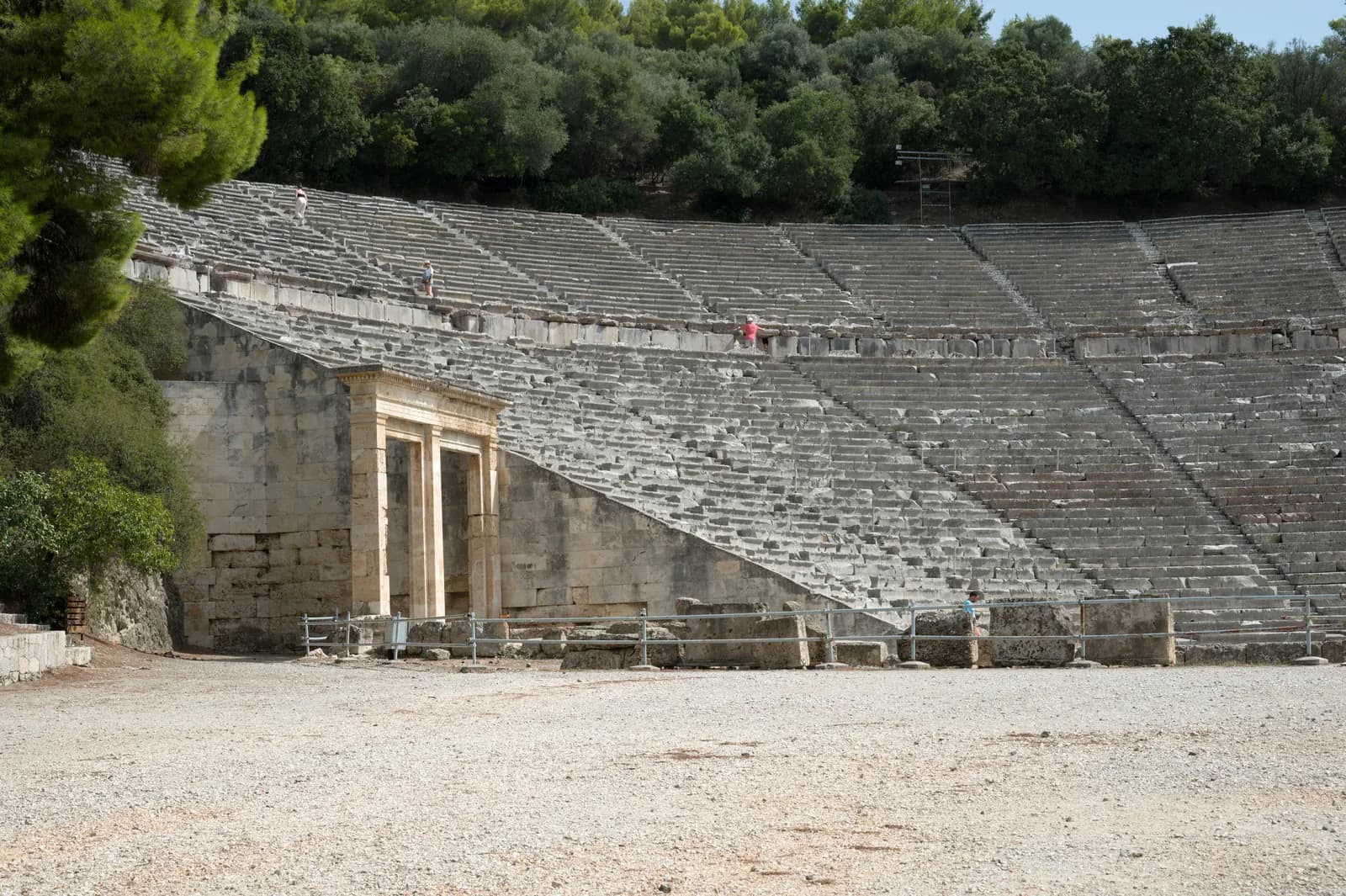
Where the site is
An inland valley about eight kilometres from the coastal town of Epidaurus, ringed by hills, with springs. The sanctuary is deliberately away from the city: the sick came to it, and it developed the accommodation, water supply and stadium of a place that expected people to stay.
- Ancient region
- The Argolid
- Modern country
- Greece
- Position
- 37.596° N, 23.079° E — The theatre
- Given to three decimal places, about a hundred metres. It locates the named feature, not the extent of the site.
What survives
The theatre is the most complete Greek theatre in existence: fifty-five tiers of original seating, the circular orchestra intact, and enough of the stage building to reconstruct the rest. It is still used, and its acoustics are genuinely exceptional, though the popular claim that a whisper carries to the back row is a demonstration effect rather than a measured one.
The sanctuary itself is foundations: the temple of Asklepios, the long stoa of the abaton where the sick slept, the round tholos with its extraordinary underground labyrinth of concentric walls, the propylaia, the guest-house of a hundred and sixty rooms, and the stadium cut into the slope with its stone starting sill in place.
The tholos has been partly re-erected in recent decades using surviving blocks and new marble, a reconstruction carried out under the same reversibility principles as the Acropolis work and clearly identifiable as modern.
Occupation and chronology
Dates below are stored as signed years and rendered with the precision they actually carry. c. 600 BCE is approximate; 426 CE is fixed.
6th–5th centuries BCE
Early cult
An older cult of Apollo Maleatas on the hill above, into which Asklepios is introduced. The sanctuary's rise is genuinely rapid and roughly contemporary with the plague years at Athens.
c. 400–320 BCE
The building programme
Temple, tholos, abaton, propylaia, stadium and theatre, funded by the sanctuary's own income and dated by inscribed accounts rather than by style.
2nd century CE
Roman rebuilding
Baths, a library and new accommodation, largely paid for by the Roman senator Antoninus. The sanctuary was still fully functional five hundred years after its expansion.
4th–5th centuries CE
Closure
Damaged by raids, then closed under the anti-pagan legislation. A Christian basilica was built inside the sanctuary.
History of excavation
Who recovered the evidence, when, and by what method. Where an excavation destroyed as much as it found, the entry says so.
- Evidence level: Documented
1881–1928
Panagiotis Kavvadias, Greek Archaeological Society
Uncovered the sanctuary and, critically, the inscribed stelae — both the cure records and the building accounts. Kavvadias published the inscriptions promptly, which is why they entered scholarship as fast as they did.
- Evidence level: Documented
1948–present
Greek Archaeological Service and the Committee for the Preservation of the Epidaurus Monuments
Study, anastylosis of the tholos and the temple façade, and continued excavation of the Apollo Maleatas sanctuary on the hill above.
Principal structures
The evidence level answers how we know what a structure looked like, not whether it existed.
- Evidence level: Documented
later 4th century BCE, upper tiers 2nd century BCE
The theatre
Pausanias attributes it to Polykleitos. The famous sculptor of that name belongs to the fifth century and the building to the fourth, so the attribution is either to a younger namesake or is simply mistaken.
- Evidence level: Documented
c. 380–375 BCE
The Temple of Asklepios
Doric, modest in size, and dated precisely because its building accounts survive on stone. They name the architect Theodotos, the contractors, the penalties for late delivery and the cost of transporting the ivory.
- Evidence level: Documented
c. 360–320 BCE
The tholos
A round building of exceptional refinement with three concentric underground walls forming a spiral passage beneath the floor. What the passage was for is not known; snakes, water and ritual movement have all been proposed.
- Evidence level: Documented
4th century BCE, extended later
The abaton
A two-storey stoa where patients slept in the expectation of a dream from the god. The architecture is ordinary and the function is not; this is the building the cure inscriptions describe.
- Evidence level: Documented
4th century BCE
The katagogion
A square guest-house of four courtyards and about a hundred and sixty rooms. Sanctuaries at this scale were also an accommodation industry.
Finds and where they went
Almost nothing recovered from these sites is still on them. Where an object has a full provenance record on this platform, it is linked.
- Evidence level: Documented
The iamata
Large stelae inscribed with accounts of cures: a man's blindness healed, a woman pregnant for five years delivered, a spear-head removed. Pausanias saw six of these; four survive substantially. That the stones were carved and displayed in the fourth century BCE is documented. What they record is religious testimony, published by the sanctuary about itself.
Archaeological Museum of Epidaurus
- Evidence level: Documented
The building accounts
Inscribed records of the temple and tholos construction: contractors named, sums paid, materials sourced, guarantors listed and fines levied. Among the most detailed documentation of an ancient building project anywhere, and the reason Epidaurus dates so much better than most Greek sanctuaries.
Archaeological Museum of Epidaurus, and the epigraphic corpora
- Evidence level: Documented
Anatomical votives
Terracotta and marble models of legs, eyes, ears and other body parts, dedicated in thanks for a cure. They record what people came with, which is a kind of epidemiology, subject to the obvious bias that only successes were dedicated.
Archaeological Museum of Epidaurus
- Evidence level: Documented
Sculpture from the temple pediments
Fragments of an Amazonomachy and a sack of Troy, together with an inscribed record naming the sculptor Timotheos. Divided between Athens and the site museum.
Ancient testimony
What ancient authors say about the place, and how far it can be trusted.
Pausanias, Description of Greece 2.26–29
Pausanias on the sanctuary: the birth story of Asklepios, the prohibition on dying or giving birth within the precinct, the stelae of cures, and the attribution of the theatre and tholos to Polykleitos.
Strabo, Geography 8.6.15
Strabo's brief notice of the sanctuary as always full of the sick and of the tablets recording cures.
How the site has been interpreted
Epidaurus is the best evidence there is for how ancient healing cult actually worked, and it works differently from how it is usually described. The patient arrived, purified, sacrificed, and slept in the abaton; the god appeared in a dream and either treated the patient directly or prescribed something; the patient paid a fee and, if cured, dedicated a model of the affected part. Priests are barely visible in the records. The transaction is between the sleeper and the dream.
The relationship with Hippocratic medicine is not one of competition. The same people used both; the temple accepted patients medicine had failed; and several of the prescriptions recorded in the iamata — exercise, bathing, diet — are indistinguishable from ordinary medical advice. Where the inscriptions describe surgery performed in a dream, the register changes completely, and the platform does not attempt to rationalise those cases into plausible operations.
The building accounts are a separate and underrated body of evidence. They show a sanctuary functioning as a client with a budget: competitive contracts, sureties, penalty clauses, itemised transport. Almost everything general accounts say about how Greek temples were financed and built rests disproportionately on this one site's paperwork.
Unresolved
Who designed the theatre and the tholos?
Pausanias names Polykleitos for both. The dates do not fit the famous fifth-century sculptor, so the standard solution is a Polykleitos the Younger, otherwise almost unattested. The alternative is that Pausanias, writing five hundred years later, attached a famous name to two admired buildings. Neither can be shown.
What are the cure inscriptions evidence for?
They are unambiguous evidence for what the sanctuary published and therefore for what visitors were expected to believe. They are not evidence that the events described occurred. Attempts to reinterpret them as records of drugged sleep, of surgery performed by priests in the dark, or of psychosomatic recovery are modern reconstructions, sometimes plausible and never demonstrated, and the inscriptions themselves describe none of these things.
How to read the evidence labels
- Evidence level: Documented
- Supported by a named primary text or by excavated material evidence.
- Evidence level: Probable
- Supported by strong inference that most specialists accept.
- Evidence level: Disputed
- Substantial specialist disagreement exists; competing readings are stated.
- Evidence level: Literary
- Belongs to poetic or mythological construction rather than to history.
- Evidence level: Mythological
- Belongs to shared religious or mythic tradition rather than to any single text.
- Evidence level: Unknown
- The available evidence is insufficient to decide.
These labels describe the status of the evidence, not our confidence in a conclusion. A claim marked Literary is not a claim we doubt; it is a claim about what kind of thing a poem is.