Where the site is
On the bay opposite Salamis, at the foot of a low acropolis about twenty kilometres west of Athens along the Sacred Way. Fertile plain behind it, sheltered water in front. The modern town is heavily industrial, and the sanctuary sits in the middle of it.
- Ancient region
- Attica
- Modern country
- Greece
- Position
- 38.041° N, 23.538° E — The Telesterion
- Given to three decimal places, about a hundred metres. It locates the named feature, not the extent of the site.
What survives
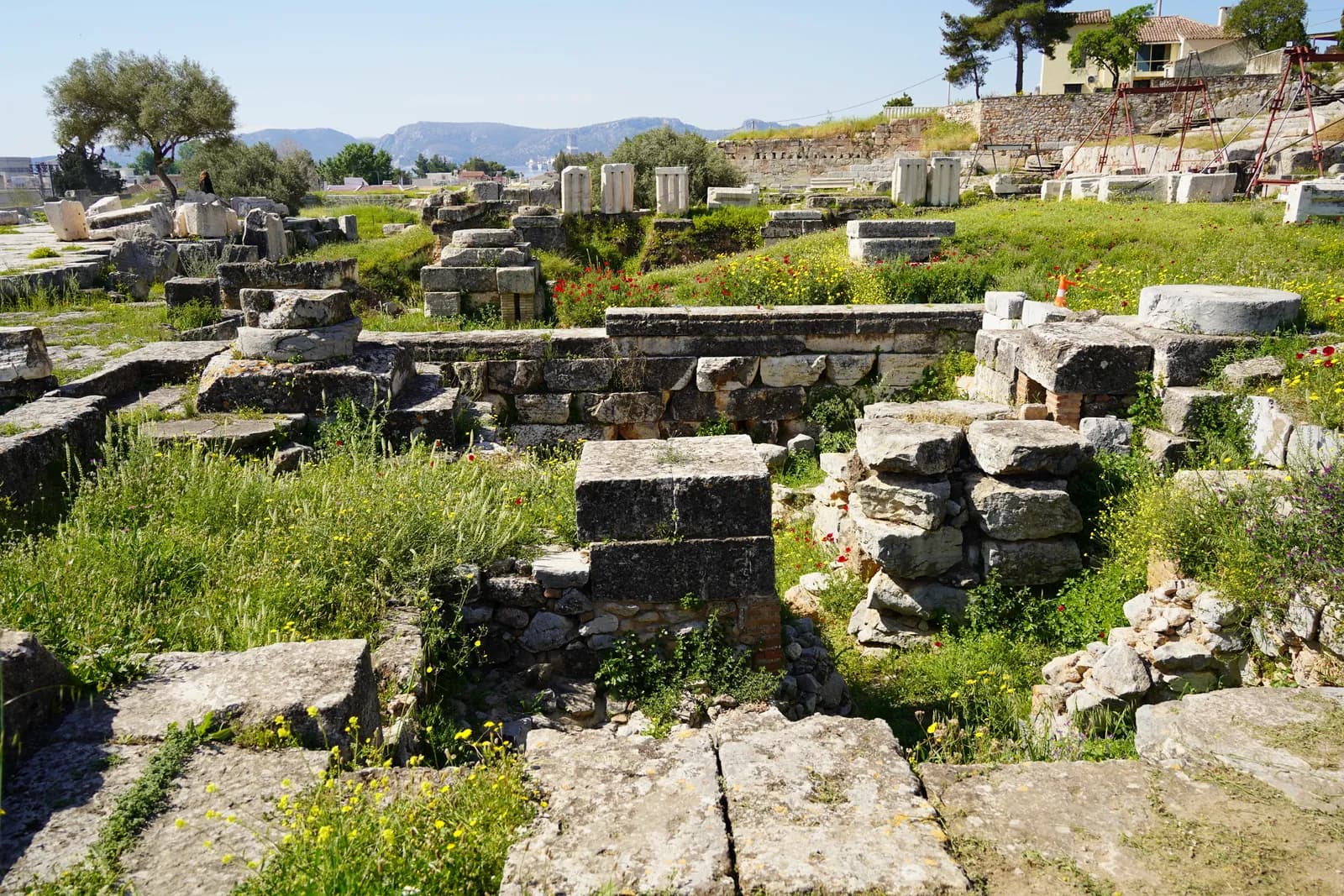
The Telesterion survives as a great rectangular platform cut into the rock of the hillside, with the tiers of steps on which the initiates stood still visible on three sides and the bases of the interior columns in place. In the middle are the foundations of the small enclosed building, the Anaktoron, which only the hierophant entered.
In front of it are the two Roman propylaia, one a direct copy of the entrance to the Athenian Acropolis, and beside the outer gate the paved well the Homeric Hymn calls Kallichoron — the maiden well, where Demeter was said to have sat. The cave identified as the entrance to the underworld is on the north side of the court.
What does not survive, because it never existed in material form, is any depiction of the rite. In a thousand years of Greek art, with the sanctuary a few hours' walk from the largest concentration of vase painters in the Mediterranean, nobody drew what happened inside the hall.
Occupation and chronology
Dates below are stored as signed years and rendered with the precision they actually carry. c. 1400 BCE is approximate; 396 CE is fixed.
c. 1400–1200 BCE
Bronze Age building
A megaron-like structure was found under the later hall. Whether it was a cult building, and whether any practice continued unbroken from it to the historical Mysteries, is argued and not settled.
7th–6th centuries BCE
Archaic sanctuary
The first hall of initiation, expanded under the Peisistratids. Eleusis is absorbed into the Athenian state and the Mysteries become an Athenian institution administered by two priestly families.
mid-5th century BCE
The Periclean Telesterion
The hall rebuilt at its largest, roofed, with rock-cut tiers on all four sides for several thousand initiates. This is the building the classical Mysteries happened in.
1st–2nd centuries CE
Roman patronage
Emperors were initiated and paid for building. Marcus Aurelius rebuilt after a raid in the 170s; the Greater Propylaia copies the Athenian Propylaia directly.
late 4th century CE
Closure
The sanctuary was destroyed in the invasion of 396 CE and was not restored; the Theodosian legislation against pagan cult had already made its continuation impossible.
History of excavation
Who recovered the evidence, when, and by what method. Where an excavation destroyed as much as it found, the entry says so.
- Evidence level: Documented
1812
The Society of Dilettanti and E. D. Clarke's removal
A colossal caryatid from the Lesser Propylaia was taken to Cambridge, where it remains. The villagers reportedly resisted its removal, believing the statue protected the harvest.
- Evidence level: Documented
1882–1890s
Dimitrios Philios, Greek Archaeological Society
The first systematic excavation, which established the plan of the sanctuary and the sequence of the Telesterion's rebuildings.
- Evidence level: Documented
1917–1945
Konstantinos Kourouniotis
Excavation of the earlier phases beneath the classical hall, including the Bronze Age structure.
- Evidence level: Documented
1930s–1960s
George Mylonas
Final publication of the sanctuary in 1961, still the standard account, and a deliberately restrained one about the content of the rite.
Principal structures
The evidence level answers how we know what a structure looked like, not whether it existed.
- Evidence level: Documented
successive halls, 6th century BCE – 2nd century CE
The Telesterion
Square, roofed, internally columned, with stepped standing room around the walls — a building type with no other real parallel in Greek architecture, because no other Greek ritual required several thousand people indoors.
- Evidence level: Documented
in every phase of the hall
The Anaktoron
A small rectangular structure kept in the same position through every rebuilding, so that the hall was enlarged around it. Its position is fixed and documented; what was kept in it is not.
- Evidence level: Documented
2nd century CE
The Greater Propylaia
A direct architectural quotation of the Propylaia on the Athenian Acropolis, built with imperial money. The quotation is the message.
- Evidence level: Documented
6th century BCE, rebuilt later
The Kallichoron well
A round marble-curbed well outside the gate, on the spot the Homeric Hymn names. One of the few cases where a Greek cult text and a Greek excavation point at the same stone.
Finds and where they went
Almost nothing recovered from these sites is still on them. Where an object has a full provenance record on this platform, it is linked.
- Evidence level: Documented
The Eleusis relief
A large votive relief showing Demeter, Kore and a boy usually identified as Triptolemos. One of the defining works of fifth-century sculpture, and one of the very few images the sanctuary produced of its own deities in action.
- Evidence level: Documented
The Protoattic amphora
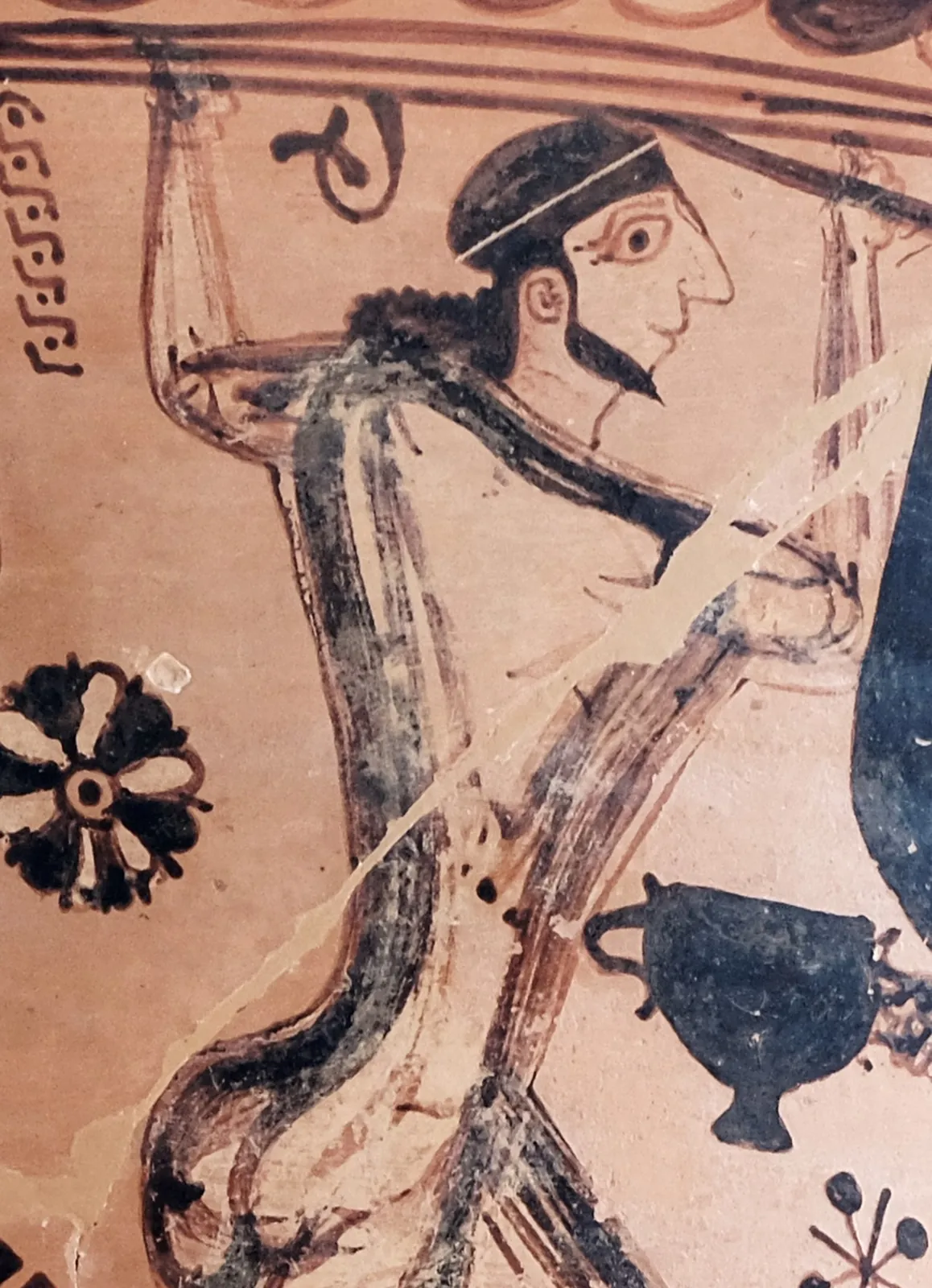
A large seventh-century BCE burial jar from Eleusis painted with the blinding of Polyphemus and the pursuit of Perseus by the Gorgons — among the earliest surviving narrative scenes from Greek myth.
Archaeological Museum of Eleusis
- Evidence level: Probable
Kernoi and plemochoai
Ritual vessel types found in quantity at the sanctuary and almost nowhere else. That they were used is documented; what was done with them is inference from their shape and from scattered references.
Archaeological Museum of Eleusis
- Evidence level: Documented
The Eleusis caryatid
One of two colossal basket-bearing figures from the Lesser Propylaia, removed in 1812 and now in the Fitzwilliam Museum, Cambridge. Its pair remains at Eleusis.
Fitzwilliam Museum, Cambridge
Ancient testimony
What ancient authors say about the place, and how far it can be trusted.
Pausanias, Description of Greece 1.38.7
Pausanias reaches the sanctuary wall and stops: a dream forbade him to describe what lies within. The most valuable non-description in ancient literature.
Herodotus, Histories 8.65
Herodotus' story of the dust cloud and the Iacchus cry rising from Eleusis before Salamis, told as a portent reported by an exile. Evidence for what the procession sounded like, embedded in a piece of wartime omen literature.
Homeric Hymn to Demeter 1–495
The founding narrative: the abduction of Persephone, Demeter's search, her stay at Eleusis and her instruction to build the hall. The Kallichoron well and the sanctuary's position appear in it, and it is the closest thing to a charter the cult has.
How the site has been interpreted
The framework of the Mysteries is well documented and largely uncontroversial: an annual festival in the month of Boedromion, a preliminary stage at Athens, a purification in the sea, a procession of many thousands along the Sacred Way carrying sacred objects, a fast broken with a barley drink, and a night in the Telesterion after which the initiate was held to have a better lot after death. Initiation was open to anyone who spoke Greek and had not committed homicide, including women and enslaved people, which is unusual enough to be worth stating plainly.
What happened inside the hall is not known. The oath of secrecy held for a millennium, and the accounts that claim to reveal it are all late, all Christian and all polemical — they are evidence for how Christian apologists argued about pagan cult, not for what fifth-century initiates saw. Reconstructions involving grain, a birth, a light, or a drug are hypotheses of varying quality, and this platform states them as hypotheses or not at all.
The secrecy was enforceable in law. Alcibiades was condemned in his absence in 415 BCE for profaning the Mysteries in a private house, and the charge was serious enough to lose Athens its most capable commander at the worst possible moment. Aeschylus was said to have faced the same accusation. The Mysteries were not a mood; they were an institution with sanctions.
Pausanias, who describes everything, reaches the wall of the sanctuary and stops, saying a dream forbade him to write what is inside. A traveller whose entire method is description recording that he chose not to describe is the best single piece of evidence for how the secret was kept.
Unresolved
Was there continuity from the Bronze Age?
A Mycenaean building lies under the Telesterion, and the sanctuary's later ideology claimed extreme antiquity. Whether the building was religious, and whether any practice survived the collapse of the Mycenaean world to re-emerge centuries later, is argued from stratigraphy that is neither continuous nor conclusive. The claim of continuity is ancient; the evidence for it is not.
Was the kykeon psychoactive?
A hypothesis published in 1978 proposed that the barley drink carried ergot alkaloids and that the experience was pharmacological. It has been influential in popular writing and has never been substantiated: no residue analysis supports it, ergotised barley is toxic in ways the sources do not describe, and the argument runs from a modern assumption about what could produce such an effect. It is recorded here as a modern hypothesis, not as a finding.
How to read the evidence labels
- Evidence level: Documented
- Supported by a named primary text or by excavated material evidence.
- Evidence level: Probable
- Supported by strong inference that most specialists accept.
- Evidence level: Disputed
- Substantial specialist disagreement exists; competing readings are stated.
- Evidence level: Literary
- Belongs to poetic or mythological construction rather than to history.
- Evidence level: Mythological
- Belongs to shared religious or mythic tradition rather than to any single text.
- Evidence level: Unknown
- The available evidence is insufficient to decide.
These labels describe the status of the evidence, not our confidence in a conclusion. A claim marked Literary is not a claim we doubt; it is a claim about what kind of thing a poem is.