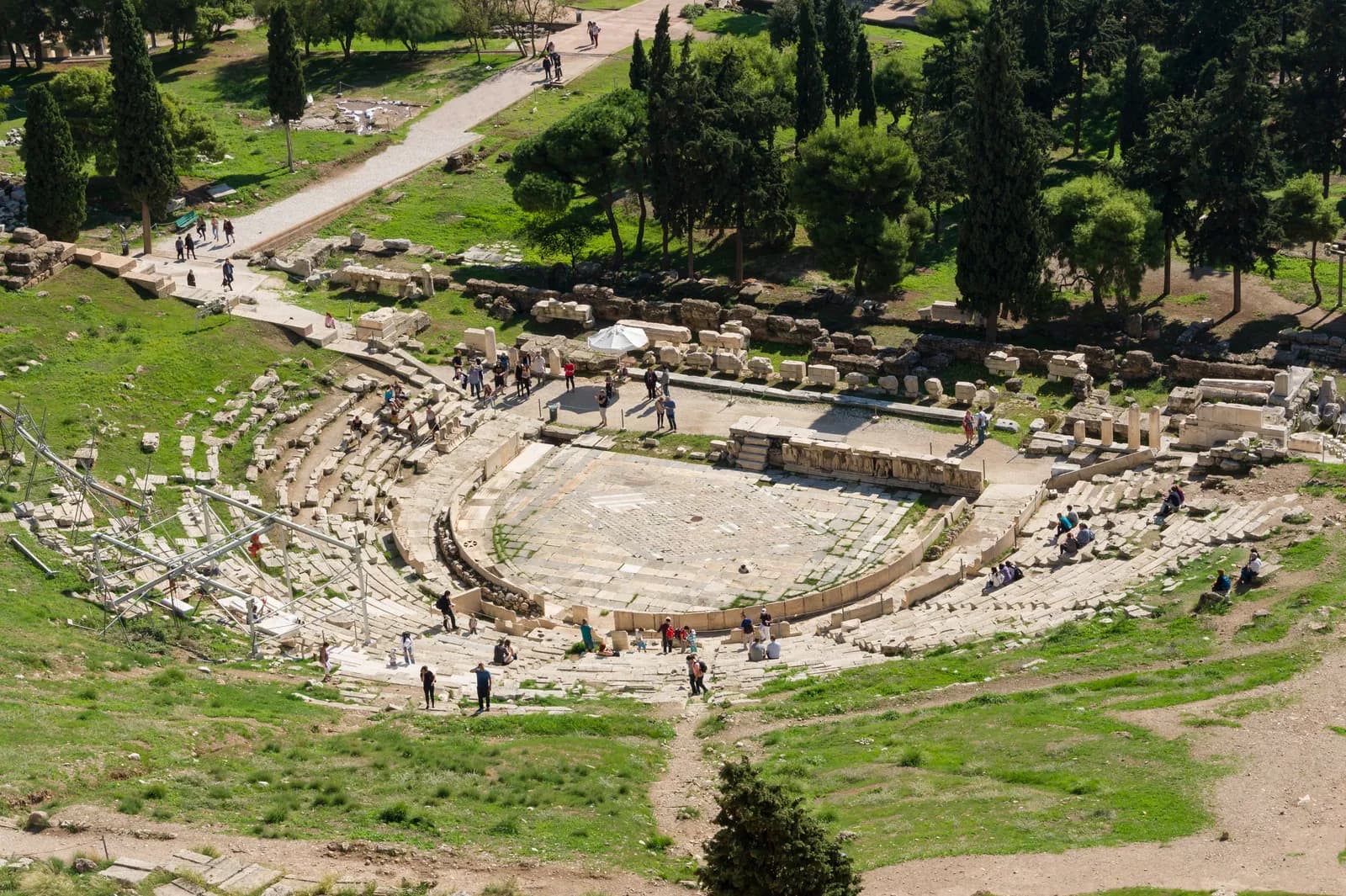
A Greek theatre uses the ground: seating is cut into a hillside around a circular orchestra where the chorus performed, with a low stage building behind. The site had to have a slope, which is why Greek theatres are where the topography allowed rather than where the town centre was.
Roman engineering removed that constraint. Concrete vaulting could carry banked seating on a free-standing structure, so a Roman theatre could be built anywhere, and its semicircular orchestra became seating rather than performance space, with a tall permanent stage building closing the view.
A caution that catches most visitors: the stone theatre at Athens visible today is substantially later than the fifth-century plays first performed on the site. The Theatre of Dionysus was a wooden and earthen arrangement when Aeschylus, Sophocles, Euripides and Aristophanes were staged there, and the surviving masonry is a Hellenistic and Roman rebuilding.
What the evidence supports
Greek theatres depend on a hillside; Roman theatres do not.
The structural difference follows from concrete vaulting and is visible at every Roman example.
The stone remains at Athens post-date the classical drama.
The fifth-century arrangements were largely wooden. The surviving seating is later, which is well established and routinely elided.
How the fifth-century staging worked is reconstructed, not attested.
Skene, ekkyklema and mechane are known from the plays and later commentators. Their physical form is inference; no fifth-century stage building survives.
Terms
- cavea / koilon
- The banked seating.
- orchestra
- The circular dancing floor of the chorus; a semicircle in Roman practice.
- skene
- The stage building; the origin of the word scene.
Examples
The evidence level on each answers how we know what the building looked like, not whether it existed.
- Evidence level: Probable
Athens · Successive phases from the 6th century BCE
The Theatre of Dionysus
The birthplace of Attic drama. Its visible stone form is Hellenistic and Roman. Excavated, with the surviving stone seating standing.
- Evidence level: Documented
Delphi · 4th century BCE, rebuilt later
The theatre at Delphi
Set above the temple, with the sanctuary and valley as the backdrop. The seating and orchestra survive in situ.
- Evidence level: Documented
Pompeii · 2nd century BCE, remodelled under Augustus
The large theatre at Pompeii
A Greek-plan theatre in an Italian town, later Romanised. Excavated and standing; the Augustan remodelling is legible in the fabric.
Primary sources
Vitruvius, On Architecture 5.3-9
Theatre design, acoustics and the sounding vessels Vitruvius describes.
Aristotle, Poetics
The dramatic form the building housed, though Aristotle says little about the building.
How to read the evidence labels
- Evidence level: Documented
- Supported by a named primary text or by excavated material evidence.
- Evidence level: Probable
- Supported by strong inference that most specialists accept.
- Evidence level: Disputed
- Substantial specialist disagreement exists; competing readings are stated.
- Evidence level: Literary
- Belongs to poetic or mythological construction rather than to history.
- Evidence level: Mythological
- Belongs to shared religious or mythic tradition rather than to any single text.
- Evidence level: Unknown
- The available evidence is insufficient to decide.
These labels describe the status of the evidence, not our confidence in a conclusion. A claim marked Literary is not a claim we doubt; it is a claim about what kind of thing a poem is.