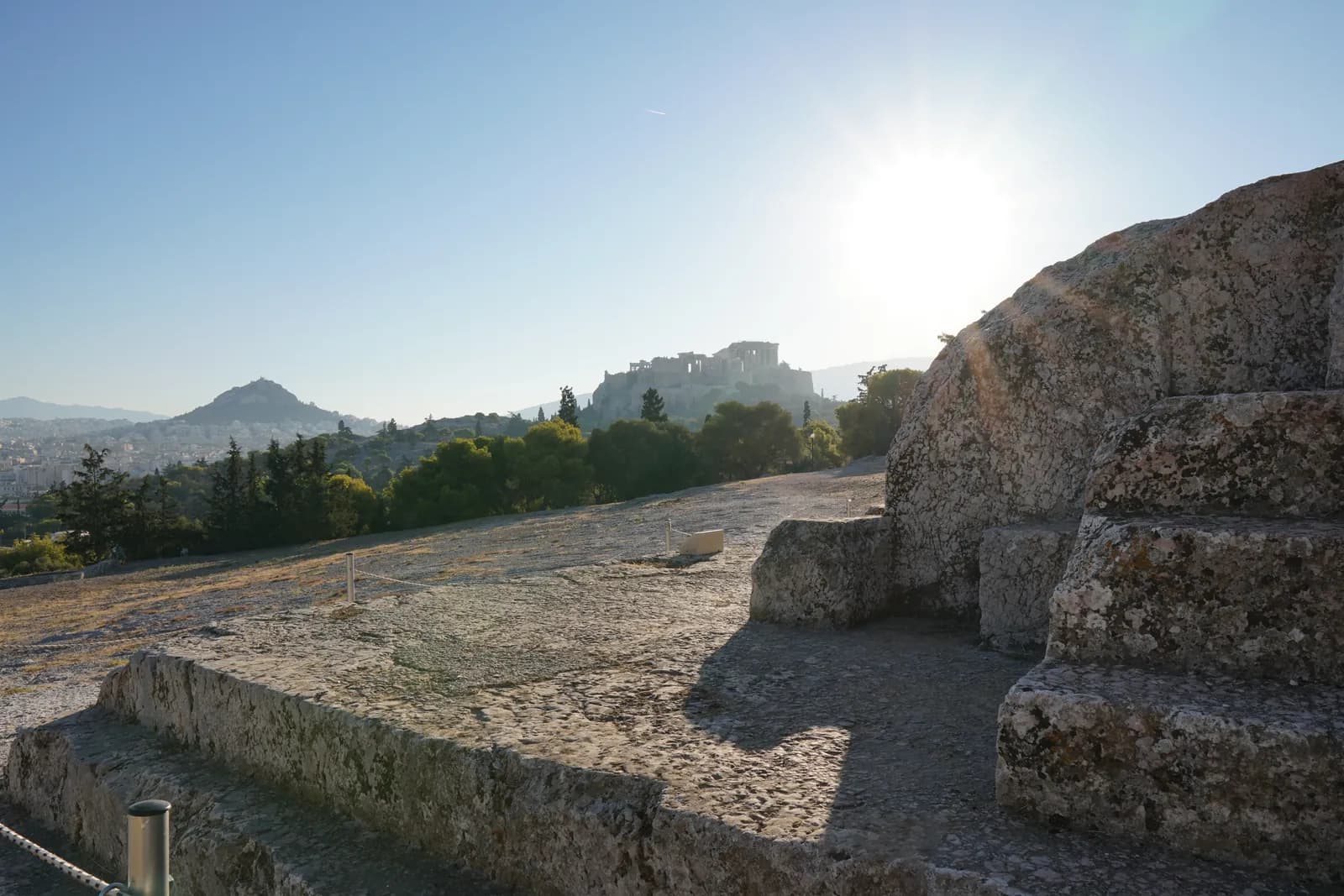
The site and its setting
Athens sits in the Attic plain, ringed by Hymettus, Pentelicus, Parnes and Aigaleos, roughly eight kilometres from the sea. The site's advantages are a defensible limestone outcrop with a spring, good agricultural land around it, silver at Laurion in the south of Attica, and marble on Pentelicus.
The distance from the coast is the fact that shapes the city's later strategy. Athens is not a port; it acquired one, at the Piraeus, and then had to solve the problem of holding the ground between them.
Foundation
Founded by the autochthonous king Cecrops, and named by Athena after her contest with Poseidon.
The foundation story belongs to Athenian civic religion, not to the record. What the archaeology shows is continuous occupation of the Acropolis rock from the Neolithic, with Mycenaean fortification in the Late Bronze Age.
History of the settlement
The Acropolis was a Mycenaean citadel, and stretches of its Bronze Age circuit survive. After the collapse Athens escaped the worst of the disruption, and Attica was unified politically — an event the Athenians attributed to Theseus — at a date that is not recoverable.
The sixth century brought the tyranny of Peisistratus and his sons and a substantial building programme, and then the reforms of Cleisthenes. In 480 BCE the Persians took and burned the city; the Athenians had evacuated. The debris of that destruction was buried on the Acropolis and is the single most useful archaeological deposit in Greek art history, because it seals everything above it as later than 480.
The rebuilding under Pericles produced the classical Acropolis. Athens then lost the Peloponnesian War, was occupied, recovered, lost its independence to Macedon, was sacked by Sulla in 86 BCE, and continued as a university town under Rome with imperial patronage from Hadrian in particular.
Urban plan
Athens was never planned. It grew, and its street pattern is irregular — which the Athenians knew, and which contrasts with the grid Hippodamus laid out at their own port.
The functional division is clear. The Acropolis carried the cults; the Agora below it to the north-west was the civic and commercial centre, with the council house, the law courts, the mint and the stoas; the Kerameikos outside the walls held the principal cemetery and the potters' quarter.
The Themistoclean circuit went up in haste after 480, and the Long Walls, completed by the 450s, ran roughly six kilometres to enclose a corridor to the Piraeus. That corridor made the city a fortified island: as long as the fleet held the sea, Athens could not be starved by an army in Attica. The strategy is Pericles's, and it worked until the plague.
Economy and supply
Silver from the mines at Laurion, worked by very large numbers of enslaved people in conditions that were lethal, funded the fleet and the coinage. The Athenian owl tetradrachm became the most widely accepted coin in the eastern Mediterranean.
Grain came from the Black Sea and had to be convoyed, which is one reason naval supremacy was not optional. Pottery was exported across the Mediterranean, and marble came from Pentelicus, eighteen kilometres away.
Under the empire, tribute from the allied cities paid for the building programme. Plutarch records the political argument that the money was allied money being spent on Athenian ornament, and does not dismiss it.
Cult and sanctuaries
The Acropolis was the sanctuary of Athena Polias, and the Panathenaic festival that culminated there was the city's principal civic-religious event. The olive tree and the salt spring on the rock were shown as the tokens of the contest between Athena and Poseidon.
The Erechtheion housed the oldest and holiest cult image, an olive-wood statue of Athena, and the Parthenon housed Phidias's chryselephantine Athena Parthenos — a dedication rather than a cult statue in the older sense.
Outside the city, Eleusis in western Attica held the Mysteries, and the theatre of Dionysus on the south slope of the Acropolis was a sanctuary before it was a theatre: Athenian drama was performed at a religious festival.
The city at war
Athens fought as a naval power, and the physical evidence of that is at the Piraeus, where the ship sheds at Zea held the trireme fleet and their dimensions constrain what a trireme can have been.
The city's land defences were the Themistoclean circuit and the Long Walls. The demolition of the Long Walls in 404 BCE, to the sound of flute-girls according to Xenophon, was the physical form of the surrender.
Population
Ancient population figures are quoted with a confidence the evidence never supported. Each estimate below carries what it rests on and what it is worth.
Attica, including Athens, on the eve of the Peloponnesian War
Commonly estimated at 250,000–300,000 in total, of whom perhaps 30,000–40,000 were adult male citizens
Modern reconstruction from military strengths in Thucydides, the size of the citizen assembly, and agricultural capacity
No ancient census of Attica survives. The citizen figure is the firmest, because armies and juries were counted; the totals for women, children, metics and the enslaved are extrapolations from ratios that are themselves argued. Estimates of the enslaved population in particular range from roughly 20,000 to over 100,000.
The urban centre itself
Not separately recoverable
No basis exists
Ancient sources count citizens of the polis, which is a political community covering all of Attica, not residents of the town. The population of the built-up area is not something the evidence distinguishes.
Monuments
- Evidence level: Documented
447–432 BCE
The Parthenon
Built under Pericles by Iktinos and Kallikrates with sculptural programme under Phidias. The building accounts were inscribed on stone and partly survive, which makes its construction one of the best-documented in antiquity.
- Evidence level: Documented
c. 421–406 BCE
The Erechtheion
An irregular building because it had to accommodate several older cults on uneven ground. Its Caryatid porch is the best-known element; one Caryatid is in London.
- Evidence level: Documented
437–432 BCE
The Propylaia
The monumental gateway to the Acropolis, by Mnesikles, left unfinished at the outbreak of the Peloponnesian War.
- Evidence level: Documented
c. 449–415 BCE
The Temple of Hephaestus
Overlooking the Agora, and the best-preserved Doric temple anywhere, because it served as a church from the seventh century until 1834.
- Evidence level: Documented
Successive phases from the 6th century BCE
The Theatre of Dionysus
The place where Aeschylus, Sophocles, Euripides and Aristophanes were first performed. The stone structure visible now is substantially later than the classical drama staged there, which is a common and easily missed point.
Archaeology and excavation
The Acropolis was cleared through the nineteenth century by the Greek Archaeological Service, in a process that removed the medieval and Ottoman phases entirely — a loss now regretted. The Agora has been excavated by the American School of Classical Studies since 1931, requiring the demolition of a nineteenth-century neighbourhood; the Stoa of Attalos was reconstructed in the 1950s to house the finds. The Kerameikos has been worked by the German Archaeological Institute.
Athens is the best-documented classical city because excavation has been continuous for nearly two centuries and because inscriptions survive in quantity — building accounts, tribute lists, decrees, casualty lists. The city can be read against its own paperwork to a degree almost nowhere else allows.
Museum collections
Where the finds are now. Where a holding is contested, the entry says so.
Acropolis Museum · Athens
The sculpture from the Acropolis, including the archaic korai from the Persian destruction deposit and the surviving Parthenon frieze blocks held in Greece.
National Archaeological Museum · Athens
The principal collection of Greek antiquities, including material from Attica and the great bronzes.
Museum of the Ancient Agora, Stoa of Attalos · Athens
Finds from the Agora excavations, including ostraka bearing the names of politicians proposed for ostracism, and the bronze allotment machines and jurors' tokens that document how the democracy physically worked.
British Museum · London
Approximately half the surviving Parthenon sculptures, removed by agents of Lord Elgin between 1801 and 1812.
Ownership and return are actively contested between the United Kingdom and Greece. This platform records the dispute and takes no position on it here; the relevant point for a reader is that the sculptural programme is now divided between two cities.
Open questions
How large was the enslaved population of Attica?
Estimates run from around 20,000 to well over 100,000. The high figures derive from a passage in Thucydides about desertions during the Decelean War and from mining-industry requirements; the low ones from agricultural carrying capacity. The disagreement is substantial and matters for almost every quantitative claim about the Athenian economy.
What was the Parthenon frieze depicting?
The traditional reading is the Panathenaic procession. Alternatives have proposed a mythological subject, including the sacrifice of the daughters of Erechtheus. No inscription identifies the subject and the question is open.
Primary sources
Pausanias, Description of Greece 1.1-29
A traveller's account of Athens and Attica in the second century CE, describing monuments many of which no longer stand.
Thucydides, History of the Peloponnesian War 1.89-93, 2.13-17
The building of the walls and the strategy of abandoning Attica for the fortified city.
Aristotle, Constitution of the Athenians
The institutional history, valuable alongside the Agora finds that document the same institutions physically.
Athenian state, Athenian tribute lists IG I³ 259-291
Inscribed records of allied contributions, cut on stone and set up on the Acropolis.
How to read the evidence labels
- Evidence level: Documented
- Supported by a named primary text or by excavated material evidence.
- Evidence level: Probable
- Supported by strong inference that most specialists accept.
- Evidence level: Disputed
- Substantial specialist disagreement exists; competing readings are stated.
- Evidence level: Literary
- Belongs to poetic or mythological construction rather than to history.
- Evidence level: Mythological
- Belongs to shared religious or mythic tradition rather than to any single text.
- Evidence level: Unknown
- The available evidence is insufficient to decide.
These labels describe the status of the evidence, not our confidence in a conclusion. A claim marked Literary is not a claim we doubt; it is a claim about what kind of thing a poem is.