Historical context
The western edge of the Achaemenid empire ran along the Aegean, where the Persian world met the Greek — and that meeting produced both the sources through which the West has always read Persia and the conflict that defined Greek political self-understanding. From Cyrus's conquest of the Ionian Greek cities of Anatolia around 546 BCE to Alexander's destruction of the empire in 330, the Persian-Greek frontier was the most consequential borderland in the ancient world. The platform reads this hub as the place where Persia is most visible to us and most distorted — the zone of encounter that generated Herodotus, the Persian Wars, and the long Western image of "the East."
Political structure
On the frontier the Achaemenid political order took a distinctive form. The Greek cities of Ionia were governed as imperial subjects, often through local tyrants installed and backed by the Persian satrap at Sardis — a workable arrangement that nonetheless generated the resentment behind the Ionian Revolt of 499–494 BCE. The satraps of Anatolia governed a true borderland: cities that were sometimes subjects, sometimes allies, sometimes in revolt, managed by a mixture of force, money and the manipulation of local rivalries. This was imperial politics conducted at the negotiated margin rather than the administered core.
Administrative structure
The western satrapies — Lydia, with its seat at Sardis, and Hellespontine Phrygia — were the empire's interface with the Greek world, and the Royal Road terminated at Sardis precisely because this was the frontier the centre most needed to reach quickly. The satraps here disposed of large revenues and, increasingly in the fourth century, used them as instruments of policy — funding Greek cities and factions against one another. The platform reads this under empire and diversity: on the western frontier the Achaemenid system's tolerance of local forms shaded into active management of a fractious Greek political world the empire never fully absorbed but learned to steer.
Military organisation
The frontier is where the Achaemenid army's strengths and limits both show. The great invasions — Darius's expedition that ended at Marathon in 490 BCE, and Xerxes's vast amphibious campaign of 480–479 that broke at Salamis and Plataea — were the most ambitious projections of imperial force the ancient world had seen, and they failed at the limits of logistics and the edge of the empire's reach rather than from any weakness at its core. The platform reads the Persian Wars from the imperial side: not the verdict on Persia that the Greek tradition made them, but the discovery of how far force could be projected across water against a hostile alliance on its home ground.
Roads and communication
The communication system that bound the empire reached its western terminus here, and the frontier shows both its power and its strain. Sardis was days from Susa by the royal post, which let the centre respond to Aegean crises with a speed the Greeks could not match politically. But the Aegean itself — the sea, the islands, the divided Greek cities — lay beyond the reach of the road-and-relay system that worked so well on land, and that gap is part of why the empire could dominate the Anatolian coast yet never securely hold the Greek mainland.
Relationship to local peoples
The Greek case is the great exception to the Achaemenid policy of governing through accommodated local order. Elsewhere the policy bound subjects in; in the Greek world it generated the Ionian Revolt and a century of intermittent conflict. The platform reads this not as a failure of the policy but as a limit of it: the fiercely autonomous Greek polis, with its ideology of citizen self-government, was the one kind of subject the Achaemenid system of layered local order struggled to digest — which is exactly why the Greeks became the empire's defining adversaries and its principal chroniclers.
Religion and governance
The frontier is also where the ideological contrast was sharpest. The Greek tradition cast the wars as a struggle between free men governing themselves and the "slaves" of an Eastern despot — a religious-political framing (Aeschylus's Persians, Herodotus's free-versus-tyranny structure) that owes more to Greek self-definition than to Achaemenid reality. The platform reads this under Persia through Greek eyes: the "Oriental despotism" that became a permanent Western category was manufactured on this frontier, out of a real conflict, by the side that lost the battles of conquest but won the battle of the record.
Architecture and symbolism
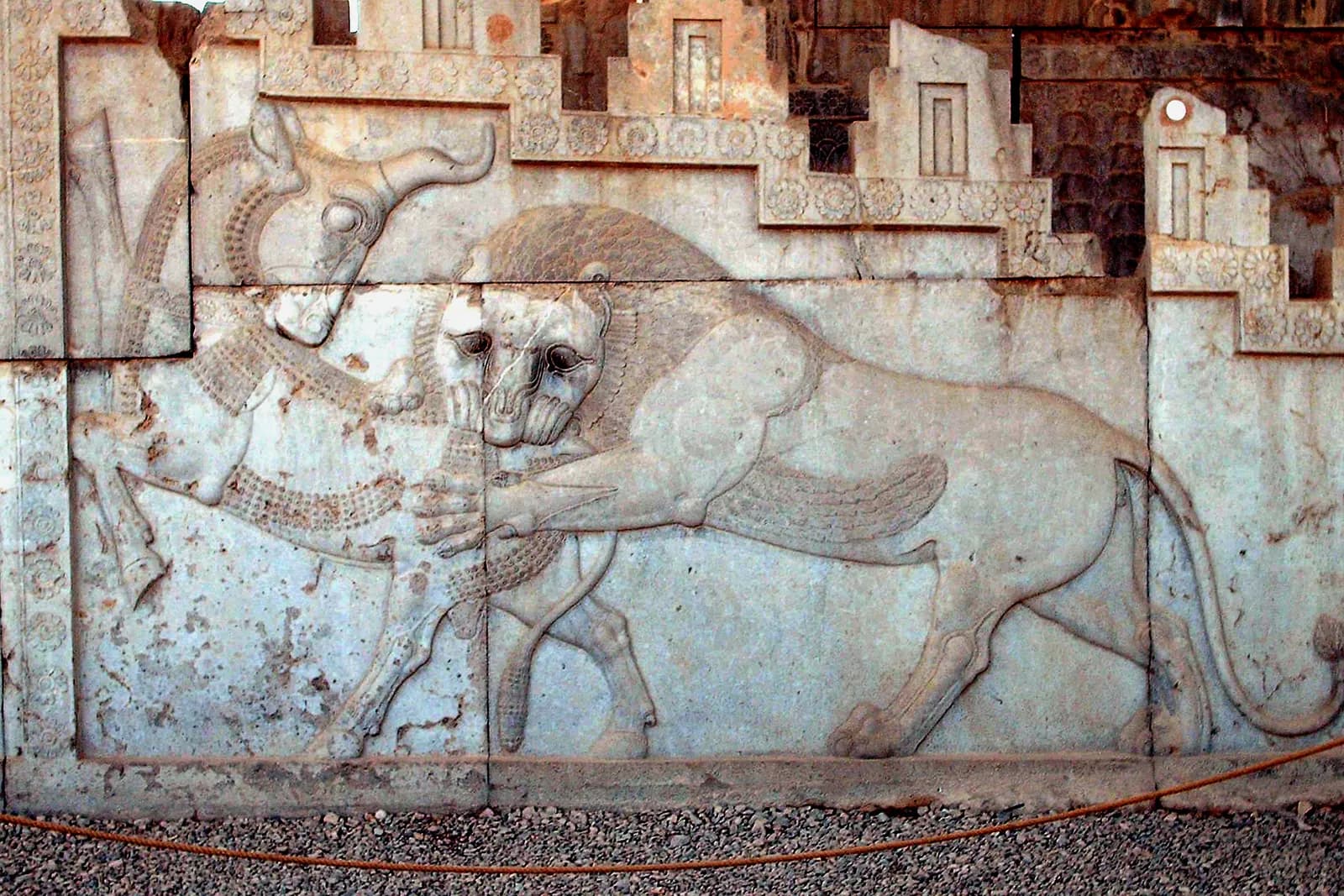
The symbolic record of the encounter survives on both sides. On the Persian side, the Apadana tribute relief at Persepolis includes delegations of Ionians and Lydians among the subject peoples — the Greek world represented as one province among many in the imperial order. On the Greek side, the very category of "the barbarian," the art of the Persian Wars memorials, and the historical writing of Herodotus are monuments to the encounter. The platform reads the two symbolic records against each other: to Persia the Greeks were a frontier people; to the Greeks, Persia was the defining Other.
Decline and transformation
The frontier story ends with its reversal. In the fourth century the empire managed the Greek world successfully by diplomacy and money under Artaxerxes I and his successors — and then, in a single generation, Alexander crossed the frontier the other way and destroyed the empire. The platform reads Alexander and the Persian inheritance: the Macedonian conqueror took over the Achaemenid system almost intact, married the Persian and Greek worlds by design, and so turned the long frontier conflict into the Hellenistic fusion the platform reads on the Hellenistic World hub.
Why this civilization matters
The platform reads Persia and the Mediterranean because it is where the three civilizational pillars meet — where Persia and Greece collided and where the collision produced both the sources we read Persia through and the categories ("East" and "West," freedom and despotism, citizen and subject) that the Western tradition has used ever since. Reading this frontier honestly — using the Greek sources while seeing through their frame — is the discipline that lets Persia stand as a civilization in its own right rather than as the Greeks' foil. It is the hub where the platform most directly does the work of balancing the record.