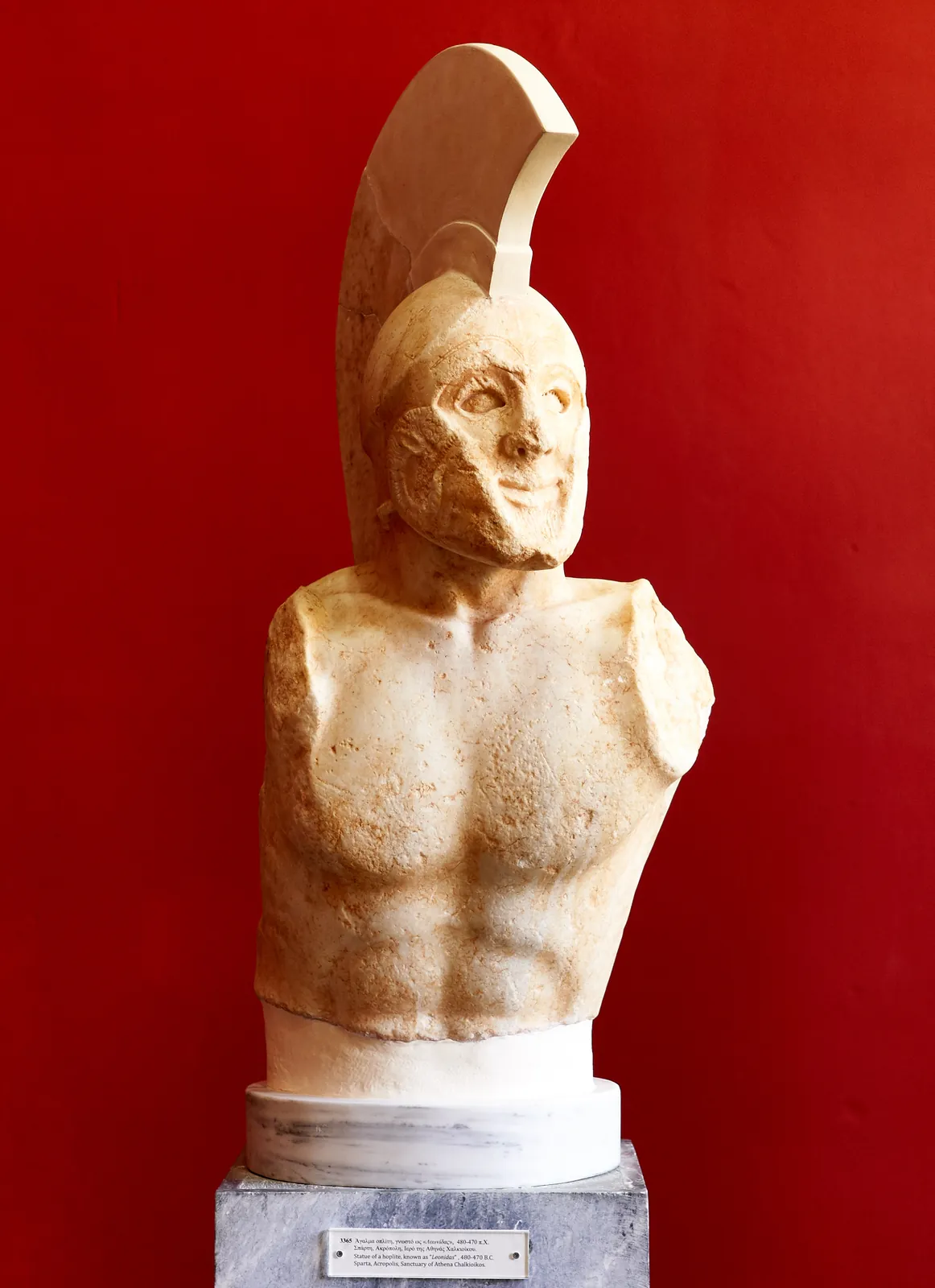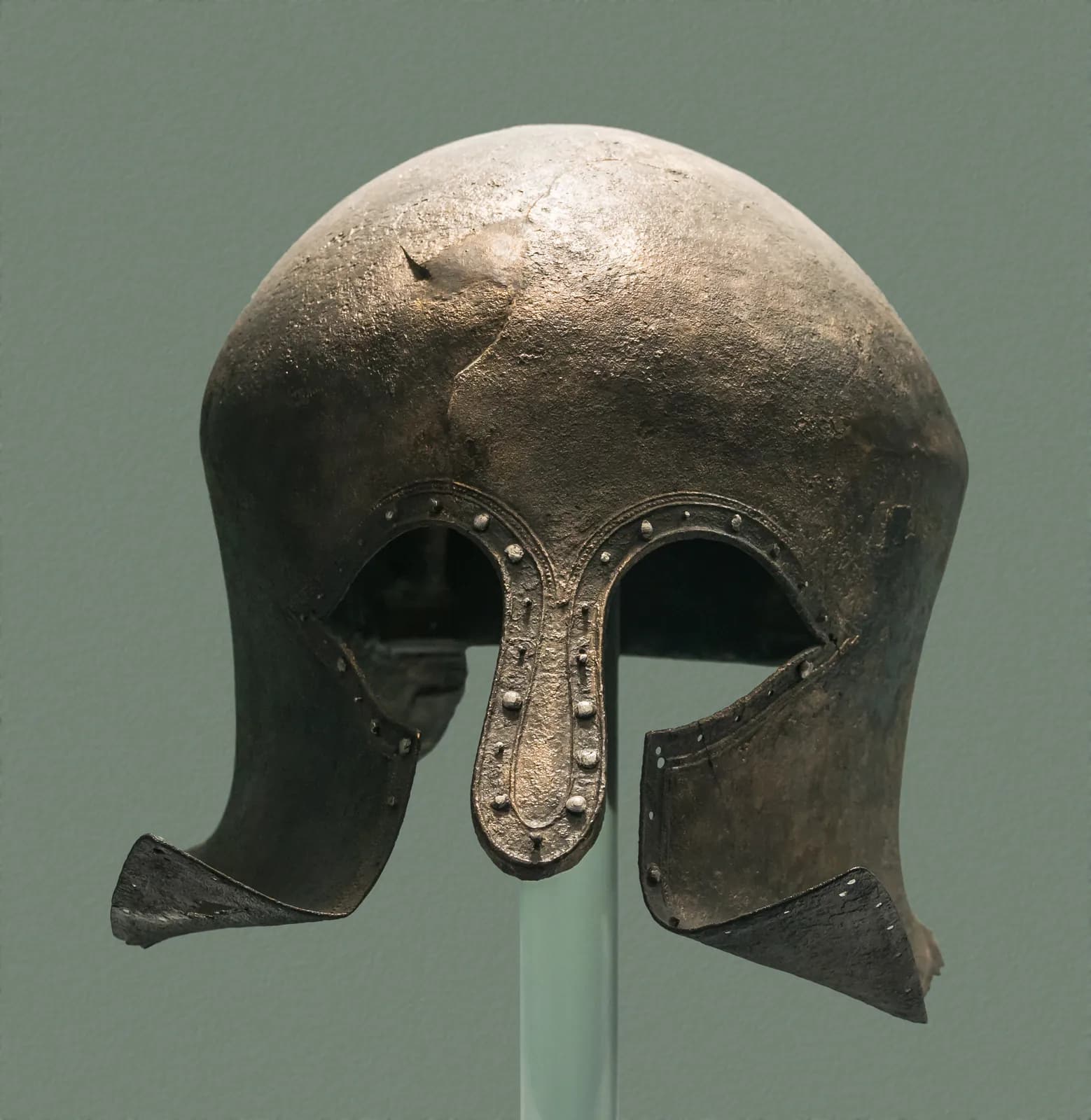
This page is about Sparta as a polity — the constitution, the helot order, the citizen body. For the physical site in the Eurotas valley, its sanctuaries and the excavation record, see Sparta, the ancient city.
How the polity read itself
Sparta read itself through eunomia — the condition of being well-ordered by law. The constitutional order the Lacedaemonian citizen body accepted as binding was, in the Spartan self-understanding, the working instrument by which the citizen became what a citizen could be. The Lycurgan tradition the Spartans inherited and continued to perform across centuries was not nostalgia for a founding moment; it was the daily working substrate of how Spartan life was conducted.
The principal surviving sources for the polity are external — Greek and Roman writers who came to Sparta as visitors, or who wrote about it from elsewhere. Xenophon's Constitution of the Lacedaemonians (written from inside an admiring exile in the Peloponnese, c. 380s BCE) is the most considered single source; Plutarch's Life of Lycurgus (c. 100 CE) is the most elaborated; Aristotle's Politics II.9 is the most critical; Thucydides records what he had to record about Sparta during the Peloponnesian War. The Spartans themselves wrote little that survives. The platform reads Sparta with this asymmetry in view.
Political structure
The Spartan constitution was a mixed one, in the working ancient sense — combining monarchic, aristocratic and democratic elements distributed across distinct institutions. The five working organs:
- Two hereditary kings (the Agiad and Eurypontid lines), each with limited but real executive and especially military authority. The dual kingship was a stabilising feature: a single king could be checked by his colleague, and the succession crises that broke other ancient monarchies were attenuated.
- The Gerousia, a council of twenty-eight elders aged sixty or more, elected for life from the leading Lacedaemonian families. The Gerousia prepared major business and held judicial authority on capital cases.
- The Apella, the assembly of the Spartiate citizen body, ratified or rejected business prepared by the Gerousia but did not amend it (Spartan deliberation was structurally not the running argument that Athenian deliberation was).
- The Ephorate, five officials elected annually from the citizen body. The ephors held the principal executive authority over the day-to-day running of the state and the oversight of the kings. The ephorate was the democratic element of the constitution and the working political centre of the Lacedaemonian state from the seventh century BCE onward.
- The agōgē, the inherited educational system that produced the Spartiate citizen. The agōgē is not a magistracy but it was constitutionally load-bearing — the conditions of citizenship required successful passage through it.
The constitution held — with the inevitable working drift — for approximately four hundred years. Aristotle in Politics II.9 reads it as the most stable Greek constitutional form he had access to, and as an order whose structural problems (the rigidity of the citizen body, the demographic contraction the system tolerated, the unaccountability of certain magistracies) would eventually break it.
Military structure
The Spartan citizen-soldier order was the working instrument of the polity's external position. The Lacedaemonian phalanx was the most disciplined ancient Greek infantry force on record — better drilled, more cohesive in formation, and more willing to hold ground under casualty pressure than any other Greek hoplite force of the classical period. The military reputation the Spartans built across the sixth and fifth centuries BCE — Thermopylae in 480, the Persian war contributions, the Peloponnesian War campaigns culminating in the victory at Aegospotami in 405 — was earned and was disproportionate to the small size of the citizen body.
The constitutional form was the military form. The Spartan citizen was structurally a soldier; civilian life in the Athenian sense was not part of the form. The syssitia (common messes), the agōgē, the krypteia, the constant training and inspection — these were not occasional adjuncts to a separate civic life; they were the civic life. The platform reads this without romanticising it: the arrangement produced unusual military quality and unusual internal solidarity, and it also produced a polity that could not adapt structurally when its conditions changed.
The helot order — and what it carried
The Spartan polity's working stability was inseparable from the structural subjection of the helot population. The helots — the conquered Messenian and Laconian populations, held as state-owned agricultural labour bound to the land — were the working substrate of the Spartiate citizen's freedom to be a full-time soldier. The Spartiate citizen body itself, at its working peak, was perhaps eight to nine thousand. The helot population was several times that — possibly an order of magnitude larger.
The polity managed this structural imbalance through specific working instruments. The annual declaration of war on the helots by the ephors (recorded by Aristotle in Politics II.9 and by Plutarch in Lycurgus 28) gave Spartan magistrates the legal right to kill helots without judicial process. The krypteia — the periodic Spartan paramilitary practice of sending young men into helot territory to ambush and kill selected helot leaders — was the working enforcement instrument. The constant Spartan readiness for helot revolt shaped both the army's home posture and the constitutional form's reluctance to send major forces far from home.
The platform reads Sparta with this fact placed at the centre, not at the margin. The constitutional achievements were real; they were also, structurally, achievements paid for by a specific working subjection. The two facts go together.
What the polity could not do
The structural fragility was demographic. Spartiate citizenship was bounded by property qualification (the citizen had to maintain his land allotment and his contribution to the common messes) and by the agōgē requirement. The system did not permit easy admission of new citizens, and it tolerated the slow contraction of the citizen body without expanding the qualifying conditions. By the early fourth century BCE the Spartiate population had contracted from perhaps nine thousand to perhaps a thousand to twelve hundred. The polity that defeated Athens in 404 could no longer field its own infantry forces a generation later. The defeat at Leuctra in 371 to the Theban Sacred Band under Epaminondas, and the loss of Messenia (and therefore of the helot agricultural base) in 369, ended Sparta's role as a major Greek power.
The polity continued, in reduced form, until Roman intervention in the second century BCE. The agōgē was revived in late-Hellenistic and Roman-period Sparta as a tourist-historical performance — a working ancient case of the political form outlasting its political substance, which the platform's reading of Tacitus and the Roman Principate will recognise.
Why later civilizations studied Sparta
The European tradition's reading of Sparta has been intense and divided. The Renaissance and early-modern European republican tradition (Machiavelli's Discorsi, Rousseau's Social Contract, the English commonwealth writers) read Sparta as the working ancient case of constitutional durability and civic discipline. The eighteenth- and nineteenth-century French and German republican traditions sometimes elevated Sparta past the point the working sources support. The twentieth-century reception has been more critical, partly because the twentieth century's experience of disciplined collectivisms made the Spartan case look different.
The platform reads Sparta as one of the two principal Greek constitutional experiments (Athens being the other), as the ancient case of an integrated military-civic discipline, and as the polity whose specific structural costs — the helot subjection, the demographic rigidity, the long inability to adapt — are part of the working reading. The historiographical counterpoint to the inherited admiration is not a counter- romance. It is the work of placing the costs at the centre.
Why the platform reads Sparta
The platform reads Sparta because the constitutional question it puts — can a polity be ordered around civic discipline at the cost of nearly everything else, and what does the order produce and require — is one no later political tradition has been able to dispense with. The Spartan answer is not the only possible answer. It is the most fully elaborated ancient one in its specific direction, and the European tradition has continued to read it seriously, without and against the simplifying readings, for two and a half thousand years.