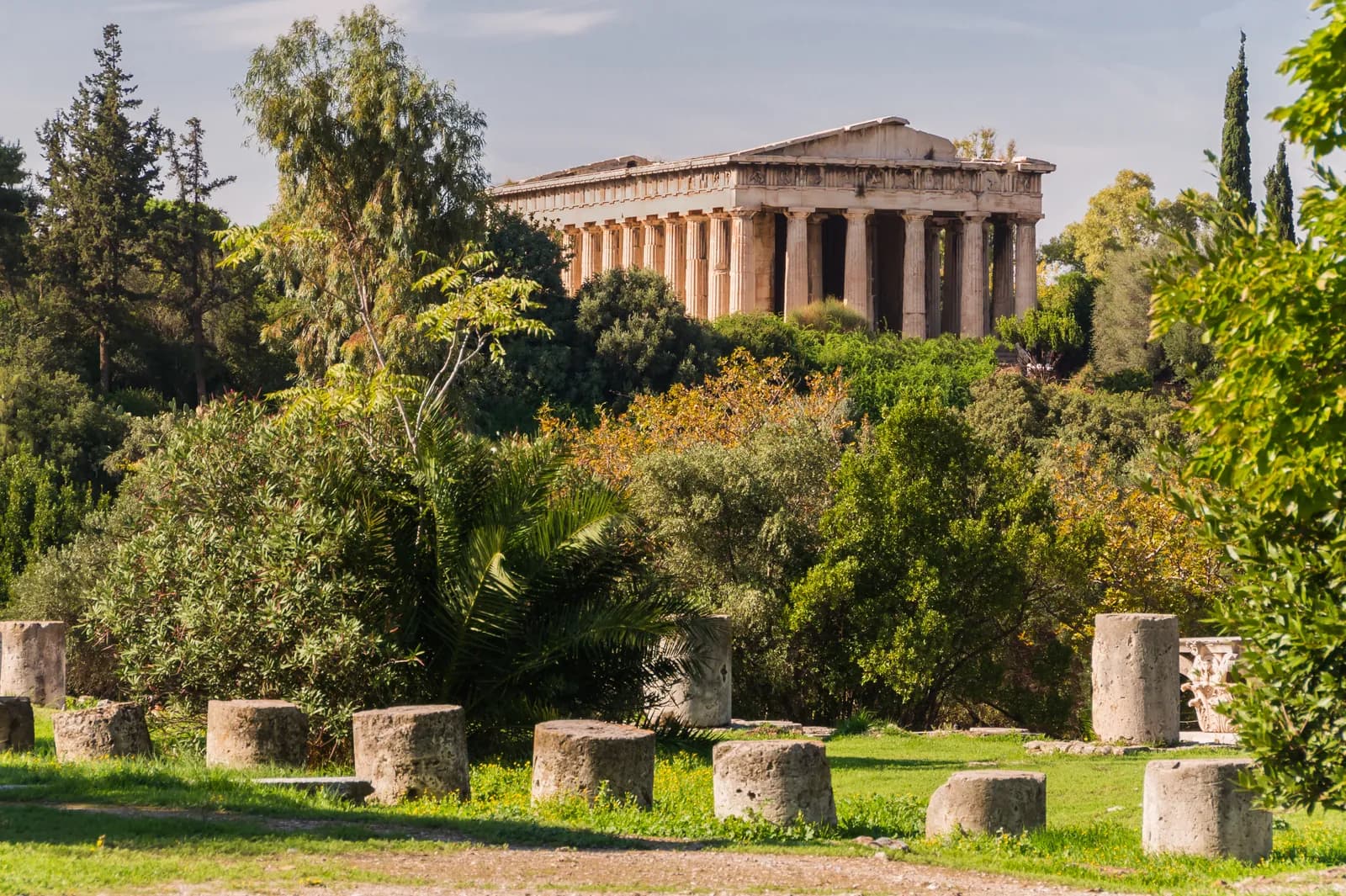
What it is
The Temple of Hephaestus — the metalworking quarter it served, the garden excavated around it, the medieval misnaming as the Theseion, and why its roof is still on.
Built Begun c. 449 BCE, cult statues installed c. 421–415. The principal date, c. 449–415 BCE, is approximate.
c. 449–440 BCE
Construction
Begun around the middle of the century, on the low hill west of the square. Dated by style and by the sequence of related buildings; there are no surviving building accounts as there are for the Parthenon.
c. 421–415 BCE
The cult statues
Bronze statues of Hephaestus and Athena by Alkamenes, recorded in the building accounts of that period — an installation a generation after the building went up.
3rd century BCE
The garden
A formal planting laid out around three sides of the temple, in rows of pits cut into the rock with pots sunk in them. Excavation recovered the pits and the pots.
c. 7th century – 1834
Church of St George
Converted, with an apse cut into the east end and a barrel vault built inside. This is why the roof, the walls and the colonnades all survive.
Who ordered it built
Each attribution carries what supports it. Ancient buildings are routinely credited to people on the authority of writers centuries later, and that is not the same claim as an inscription on the building.
- Evidence level: Unknown
Architect
Unknown
No ancient source names one. Modern scholarship groups this temple with those at Sounion, Rhamnous and Oropos as the work of one designer, referred to as the Theseum Architect — a modern label for an anonymous hand, not a name.
- Evidence level: Documented
Sculptor
Alkamenes
The building accounts for the cult statues name him, and Pausanias 1.14.6 describes the group of Hephaestus and Athena in the temple.
What it was for
A temple of Hephaestus and Athena Ergane — the god of the forge and the goddess of craft — standing directly above the quarter where Athens's metalworkers and potters worked. Excavation of the surrounding blocks has produced bronze-casting debris and workshop material, so the placement is not symbolic.
That a democracy built a major marble temple to the patrons of manual craft, overlooking the workshops, is a fact worth more than most general statements about Athenian attitudes to labour.
How it was built
A standard Doric peripteral temple, smaller than the Parthenon and less refined, with the same optical corrections applied more sparingly. Its interest is not innovation but completeness: every element of the type is present and in place, which makes it the reference building for what a Greek temple actually was.
The sculpture is concentrated at the east end, where it would be seen from the square: ten metopes of the labours of Herakles on the front and four on each flank showing deeds of Theseus, with the rest left plain. That is a budget decision made visible.
The interior carries a Doric colonnade returning behind the cult statues, and an Ionic frieze across the porches — the same mixing of orders the Parthenon uses.
Materials
- Evidence level: Documented
Pentelic marble
The superstructure
- Evidence level: Documented
Parian marble
The sculpture
- Evidence level: Documented
Limestone
The foundations and the lowest step
Measured
Every figure states what it rests on. A modern survey, an ancient text, a conversion from an ancient unit and a modern estimate are four different kinds of statement and are not interchangeable.
Stylobate
about 31.8 × 13.7 m
Modern survey.
Columns
6 by 13, about 5.7 m tall
Modern survey.
What it meant
The Theseus metopes are why the building was called the Theseion for a thousand years, on the mistaken belief that it was the hero's shrine. The real Theseion was elsewhere in the city and has never been found.
The temple stands on the edge of the square where the democracy operated, above the workshops, facing the buildings of the council and the courts. The Acropolis programme is about Athens addressing the gods; this building is about the city's working life addressing them.
Hephaestus and Athena Ergane together are the craft pairing, and the Chalkeia festival honoured them jointly. The bronze cult group by Alkamenes showed both standing.
After antiquity
Converted into the church of St George Akamates, probably in the seventh century. The east wall was pierced for an apse and a masonry vault was built inside; otherwise the ancient fabric was left alone.
Used as a burial place for Protestants and foreigners in Athens from the seventeenth century, including a number of travellers and diplomats.
From 1834 to 1874 it served as the first national archaeological museum of the new Greek state, which is a second reason it was maintained rather than quarried. The interior vault was removed in the twentieth century.
Condition today
Standing
The most completely preserved Greek temple in existence: colonnades, walls, entablature, pediments and roof all in place. The pedimental sculpture is gone and the interior was altered by the church.
The American excavation of the Agora recovered the third-century BCE garden: rows of rock-cut pits along the north, south and west sides, with flowerpots still in several of them, arranged around the temple in a formal planting.
Bronze-working debris and workshop material from the surrounding blocks confirms that the metalworking quarter was where the dedication implies it should be.
Written about in antiquity
Pausanias, Description of Greece 1.14.6
Pausanias on the temple above the Kerameikos, the standing statues of Hephaestus and Athena with grey eyes, and the local story attached to them.
The building accounts for the cult statues IG I³ 472
Athenian public accounts for the bronze group, naming the sculptor and dating the installation to a generation after the temple was built.
Still argued
When exactly was it built?
Dates from about 460 to about 440 BCE have been argued, on the evidence of style, of the pottery in the foundation fill, and of the temple's relationship to the Parthenon. There are no building accounts for the architecture itself, and the twenty-year range is a real uncertainty about the best-preserved Greek temple there is.
How to read the evidence labels
- Evidence level: Documented
- Supported by a named primary text or by excavated material evidence.
- Evidence level: Probable
- Supported by strong inference that most specialists accept.
- Evidence level: Disputed
- Substantial specialist disagreement exists; competing readings are stated.
- Evidence level: Literary
- Belongs to poetic or mythological construction rather than to history.
- Evidence level: Mythological
- Belongs to shared religious or mythic tradition rather than to any single text.
- Evidence level: Unknown
- The available evidence is insufficient to decide.
These labels describe the status of the evidence, not our confidence in a conclusion. A claim marked Literary is not a claim we doubt; it is a claim about what kind of thing a poem is.