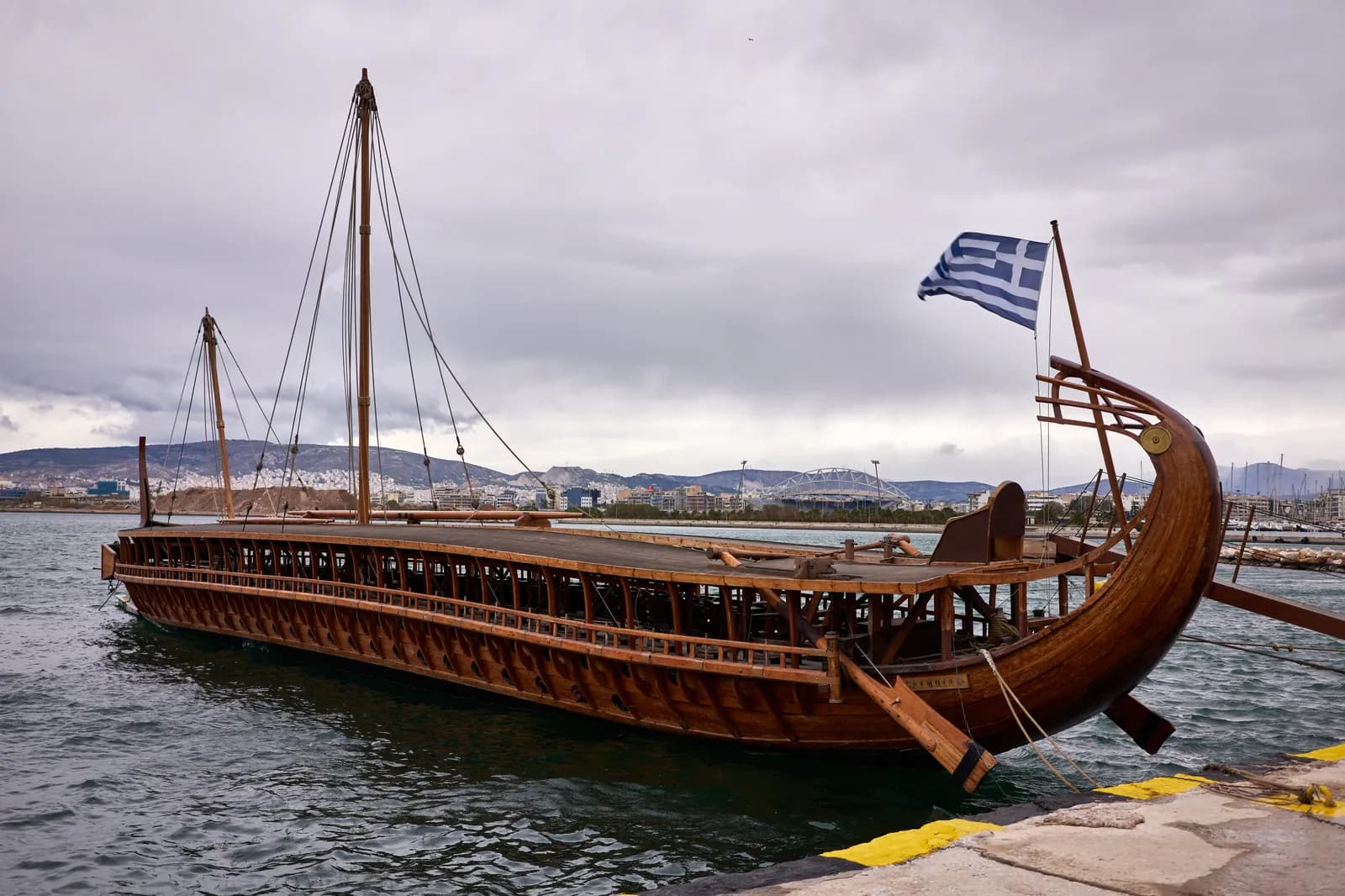
A trireme was long, narrow and light: roughly 37 metres by 5, built shell-first with mortise-and-tenon joinery, and driven by 170 oarsmen seated on three levels. It carried a small deck complement and a bronze-sheathed ram at the waterline, which was its weapon.
It was not a troop transport with oars. It was a projectile. Its purpose was to strike an enemy hull at speed and open it, and the skills that mattered were manoeuvre and the coordination of 170 rowers who could not see the water. Trireme fleets could not stay at sea: the ships had no space for stores or sleeping, and beached nightly.
The type is unusually well understood because of an experiment. The reconstruction Olympias, built in the 1980s and rowed by volunteer crews, demonstrated that the three-level arrangement works, established achievable speeds, and exposed how tight the interior is. It also failed to reproduce the highest speeds the ancient sources imply, and the reasons are still argued.
What the evidence supports
The crew numbered around 200, of whom 170 rowed.
The figure is attested in inscriptions and narrative and is confirmed as workable by the reconstruction.
Athenian naval records survive on stone.
The naval inventories from the Piraeus dockyards list ships, gear and condition — among the most detailed administrative documents of any ancient navy.
The trireme's top speed under oar is disputed.
Olympias achieved around 9 knots in bursts; the passage times implied by Thucydides suggest better. Whether the shortfall is a matter of hull form, crew training or reconstruction detail is unresolved.
Terms
- thranite, zygite, thalamite
- The three levels of oarsmen, from top to bottom. Thranites were paid most and worked hardest.
- embolon
- The ram: a bronze-sheathed timber projection at the waterline.
- diekplous
- A manoeuvre of breaking through an enemy line to strike from behind.
Archaeology
The Athlit ram, a bronze warship ram recovered off the Israeli coast, is the principal surviving example of the weapon. Ship sheds at Zea in the Piraeus give the dimensions the hulls had to fit. No trireme hull has been found.
Primary sources
Thucydides, History of the Peloponnesian War 1.49, 7.36-41
Trireme tactics and their adaptation in the confined waters of the Great Harbour at Syracuse.
Athenian dockyard officials, Athenian naval inventories IG II² 1604-1632
Dockyard records listing ships and equipment by name and condition.
The Old Oligarch, Constitution of the Athenians 1.2
On the political weight of the rowing population.
Battles
480 BCE
Salamis
A naval battle fought in the straits between Attica and the island of Salamis, and the engagement that broke the Persian campaign.
31 BCE
Actium
A naval battle off western Greece that ended the civil wars, delivered the Roman world to Octavian, and was immediately rewritten by the winner.
How to read the evidence labels
- Evidence level: Documented
- Supported by a named primary text or by excavated material evidence.
- Evidence level: Probable
- Supported by strong inference that most specialists accept.
- Evidence level: Disputed
- Substantial specialist disagreement exists; competing readings are stated.
- Evidence level: Literary
- Belongs to poetic or mythological construction rather than to history.
- Evidence level: Mythological
- Belongs to shared religious or mythic tradition rather than to any single text.
- Evidence level: Unknown
- The available evidence is insufficient to decide.
These labels describe the status of the evidence, not our confidence in a conclusion. A claim marked Literary is not a claim we doubt; it is a claim about what kind of thing a poem is.