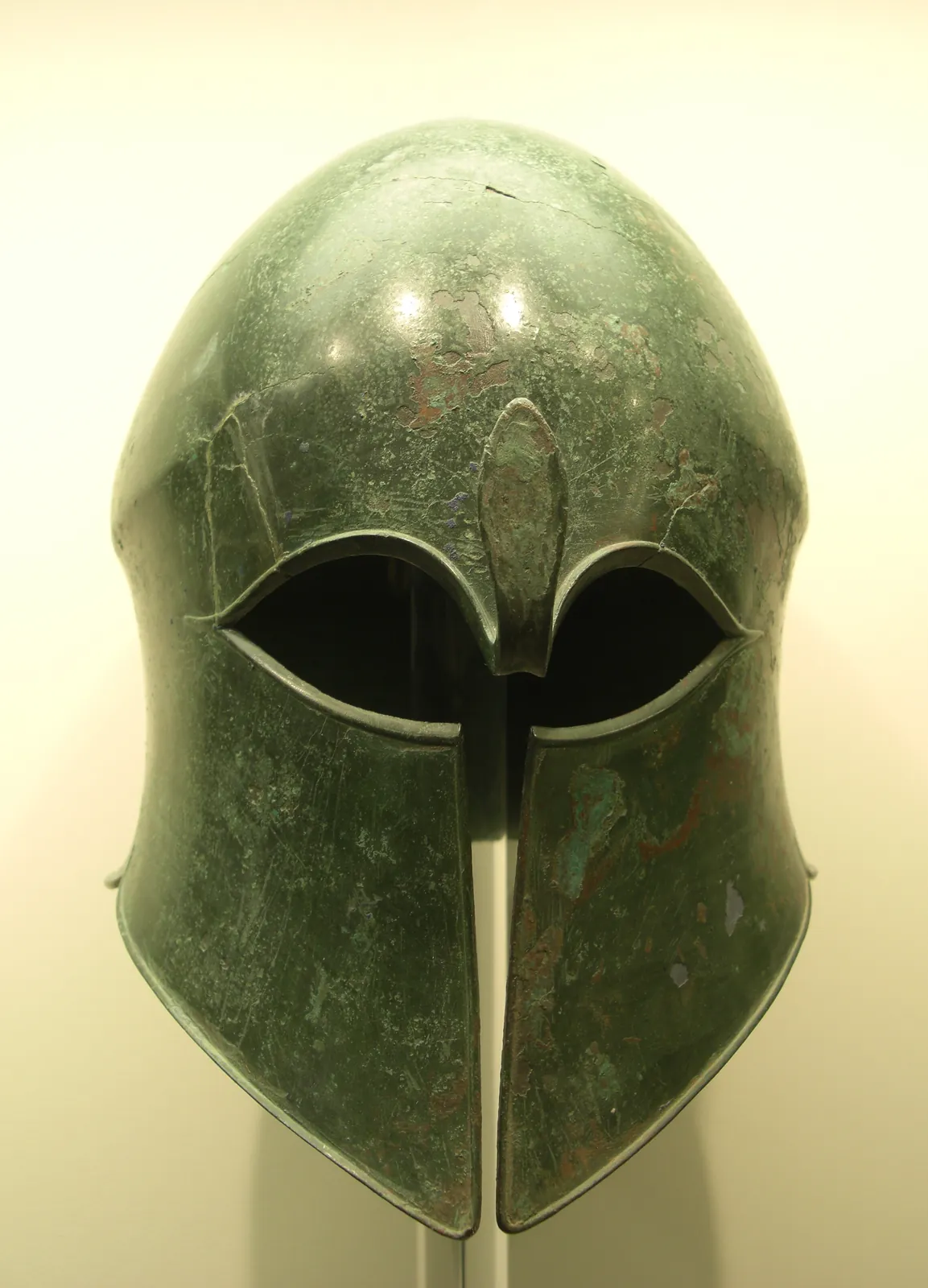
Greek warfare is inseparable from Greek politics, and the connection runs in both directions. The characteristic Greek soldier was a citizen who bought his own equipment, which made military capacity a function of property, and made the composition of the army an argument about who the community was.
The classical pattern — heavy infantry in close order, decided in a single collision on level ground — held for roughly two centuries and then broke down. The Peloponnesian War made siege, raiding, light troops and sea power decisive; the fourth century added professional generalship, mercenaries and the tactical innovations of Thebes; and Macedon combined pikemen and heavy cavalry into a system that neither city-states nor Persia could match.
Much of what is confidently said about how Greek battle actually worked is reconstruction from a small number of literary passages, and the reconstructions disagree with each other. The pages in this section say which parts are documented and which are inference.
What the evidence supports
The hoplite fought as a citizen who equipped himself.
Property qualifications for military service are attested across Greek states, and Aristotle connects the rise of hoplite armies to the political weight of the middling propertied class.
Naval power reshaped Athenian politics.
The trireme was rowed by citizens too poor to arm themselves as hoplites, and the fleet's importance became an argument for their political weight. The link is made explicitly by ancient writers hostile to the democracy.
The mechanics of hoplite collision are not settled.
Whether othismos, the 'push', describes literal massed shoving or a metaphor for pressure is one of the longest-running disputes in Greek military history.
Primary sources
Thucydides, History of the Peloponnesian War
The fullest contemporary account of Greek warfare in practice.
Xenophon, Hellenica
A continuation covering the fourth-century transformation, by a professional soldier.
Aristotle, Politics 1297b
On the relation between military service, property and constitution.
Battles
490 BCE
Marathon
An Athenian and Plataean hoplite force defeated a Persian expedition on the coast of Attica, and the Greek world learned that a Persian army could be beaten.
480 BCE
Thermopylae
A Greek force held a coastal pass in central Greece for three days against the army of Xerxes, and was destroyed when the position was turned by a mountain path.
480 BCE
Salamis
A naval battle fought in the straits between Attica and the island of Salamis, and the engagement that broke the Persian campaign.
479 BCE
Plataea
The largest hoplite battle of the Persian Wars, which destroyed the Persian field army in Greece and ended the invasion.
371 BCE
Leuctra
A Theban army under Epaminondas broke the Spartan phalanx in open battle, and with it the assumption that Spartan infantry could not be beaten.
362 BCE
Mantinea (362 BCE)
The largest hoplite battle fought between Greek states, won by Thebes and rendered indecisive by the death of the commander who won it.
338 BCE
Chaeronea
Philip II defeated the combined armies of Athens and Thebes, ending the independence of the Greek city-states as a system of competing powers.
How to read the evidence labels
- Evidence level: Documented
- Supported by a named primary text or by excavated material evidence.
- Evidence level: Probable
- Supported by strong inference that most specialists accept.
- Evidence level: Disputed
- Substantial specialist disagreement exists; competing readings are stated.
- Evidence level: Literary
- Belongs to poetic or mythological construction rather than to history.
- Evidence level: Mythological
- Belongs to shared religious or mythic tradition rather than to any single text.
- Evidence level: Unknown
- The available evidence is insufficient to decide.
These labels describe the status of the evidence, not our confidence in a conclusion. A claim marked Literary is not a claim we doubt; it is a claim about what kind of thing a poem is.