What happened
Athens and Thebes, long enemies, allied against Macedonian expansion into central Greece and took position across the plain at Chaeronea.
The ancient accounts are thin on the fighting. Diodorus reports that the eighteen-year-old Alexander commanded the Macedonian left, opposite the Sacred Band, and was the first to break the line facing him.
A tradition preserved in Polyaenus has Philip's right wing execute a feigned withdrawal that drew the Athenians forward and opened a gap in the allied line. The manoeuvre is plausible and is not attested by a contemporary.
The Sacred Band was surrounded and destroyed. Athenian losses were heavy, and a substantial number were taken prisoner and later released.
Tactics
Chaeronea is the demonstration of the Macedonian combined-arms system: a phalanx of pikemen able to fix an enemy line in place, and heavy cavalry able to exploit any gap that opened. The phalanx does not win the battle; it holds the enemy while the cavalry decides it. This is the system Alexander took into Asia four years later.
Consequence
Philip imposed the League of Corinth, which bound the Greek states to Macedon and to a projected war against Persia. Thebes was garrisoned; Athens was treated leniently. The classical city-state continued to exist and stopped being able to conduct an independent foreign policy.
Location
The plain of Chaeronea in western Boeotia
Modern: Chaironeia, Boeotia, Greece
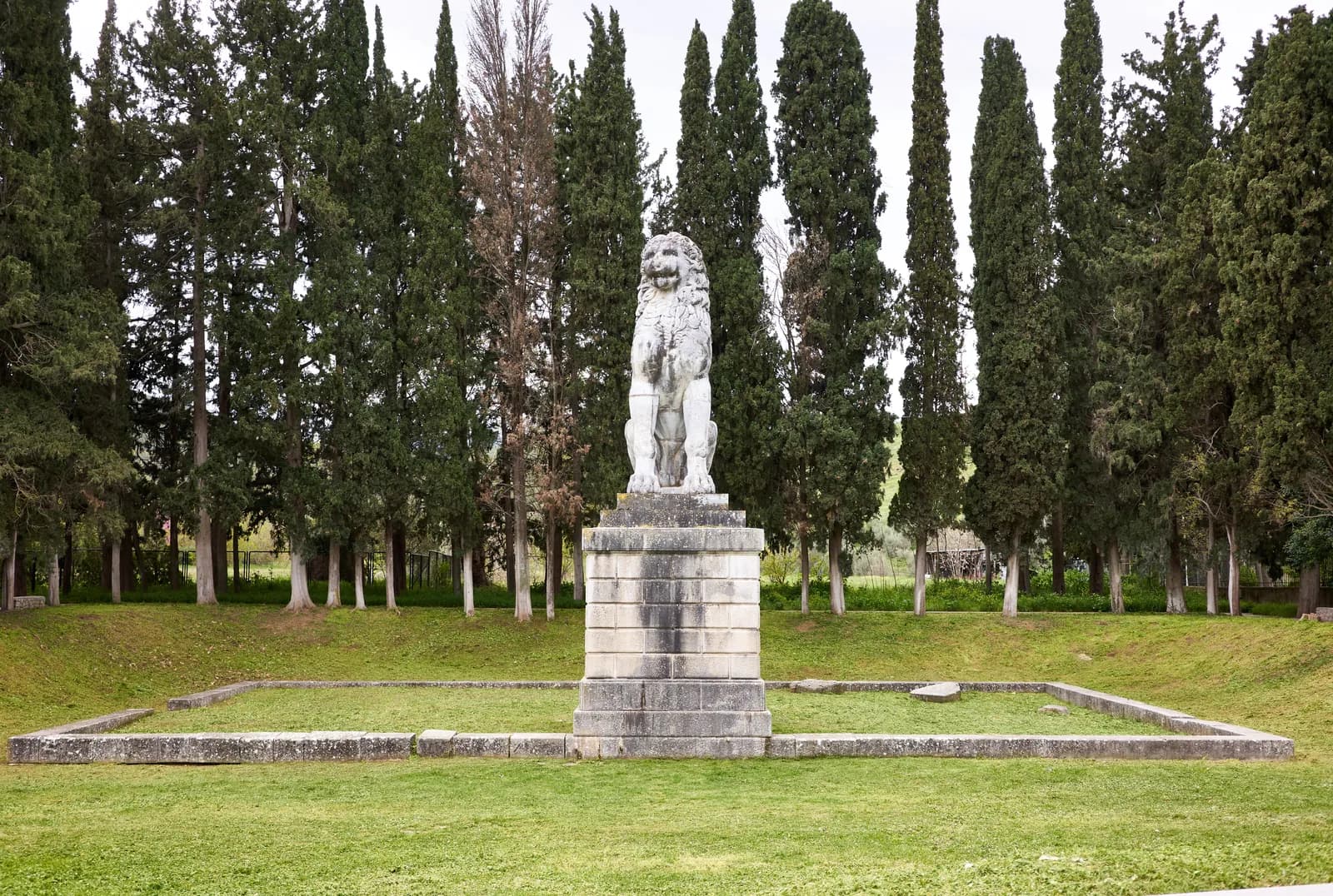
The site is secure and marked by the Lion of Chaeronea, a funerary monument raised over a mass grave on the field.
Archaeology
The Lion of Chaeronea, a monumental stone lion raised over a mass grave on the battlefield, was rediscovered in the nineteenth century and re-erected. Excavation beneath it recovered 254 skeletons laid out in rows. The monument's association with the battle is secure; its specific identification as the grave of the Sacred Band rests on Plutarch and on the arrangement of the burials.
Open questions
Did Philip's right wing execute a feigned retreat?
The manoeuvre is reported by Polyaenus, a compiler of stratagems writing in the second century CE, and not by Diodorus. It is tactically plausible and would require a level of drill the Macedonian army probably possessed. It is not contemporary evidence.
Is the mass grave beneath the Lion the Sacred Band?
The grave, the monument and the battle are securely connected. That these particular 254 men were the Sacred Band is an identification resting on the literary tradition rather than on anything found in the burial.
Primary sources
Diodorus Siculus, Library of History 16.84-88
The fullest surviving narrative.
Plutarch, Life of Alexander 9
Preserves the tradition of Alexander's role.
Plutarch, Life of Pelopidas 18
The account of the Sacred Band's destruction.
How to read the evidence labels
- Evidence level: Documented
- Supported by a named primary text or by excavated material evidence.
- Evidence level: Probable
- Supported by strong inference that most specialists accept.
- Evidence level: Disputed
- Substantial specialist disagreement exists; competing readings are stated.
- Evidence level: Literary
- Belongs to poetic or mythological construction rather than to history.
- Evidence level: Mythological
- Belongs to shared religious or mythic tradition rather than to any single text.
- Evidence level: Unknown
- The available evidence is insufficient to decide.
These labels describe the status of the evidence, not our confidence in a conclusion. A claim marked Literary is not a claim we doubt; it is a claim about what kind of thing a poem is.