Where the site is
A limestone cliff rising from the plain beside the main road from Babylon and Mesopotamia up to Ecbatana and the Iranian plateau, at a spring that made it a natural halt. Every army, caravan and courier on that route passed underneath, which is the entire reason for the monument's position and for its height.
- Ancient region
- Media
- Modern country
- Iran
- Position
- 34.391° N, 47.436° E — The relief panel
- Given to three decimal places, about a hundred metres. It locates the named feature, not the extent of the site.
What survives
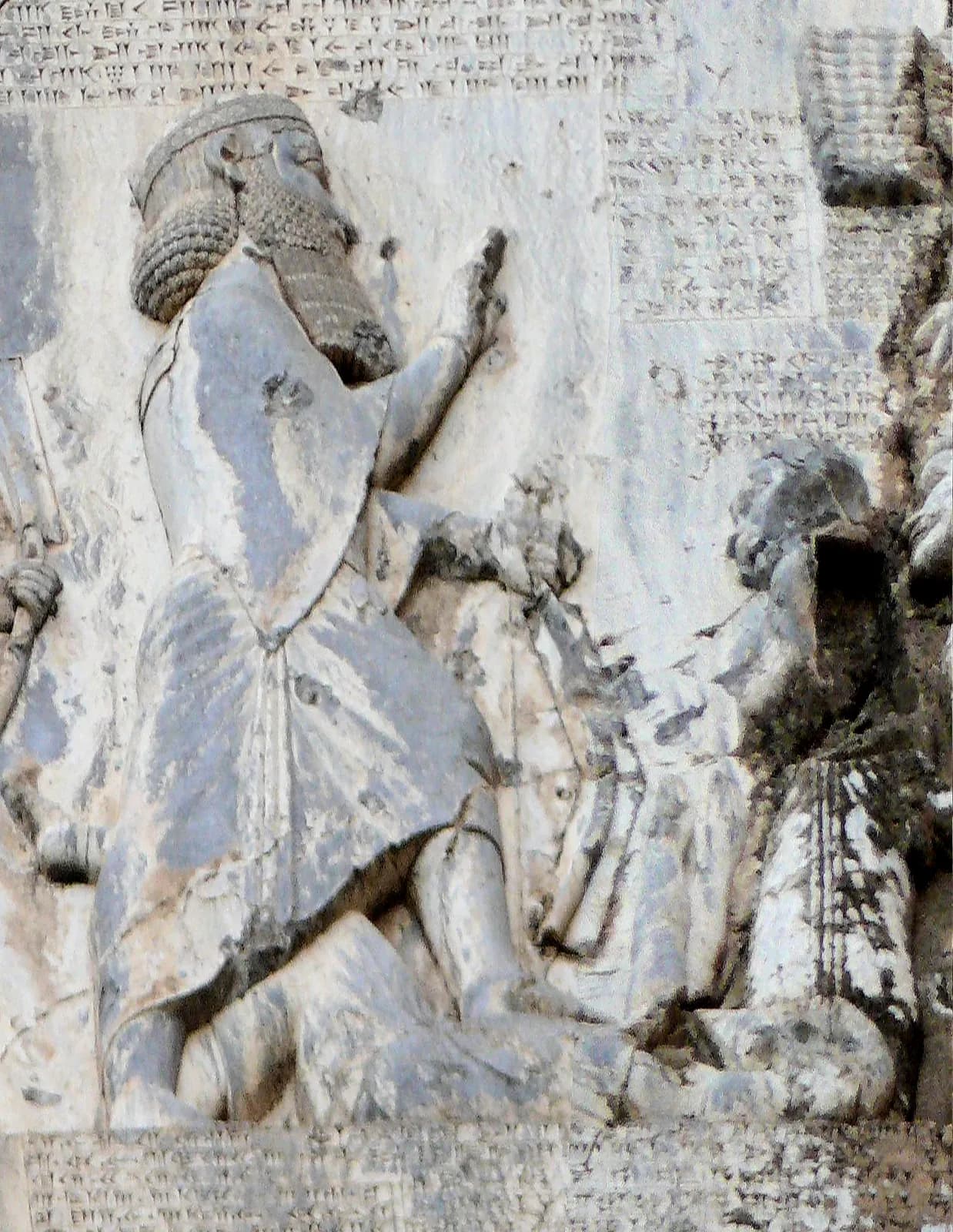
A worked surface some fifteen metres wide and twenty-five high, about a hundred metres above the road. The figured relief within it is about five and a half metres across: Darius with his bow, his foot on a prone figure, facing nine bound men roped by the neck, with the winged disc above and two attendants behind him.
Around and below it, columns of cuneiform in three languages — Old Persian, Elamite and Akkadian — running to well over a thousand lines in total. The Old Persian version is the longest Achaemenid royal inscription known.
The rock is weathering and water runs across parts of the text. Much of what is now read comes from squeezes, casts and photographs taken over the last two centuries rather than from the surface as it stands.
Occupation and chronology
Dates below are stored as signed years and rendered with the precision they actually carry. c. 521 BCE is approximate; c. 518 BCE is approximate.
c. 520 BCE
The first carving
Relief and Elamite and Babylonian texts, recording the events of Darius's first year.
shortly after
The Old Persian version
The Old Persian text appears to have been added to the monument, in a script that may have been created for the purpose. If so, Behistun is the first thing ever written in Old Persian.
c. 518 BCE
The added rebel
Skunkha the Scythian, in a pointed hat, was added at the end of the line of bound prisoners. Fitting him in required part of the Elamite text to be erased and recut elsewhere — a visible edit to a monumental document.
Hellenistic to modern
Afterlife
The ledge below the relief was cut away, apparently to prevent access. Later travellers took the figures for Christ and the apostles, or for a Persian king and his subjects; the text was unreadable to anyone for over two thousand years.
History of excavation
Who recovered the evidence, when, and by what method. Where an excavation destroyed as much as it found, the entry says so.
- Evidence level: Documented
1835–1847
Henry Creswicke Rawlinson
Rawlinson copied the Old Persian from ladders on a narrow ledge, returning over years, and finally had the Babylonian text — on an overhang he could not reach — copied by a local boy on a rope. The physical difficulty is part of the history of the decipherment.
- Evidence level: Documented
1846–1857
Rawlinson, Edward Hincks, Jules Oppert, William Henry Fox Talbot and others
The decipherment. In 1857 the Royal Asiatic Society had four scholars independently translate a newly found Assyrian text in sealed envelopes; the versions agreed closely enough to establish that Akkadian could be read. Behistun was the trilingual that made it possible.
- Evidence level: Documented
1903–1904 and 1948
A. V. Williams Jackson, then George Cameron
Re-collation of the text at the rock face, with Cameron taking latex squeezes of the passages Rawlinson had reached with difficulty and correcting a number of readings.
- Evidence level: Documented
1990s–present
Iranian antiquities authorities
Conservation, access control and survey of the wider site, which also holds Parthian and Sasanian reliefs and a Seleucid Heracles carved in 148 BCE with a dated Greek inscription.
Principal structures
The evidence level answers how we know what a structure looked like, not whether it existed.
- Evidence level: Documented
c. 520 BCE
The relief panel
Darius, two attendants, the figure under his foot, nine bound rebels and the winged disc. The composition follows Mesopotamian victory-stele conventions and adapts them to a cliff.
- Evidence level: Documented
c. 520–518 BCE
The trilingual text
Old Persian, Elamite and Akkadian versions with differing lengths and some differing content. The Old Persian version's final columns have no counterpart in the others.
- Evidence level: Probable
antiquity
The removed approach
The ledge by which the carvers reached the panel was cut away afterwards. Whether that was to protect the monument or to make it unalterable, it is the reason no one defaced it.
Finds and where they went
Almost nothing recovered from these sites is still on them. Where an object has a full provenance record on this platform, it is linked.
- Evidence level: Documented
The Aramaic version from Elephantine
A papyrus copy of the Behistun text, in Aramaic, found in a Jewish military colony in southern Egypt. It shows that the inscription was not merely a monument but a document circulated across the empire in the administrative language, more than two thousand kilometres away.
Published from the Elephantine papyri
- Evidence level: Documented
The Babylonian stone copy
A fragment of a stone slab from Babylon carrying part of the text, with traces of a version of the relief. Further evidence for publication beyond the cliff.
- Evidence level: Disputed
The Old Persian script itself
A cuneiform alphabet of about thirty-six signs, quite unlike the syllabic systems around it. Darius's text claims he made a form of writing that had not existed before, which if taken at face value makes this monument the reason Old Persian is a written language at all.
In position, Behistun
Ancient testimony
What ancient authors say about the place, and how far it can be trusted.
Darius I, The Behistun inscription DB, columns I–V
Darius's own account of his accession and the year of revolts, in three languages. The primary Achaemenid historical text, and a partisan one.
Herodotus, Histories 3.61–88
Herodotus on the Magus, the seven conspirators, the killing and the debate on constitutions that follows. Written some seventy years later from Persian informants, and agreeing with Darius on the impostor while differing on nearly every detail of what happened next.
Ctesias, Persica fragments
Ctesias, physician at the Persian court, gives a third version with different names and a different sequence. The disagreement among the three is the evidence.
How the site has been interpreted
Behistun does two incompatible jobs and both matter. It is the key that opened Akkadian, Elamite and Old Persian, and therefore the foundation of the modern study of Mesopotamia and Iran. It is also a political document written by a man who had just taken a throne by force, explaining why that was legitimate.
The account it gives is specific. Cambyses secretly killed his brother Bardiya; a Magus named Gaumata then impersonated the dead Bardiya and seized power while Cambyses was in Egypt; Darius and six companions killed the impostor; and in a single year Darius fought nineteen battles and captured nine rebel kings, by the favour of Ahuramazda. He repeats, several times, that what he has written is true and that the reader should not think it false — which is not the emphasis of a man reporting an uncontested fact.
The alternative reading, which many historians hold, is that Bardiya was the real Bardiya, that his rule was accepted across the empire, and that Darius — a distant relative at best — murdered him and invented the impostor. The pattern of the revolts, which broke out immediately and everywhere after Darius's accession, is consistent with that. Herodotus preserves a version of the story that agrees on the impostor and disagrees on much else; Ctesias gives a third.
The empire-wide publication is the underrated fact. A monumental text on an unreachable cliff persuades nobody, but Aramaic copies circulating to garrisons in Egypt do. Behistun is evidence for an Achaemenid information policy, and that is a more interesting finding about the empire than the succession story it carries.
Unresolved
Was Gaumata real?
Darius says the man on the throne was a Magus impersonating a prince already secretly dead. The objections are that a successful impersonation of a royal brother for months, across an empire, strains belief; that the speed and breadth of the revolts against Darius look like reaction to a usurpation; and that Darius's own genealogy required an Achaemenid line that is otherwise poorly attested. The defence is that the Behistun account is early, detailed, publicly circulated, and names witnesses. There is no independent contemporary source, and the question is genuinely undecided.
Did Darius invent Old Persian writing?
A passage in the Old Persian version is generally read as a claim that the king created a script. If true, the alphabet was designed for this monument and every earlier Old Persian inscription — including Cyrus's at Pasargadae — is a later addition. The passage is difficult and has been translated in ways that weaken the claim, and a minority holds that the script predates Darius.
How to read the evidence labels
- Evidence level: Documented
- Supported by a named primary text or by excavated material evidence.
- Evidence level: Probable
- Supported by strong inference that most specialists accept.
- Evidence level: Disputed
- Substantial specialist disagreement exists; competing readings are stated.
- Evidence level: Literary
- Belongs to poetic or mythological construction rather than to history.
- Evidence level: Mythological
- Belongs to shared religious or mythic tradition rather than to any single text.
- Evidence level: Unknown
- The available evidence is insufficient to decide.
These labels describe the status of the evidence, not our confidence in a conclusion. A claim marked Literary is not a claim we doubt; it is a claim about what kind of thing a poem is.