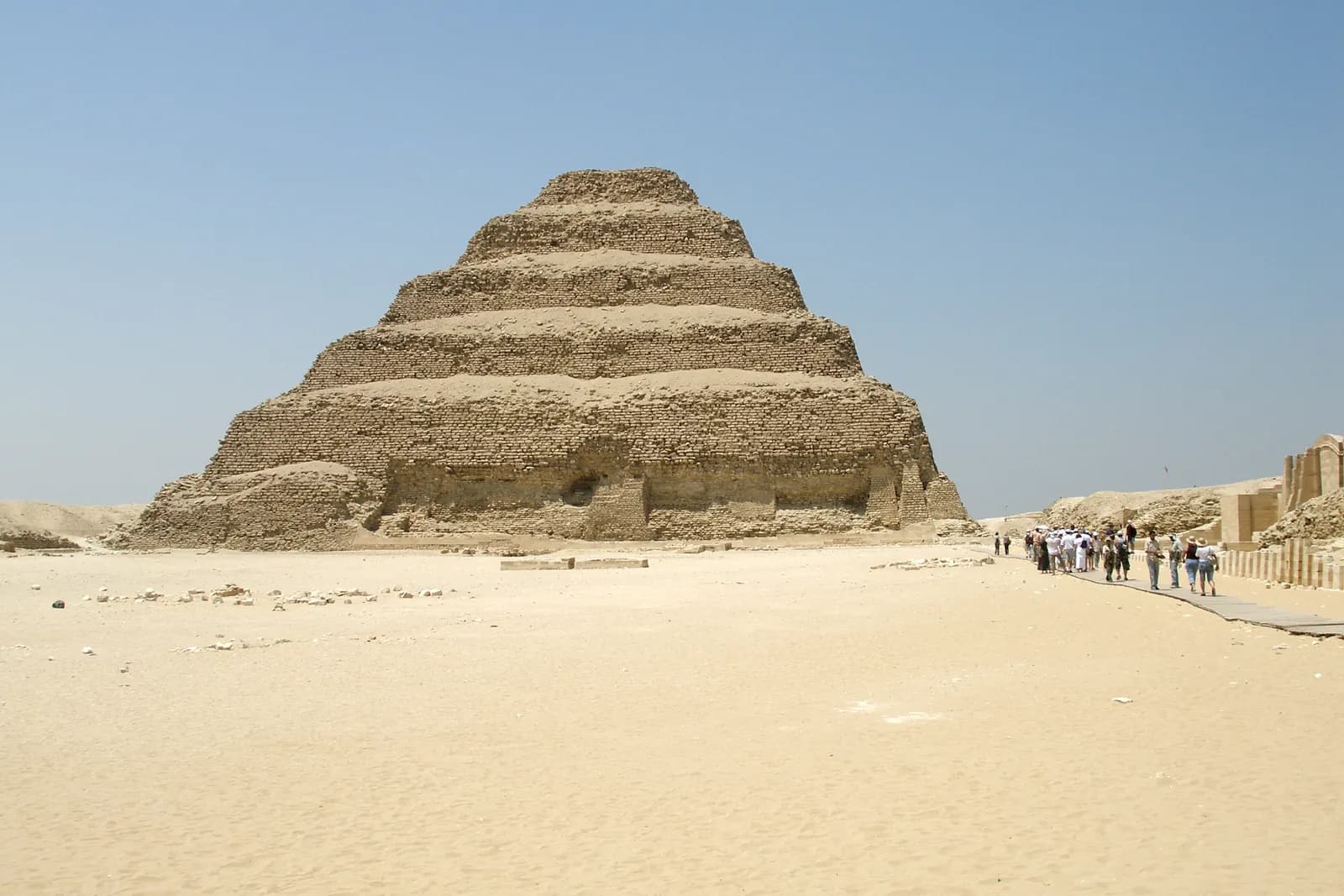
Where the site is
A desert plateau running some seven kilometres along the west bank above the ruins of Memphis. High, dry and immediately accessible from the capital, which is why it was used continuously from the First Dynasty into the Roman period — a longer span of use than almost any cemetery anywhere.
- Ancient region
- Lower Egypt, the Memphite necropolis
- Modern country
- Egypt
- Position
- 29.871° N, 31.216° E — The Step Pyramid of Djoser
- Given to three decimal places, about a hundred metres. It locates the named feature, not the extent of the site.
What survives
The Step Pyramid stands at the centre of a walled enclosure of some fifteen hectares, most of it dummy architecture: chapels with no interiors, doors carved permanently open, engaged columns imitating bundled reeds. A century of anastylosis has re-erected much of the enclosure wall and the entrance colonnade.
South and north of it are pyramids of the Fifth and Sixth Dynasties, small and badly ruined outside but preserving carved and painted burial chambers, and the mastabas of officials with their relief-covered walls largely intact and still holding colour.
Below ground, the Serapeum runs for hundreds of metres: rock-cut galleries lined with side chambers, each holding a granite sarcophagus of about seventy tonnes, most of them open and empty.
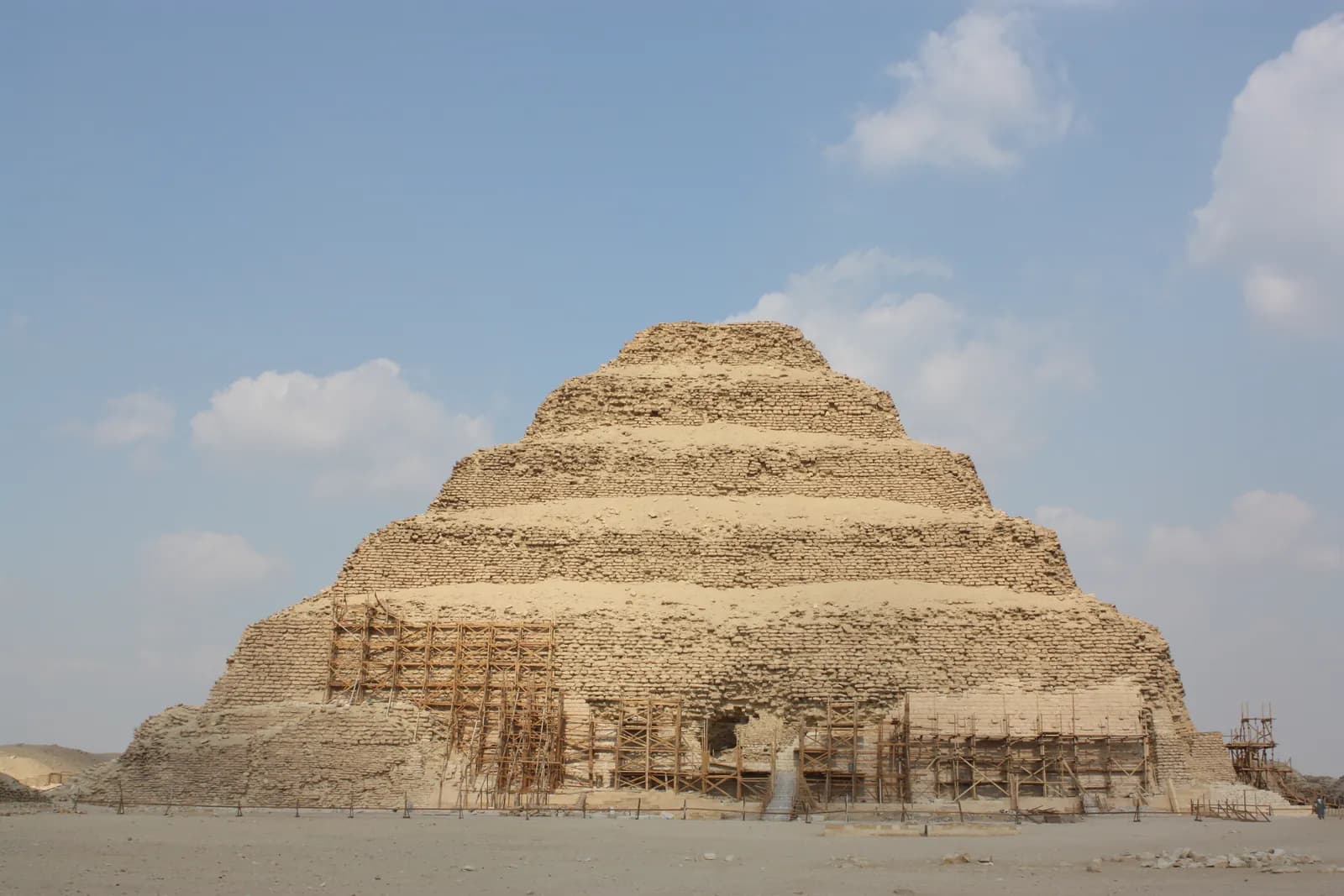
Occupation and chronology
Dates below are stored as signed years and rendered with the precision they actually carry. c. 3000 BCE is approximate; c. 400 CE is approximate.
c. 3000–2700 BCE
Early Dynastic
Large mudbrick mastabas on the northern escarpment, with panelled façades imitating the palace enclosure. Whether they are royal tombs or the tombs of officials has been argued since Emery excavated them.
c. 2670–2650 BCE
The Step Pyramid
Djoser's complex: the first monumental building in cut stone anywhere, and a stone translation of a mudbrick, reed and timber architecture that no longer existed by the time it was copied.
c. 2600–2150 BCE
Old Kingdom cemetery
Pyramids of the Fifth and Sixth Dynasties, and the great decorated mastabas of officials — Ti, Ptahhotep, Mereruka — whose wall scenes are the primary source for Old Kingdom daily life.
c. 1400 BCE – 1st century CE
The Serapeum and the animal cults
Apis bull burials in rock-cut galleries, and from the Late Period onward vast catacombs of mummified ibises, baboons, falcons and cats, produced and sold as votives at industrial scale.
History of excavation
Who recovered the evidence, when, and by what method. Where an excavation destroyed as much as it found, the entry says so.
- Evidence level: Documented
1850–1852
Auguste Mariette
Mariette found a sphinx head protruding from the sand, recalled Strabo's description of an avenue of sphinxes leading to a Serapeum that was constantly being buried, and dug along the line. It led him to the Apis galleries. It is one of the few cases where an ancient text directly produced a major discovery.
- Evidence level: Documented
1880–1881
Gaston Maspero
Entry into the pyramid of Unas and the Sixth Dynasty pyramids, where the burial chambers proved to be covered in carved and painted vertical columns of text — the Pyramid Texts, the oldest substantial religious corpus in the world.
- Evidence level: Documented
1926–2001
Cecil Firth, James Quibell and Jean-Philippe Lauer
The Djoser complex. Lauer worked on it for some seventy-five years, reconstructing the enclosure from its fallen blocks. The site's present appearance is very largely his.
- Evidence level: Documented
1930s–1950s
Walter Bryan Emery
The Early Dynastic mastabas on the northern escarpment, and later the search for the tomb of Imhotep, which was not found.
- Evidence level: Documented
1975–present
The Egypt Exploration Society, the Leiden and Cairo missions, and the Egyptian antiquities service
The New Kingdom cemetery including the tomb Horemheb built as a general before he became king, the animal catacombs, and a continuing series of Late Period shaft burials.
Principal structures
The evidence level answers how we know what a structure looked like, not whether it existed.
- Evidence level: Documented
c. 2670–2650 BCE
The Step Pyramid of Djoser
Six diminishing stages, begun as a square mastaba and enlarged in stages that are visible in the fabric. The first large stone building in the world, and its own construction sequence is legible in it.
- Evidence level: Documented
c. 2660 BCE
The enclosure and its dummy buildings
Chapels with solid cores, false doors, and engaged fluted columns — stone imitations of a perishable architecture, built for a ritual the king was to perform for ever rather than for use.
- Evidence level: Documented
from the 18th Dynasty; main galleries from the 26th Dynasty
The Serapeum
Rock-cut galleries for the burial of the Apis bulls, each in a monolithic granite sarcophagus. How sarcophagi of that weight were manoeuvred into the side chambers is not established.
- Evidence level: Documented
c. 2350 BCE
The Pyramid of Unas
Small and collapsed outside; inside, the burial chamber walls carry the earliest Pyramid Texts, with a star-painted ceiling and alabaster panelling imitating a reed shelter.
- Evidence level: Documented
c. 2330 BCE
The mastaba of Mereruka
Over thirty rooms of carved and painted scenes — agriculture, metalworking, hunting, force-feeding hyenas, tax collection with defaulters being beaten. The fullest surviving visual record of Old Kingdom life.
Finds and where they went
Almost nothing recovered from these sites is still on them. Where an object has a full provenance record on this platform, it is linked.
- Evidence level: Documented
The Imhotep statue base
A pedestal from the Step Pyramid complex bearing Djoser's titulary and, beside it, the name and titles of Imhotep. It is contemporary, it is the reason Imhotep is a historical person rather than a legend, and it is why the attribution of the complex to him is taken seriously.
Egyptian Museum, Cairo
- Evidence level: Documented
The Pyramid Texts
Spells for the king's transformation and ascent, carved in the burial chambers of the late Fifth and Sixth Dynasty pyramids. The oldest surviving religious literature, and the ancestor of the Coffin Texts and the Book of the Dead.
In position, and in published editions
- Evidence level: Documented
The Djoser statue
A seated limestone figure of the king found in the serdab against the north side of the pyramid, still positioned to look out through two eyeholes. The earliest surviving life-size Egyptian royal statue.
Egyptian Museum, Cairo
- Evidence level: Documented
The Serapeum stelae
Votive stelae left by visitors at the Apis burials, many dated by regnal year. They provide a chronological series running across centuries and are used to anchor Late Period chronology.
- Evidence level: Documented
Animal mummies
Millions of them, in dedicated catacombs. Modern imaging has shown that a substantial proportion contain partial remains or none at all, which is evidence about the votive industry rather than about belief.
Ancient testimony
What ancient authors say about the place, and how far it can be trusted.
Strabo, Geography 17.1.32
Strabo describes an avenue of sphinxes at Memphis buried to the head in windblown sand, leading to a temple of Serapis. Mariette used the passage as a field instruction and found the Serapeum.
Herodotus, Histories 2.153, 3.27–29
Herodotus on the Apis bull, its identifying marks and its cult at Memphis, and on Cambyses' alleged wounding of the animal — a story Egyptian evidence contradicts, since the Apis that died under Cambyses was buried with full honours and a stela in his name.
How the site has been interpreted
Saqqara is where Egyptian monumental architecture can be watched starting. Djoser's complex is built in small stone blocks of roughly mudbrick size, laid in courses, imitating reed matting, timber and bundled plant columns in a material that could not fail. It is a translation, and the thing it translates had already stopped being built.
Imhotep is the earliest architect anywhere whose name is attached to a building by contemporary evidence. What that evidence says is that he was Djoser's chief official and held priestly titles; it does not say that he designed the pyramid, which is a reasonable inference from the association rather than a documented fact. Two thousand years later he was worshipped as a god of healing and identified by Greeks with Asklepios.
The Pyramid Texts changed what could be said about Egyptian religion, because before Maspero the earliest religious corpus available was the Book of the Dead, a thousand years later and written for private people. The Pyramid Texts are royal, they are older, and they show a system already fully formed at the point it becomes visible.
The animal catacombs are best read as an economy. Late Period pilgrims bought a mummified animal and had it interred as a votive on their behalf; the demand supported breeding, killing, embalming, packaging and burial at a scale that filled kilometres of gallery. The frequency of empty or partial bundles is a fact about that trade, and it is not evidence that the practice was insincere.
Unresolved
Whose are the Early Dynastic mastabas?
Emery excavated large panelled mastabas at north Saqqara bearing the names of First Dynasty kings and argued they were the royal tombs, with the smaller Abydos monuments as cenotaphs. The prevailing view since has reversed that: Abydos holds the tombs and Saqqara the tombs of high officials, whose monuments bore the king's name because they served him. The argument turns on the sealings and on what a name on a tomb means.
How were the Serapeum sarcophagi installed?
Granite boxes of some seventy tonnes with separate lids stand in narrow side chambers off a low gallery, and several were left in mid-manoeuvre. Sledges, sand, levers and timber cradles are all plausible and none is attested. The precision of the interior surfaces is often cited as inexplicable; it is not, since Egyptian stoneworking in granite is well documented, but the moving remains unexplained.
How to read the evidence labels
- Evidence level: Documented
- Supported by a named primary text or by excavated material evidence.
- Evidence level: Probable
- Supported by strong inference that most specialists accept.
- Evidence level: Disputed
- Substantial specialist disagreement exists; competing readings are stated.
- Evidence level: Literary
- Belongs to poetic or mythological construction rather than to history.
- Evidence level: Mythological
- Belongs to shared religious or mythic tradition rather than to any single text.
- Evidence level: Unknown
- The available evidence is insufficient to decide.
These labels describe the status of the evidence, not our confidence in a conclusion. A claim marked Literary is not a claim we doubt; it is a claim about what kind of thing a poem is.