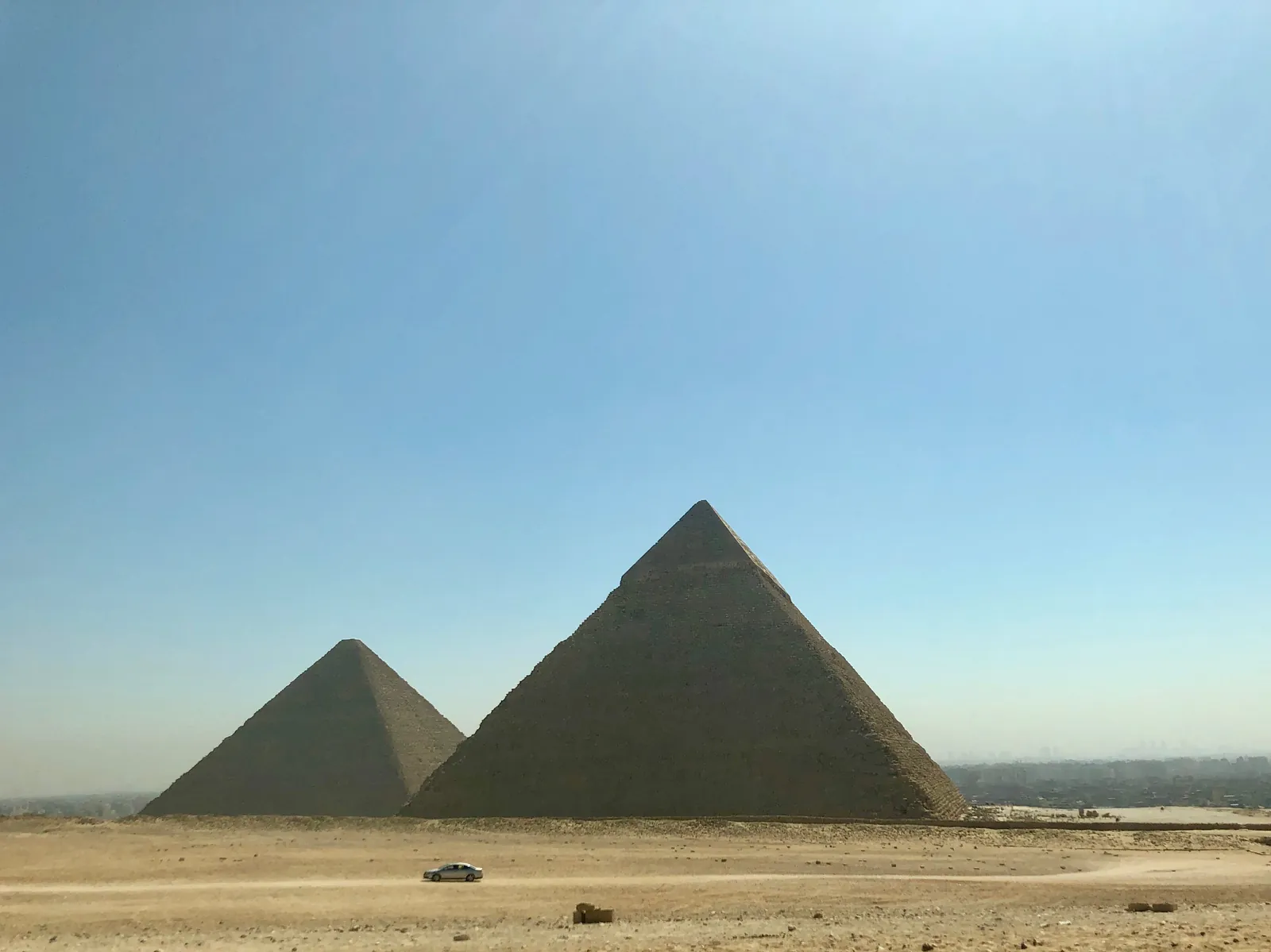
The sequence is visible in the monuments. Early royal tombs are mastabas, flat-topped rectangular structures. Djoser's at Saqqara stacks six diminishing mastabas into a step pyramid — the earliest large-scale cut-stone building known. Within a century the true pyramid appears at Dahshur and Giza, with the Bent Pyramid recording a change of angle mid-construction.
Construction method is not documented by anyone who built one, and remains the central open question. Ramp systems of various geometries have been proposed; the evidence for each is indirect. What is documented is the organisation: the workers' settlement at Giza has been excavated, with bakeries, breweries, dormitories and a cemetery of workers buried near the monument they built.
That settlement settles one question decisively. The builders were organised labour with provisioning and medical care, not chattel slaves — a claim that goes back to Herodotus and has no support in the material.
What the evidence supports
A workers' settlement and cemetery have been excavated at Giza.
Bakeries, breweries, accommodation and burials of workers, some showing healed injuries treated well enough to survive. The labour force was fed, housed and buried honourably.
The pyramids were not built by enslaved foreigners.
The tradition derives from Herodotus and later religious narrative. The archaeological evidence indicates organised Egyptian labour, and there is no material support for the older story.
How the blocks were raised is not established.
Straight, spiral and internal ramp reconstructions all have advocates and all have difficulties. No ancient account of the method survives from the period.
Examples
The evidence level on each answers how we know what the building looked like, not whether it existed.
- Evidence level: Documented
Saqqara · c. 2670 BCE
The Step Pyramid of Djoser
Attributed to Imhotep on the strength of an inscription naming him on a statue base of Djoser — a rare direct link between a named architect and a surviving building. Standing, and excavated together with its walled complex.
- Evidence level: Documented
Giza · c. 2560 BCE
The Great Pyramid of Khufu
The largest, and the only one of the Seven Wonders still standing. The Diary of Merer, papyri found at Wadi al-Jarf, records the transport of Tura limestone for its casing. Standing, and the only one of the Seven Wonders still surviving.
- Evidence level: Documented
Dahshur · c. 2600 BCE, under Sneferu
The Bent Pyramid
Its angle changes partway up, which is generally read as a structural correction made during construction — a building that records its own engineering problem. Standing, with the change of angle visible in the surviving fabric.
Archaeology
The Giza workers' settlement, the Wadi al-Jarf papyri and the quarry evidence together document organisation, supply and logistics far better than they document technique.
Open questions
How were the blocks raised?
External straight ramps require enormous volumes of material; spiral ramps obstruct the corners used for surveying; internal ramps are proposed from density anomalies and are not confirmed. The question is genuinely open, and openness here is not an invitation to speculation from outside the field.
Primary sources
Merer, The Diary of Merer Papyri from Wadi al-Jarf
The logbook of a work gang transporting limestone for the Great Pyramid — the oldest inscribed papyri known, and a direct administrative record of the project.
Herodotus, Histories 2.124-128
Herodotus on the building of the pyramids, including the labour story that the archaeology does not support.
How to read the evidence labels
- Evidence level: Documented
- Supported by a named primary text or by excavated material evidence.
- Evidence level: Probable
- Supported by strong inference that most specialists accept.
- Evidence level: Disputed
- Substantial specialist disagreement exists; competing readings are stated.
- Evidence level: Literary
- Belongs to poetic or mythological construction rather than to history.
- Evidence level: Mythological
- Belongs to shared religious or mythic tradition rather than to any single text.
- Evidence level: Unknown
- The available evidence is insufficient to decide.
These labels describe the status of the evidence, not our confidence in a conclusion. A claim marked Literary is not a claim we doubt; it is a claim about what kind of thing a poem is.