Where the site is
A small enclosed valley on the west bank, between the cultivation and the Valley of the Kings, with no water source of its own. Everything the village consumed — water above all — was carried in by donkey, which is why so much of its administration is about rations and delivery.
- Ancient region
- Upper Egypt, western Thebes
- Modern country
- Egypt
- Position
- 25.729° N, 32.601° E — The village enclosure
- Given to three decimal places, about a hundred metres. It locates the named feature, not the extent of the site.
What survives
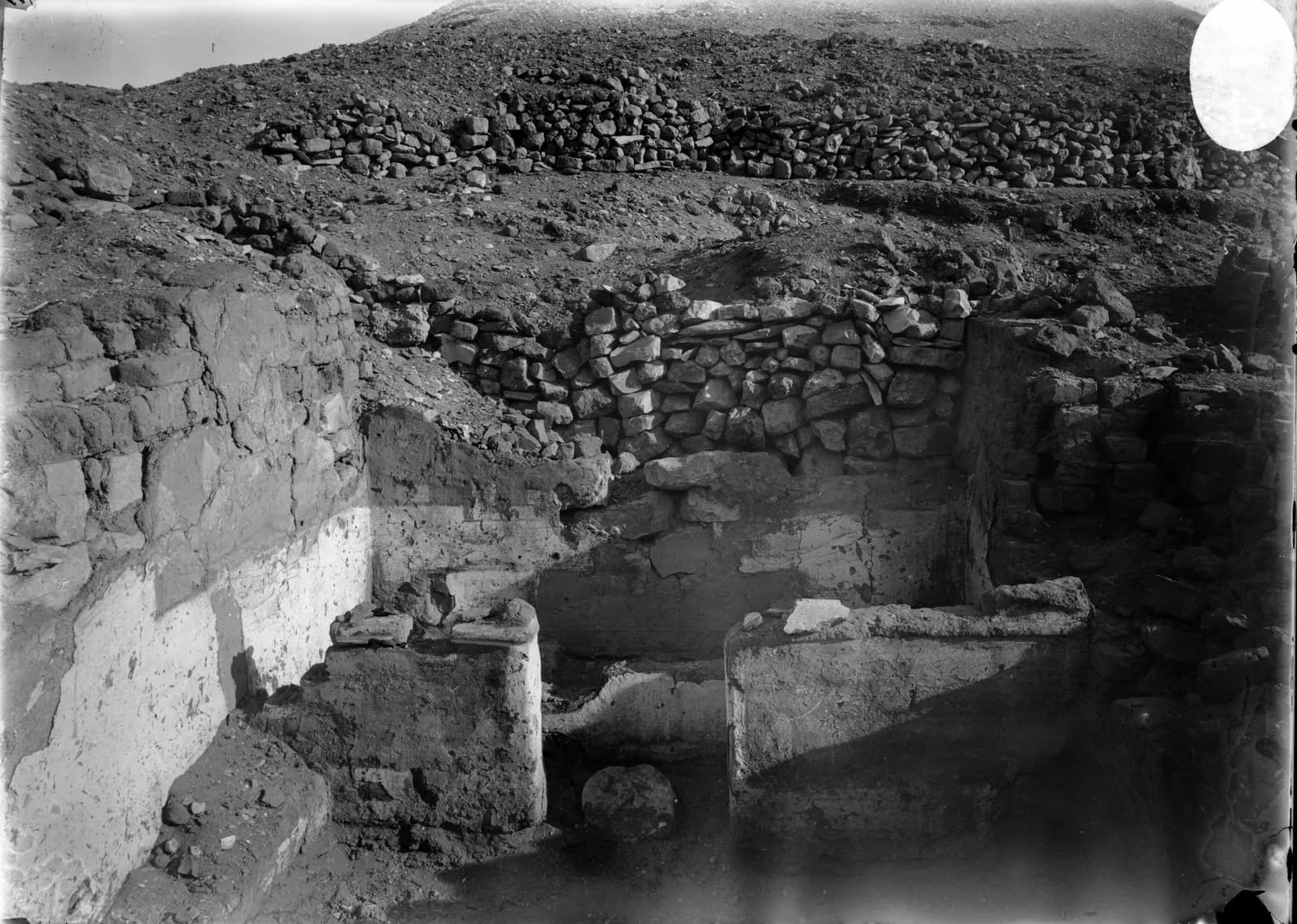
About seventy small houses in a walled grid on a north–south street, standing to a metre or so: a front room with a built platform, a living room with a column base, a rear room and a stair to the roof, with a cellar under many of them. The plans are so similar that the village reads as designed rather than grown.
Above the village on the slope, the workmen's own tombs, with small mudbrick pyramids over decorated chapels. Men who spent their working lives decorating royal tombs decorated their own, which is why the painting in Sennedjem's tomb is of royal quality in a labourer's grave.
And the rubbish. The Great Pit beside the village, dug for water and abandoned, was filled over generations with discarded limestone flakes and potsherds bearing writing — tens of thousands of them.
Occupation and chronology
Dates below are stored as signed years and rendered with the precision they actually carry. c. 1500 BCE is approximate; c. 1070 BCE is approximate.
c. 1500 BCE
Foundation
Established under Thutmose I to house the workforce for the new royal cemetery, with the enclosure wall stamped with his name.
c. 1290–1070 BCE
The documented century
The Nineteenth and Twentieth Dynasties, from which almost all the written material comes. Around sixty to a hundred and twenty workmen at a time, in two gangs, with a scribe and foremen.
regnal year 29 of Ramesses III
The strike
The gangs stopped work over late grain rations and sat down at the mortuary temples until they were paid. The earliest recorded industrial action anywhere.
c. 1070 BCE
Abandonment
The village was given up as royal burial in the valley ceased and security in the Theban west deteriorated. A Ptolemaic temple was later built beside it, which is where the modern name comes from.
History of excavation
Who recovered the evidence, when, and by what method. Where an excavation destroyed as much as it found, the entry says so.
- Evidence level: Documented
1886
Gaston Maspero's service, and local finders
The intact tomb of Sennedjem was opened, with its painted chamber and its contents, which passed into museums in Cairo, Berlin and New York.
- Evidence level: Documented
1905–1909
Ernesto Schiaparelli for the Italian mission
The undisturbed tomb of the architect Kha and his wife Merit, complete with furniture, linen, cosmetics, tools and food, now displayed together in Turin. It is the most complete non-royal New Kingdom burial known.
- Evidence level: Documented
1922–1951
Bernard Bruyère for the French Institute
Excavation of the village, the tombs, the chapels and the Great Pit, published in a long series of reports. Bruyère's method was of its period and his recording of the ostraca findspots was uneven, which has limited what can be reconstructed about who wrote what.
- Evidence level: Documented
1970s–present
The French Institute and international teams
Publication and re-study of the texts, conservation of the tombs, and continuing work on the chapels and the surrounding paths.
Principal structures
The evidence level answers how we know what a structure looked like, not whether it existed.
- Evidence level: Documented
c. 1500 BCE, extended later
The village enclosure
A rectangular walled block of terraced houses. Access was through a single gate for most of its life, which is a fact about the state's relationship to a workforce that knew where the royal tombs were.
- Evidence level: Documented
c. 1290 BCE
The tomb of Sennedjem
A small vaulted chamber painted over every surface with funerary scenes, including the Field of Reeds. Found intact.
- Evidence level: Documented
19th–20th Dynasties
The workmen's pyramids
Small steep mudbrick pyramids over the tomb chapels — a royal form appropriated by artisans, on a scale of a few metres.
- Evidence level: Documented
20th Dynasty
The Great Pit
A shaft over fifty metres deep sunk in a failed search for water and then used as a dump. Bruyère recovered many thousands of inscribed ostraca from it.
Finds and where they went
Almost nothing recovered from these sites is still on them. Where an object has a full provenance record on this platform, it is linked.
- Evidence level: Documented
The ostraca
Tens of thousands of inscribed limestone flakes and sherds: work rosters, absence registers with the reason for each absence, delivery notes, letters, laundry lists, legal statements, school exercises, sketches, literary copies, dream interpretations and love poetry. Ordinary writing survives almost nowhere else in the ancient world in this quantity.
IFAO Cairo, the British Museum, the Egyptian Museum, and collections worldwide
- Evidence level: Documented
The Turin Strike Papyrus
The scribe Amennakht's record of the events of year 29 of Ramesses III: the gangs walking off, the sit-down at the mortuary temples, the negotiations, and the eventual delivery of the grain. A contemporary account of a labour dispute, written by the party keeping the books.
Museo Egizio, Turin
- Evidence level: Documented
The tomb of Kha and Merit
Undisturbed: beds, chairs, chests, a cubit rod inscribed with the king's name, linen, wigs, cosmetics, bread and a jar of preserved food, together with a Book of the Dead. It is the fullest picture available of what a well-off Egyptian household owned.
Museo Egizio, Turin
- Evidence level: Documented
Oracle questions
Written questions put to the deified Amenhotep I, whose statue was carried in procession and whose movement was read as a yes or no. Property disputes, thefts and accusations were settled this way, and the records are the village's court archive.
IFAO Cairo and collections worldwide
Ancient testimony
No ancient author outside the village mentions it. Everything on this page comes from the village's own writing and from its excavation, which is precisely what makes it valuable: for once the evidence is not a literary account of workers written by someone else.
How the site has been interpreted
Deir el-Medina is the exception that makes the rest of Egyptian social history legible by contrast. Almost everything else that survives from Egypt is monumental, official and produced for eternity. Here the surviving material is disposable — notes written on rubbish because papyrus was expensive — and the result is a community visible at the scale of individuals over several generations: named men, their wives, their debts, their quarrels and their days off.
The absence registers are the best single example. A workman is off because he is brewing beer, because his mother is being embalmed, because he is building his own tomb, because of a scorpion sting, because he was drinking with a colleague, or because his wife or daughter is menstruating. This is a document type that exists nowhere else in the ancient world.
The strike record matters beyond its novelty. It shows workers with a shared understanding of what the state owed them, a tactic — occupying the mortuary temples, where the offerings were — and officials who negotiated rather than punished. It should not be read as a labour movement; it should be read as evidence that rations were an obligation and that everyone involved knew it.
The village must also be read for what it is not. These were literate, skilled, state-employed artisans with servants assigned to them, living in purpose-built housing. They were not the Egyptian population, and the ease with which their archive can be generalised is the main risk this site presents.
Unresolved
Could the women of the village read and write?
Letters addressed to women and a small number apparently written by them have been cited as evidence of female literacy. Others hold that dictation to a scribe explains the material, and that the absence of women among the recorded scribes is decisive. The texts are consistent with either reading, and the sample is small.
How representative is the archive?
The material clusters heavily in the Twentieth Dynasty and in a small number of families, partly because Bruyère's recording of findspots was uneven and partly because ostraca survive where they were dumped. Statements about the village frequently rest on a handful of unusually well-documented individuals, and the distinction between what the archive shows and what the community was is not always kept.
How to read the evidence labels
- Evidence level: Documented
- Supported by a named primary text or by excavated material evidence.
- Evidence level: Probable
- Supported by strong inference that most specialists accept.
- Evidence level: Disputed
- Substantial specialist disagreement exists; competing readings are stated.
- Evidence level: Literary
- Belongs to poetic or mythological construction rather than to history.
- Evidence level: Mythological
- Belongs to shared religious or mythic tradition rather than to any single text.
- Evidence level: Unknown
- The available evidence is insufficient to decide.
These labels describe the status of the evidence, not our confidence in a conclusion. A claim marked Literary is not a claim we doubt; it is a claim about what kind of thing a poem is.