Where the site is
On the east bank at Thebes, a few hundred metres from the Nile and connected to it by a canal and a quay whose successive levels record the river's changing position. An avenue of sphinxes ran nearly three kilometres south to Luxor temple, and the royal mortuary temples and tombs lie directly opposite on the west bank.
- Ancient region
- Upper Egypt, Thebes
- Modern country
- Egypt
- Position
- 25.719° N, 32.657° E — The Great Hypostyle Hall
- Given to three decimal places, about a hundred metres. It locates the named feature, not the extent of the site.
What survives
An enclosure of around twenty-five hectares containing the temple of Amun-Re, with ten pylons on two axes, courts, a sacred lake, festival halls, storerooms and chapels, and beyond it two further walled precincts for Mut and for Montu.
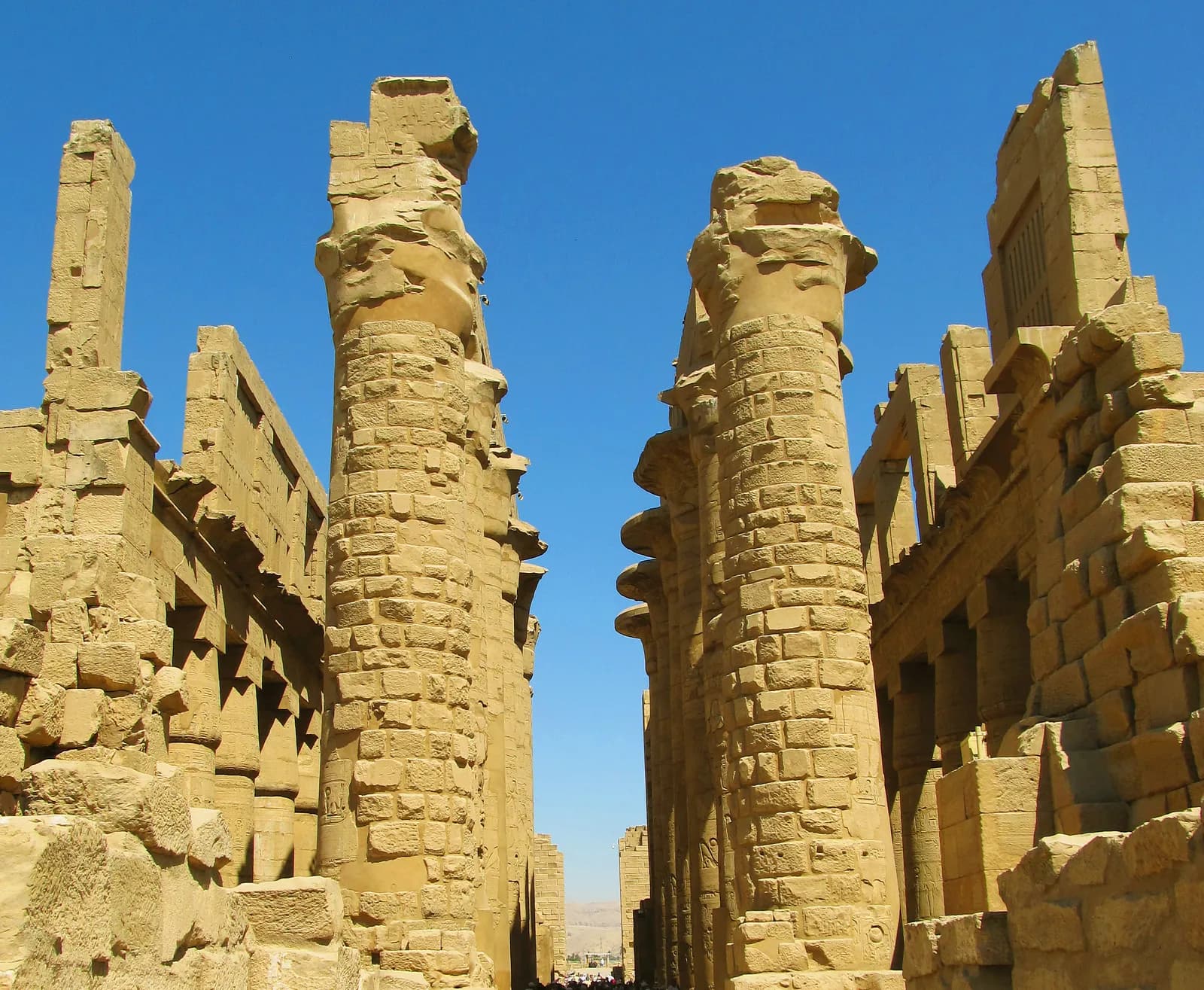
The Great Hypostyle Hall stands: a hundred and thirty-four columns over some five thousand square metres, the central twelve of them about twenty-one metres tall with open papyrus capitals, carrying clerestory windows in stone grilles. The roofing slabs are gone from most of it and remain in a few bays.
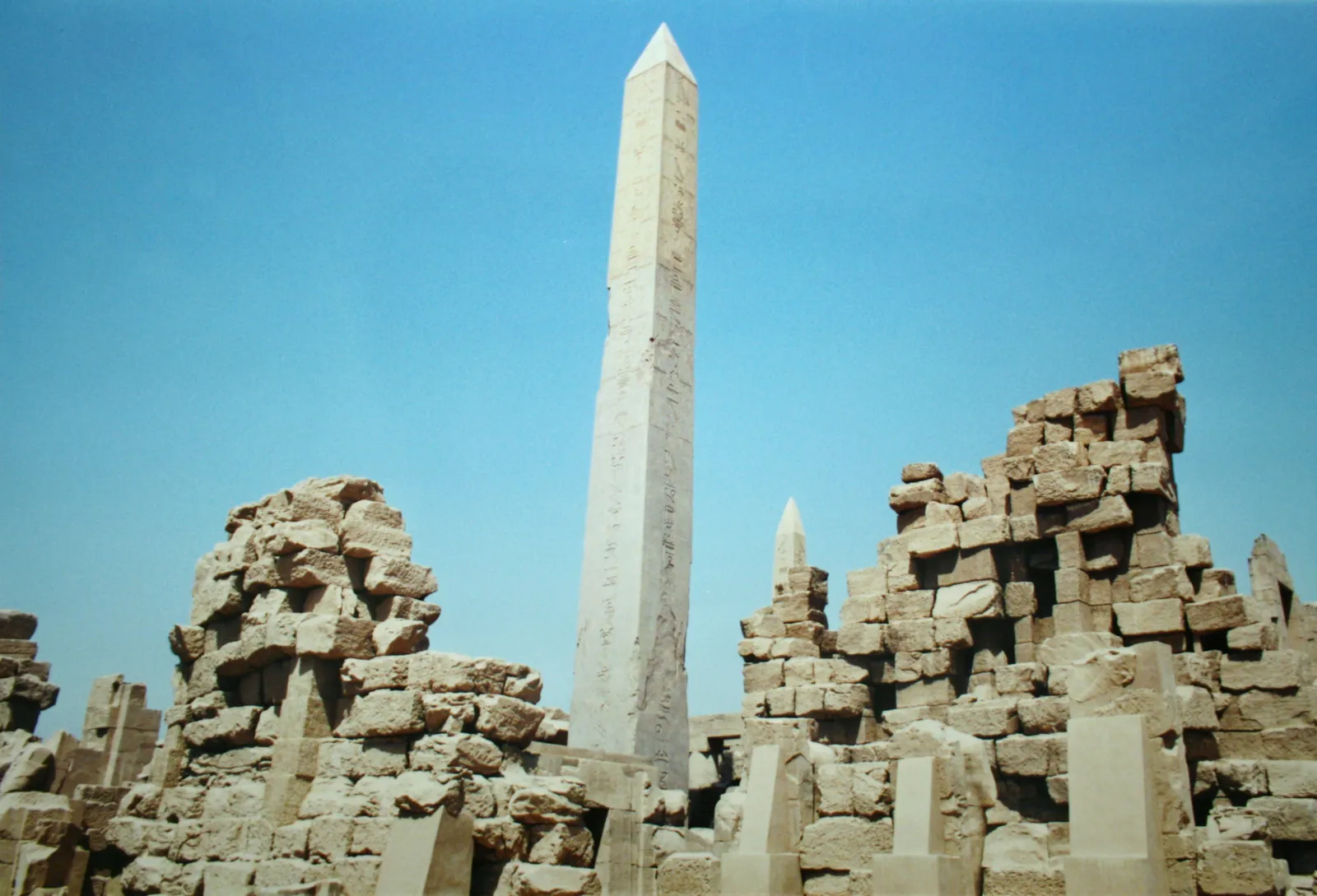
One of Hatshepsut's obelisks still stands, close to thirty metres of a single piece of granite. Its pair lies broken beside the sacred lake, and the base of Thutmose I's stands nearby.
Occupation and chronology
Dates below are stored as signed years and rendered with the precision they actually carry. c. 2000 BCE is approximate; c. 300 CE is approximate.
c. 2000–1700 BCE
Middle Kingdom core
The earliest structures, of which the finest surviving piece is Senusret I's limestone chapel — recovered in pieces from inside a later pylon and re-erected.
c. 1550–1300 BCE
The Eighteenth Dynasty
Amun becomes the state god and Karnak becomes the state's principal investment. Hatshepsut and Thutmose III build obelisks, pylons and festival halls; Thutmose III inscribes his campaign annals on the walls.
c. 1350–1330 BCE
The Amarna interruption
Akhenaten builds temples to the Aten at East Karnak and closes the Amun cult. After his death his buildings are dismantled and the blocks used as rubble fill in new pylons.
c. 1290–1213 BCE
The Ramesside hall
Seti I and Ramesses II build the Great Hypostyle Hall, decorated by both — Seti's raised relief on the north, Ramesses' sunk relief on the south, the change of technique visible on a single walk through.
1st millennium BCE – Roman
Late additions
Kushite, Saite, Ptolemaic and Roman work continues to add pylons, kiosks and gateways. The last pylon at the front of the temple is the least finished, because the temple grew outward.
History of excavation
Who recovered the evidence, when, and by what method. Where an excavation destroyed as much as it found, the entry says so.
- Evidence level: Documented
1798–1799
The French expedition's savants
The Description de l'Égypte's plans and elevations, made when much of the temple was buried and inhabited, are the earliest systematic record and remain evidence for what has since been removed.
- Evidence level: Documented
1895–1917
Georges Legrain for the Antiquities Service
Clearance of the temple, re-erection of eleven hypostyle columns that collapsed in 1899, and in 1903 the discovery of the Cachette in the court of the Seventh Pylon — a pit into which the priests had buried unwanted statuary.
- Evidence level: Documented
1960s–1970s
The Akhenaten Temple Project, Ray Winfield Smith and Donald Redford
Some forty-five thousand small decorated blocks from Akhenaten's dismantled Aten temples had been recovered from pylon fill. The project photographed them and used early computer matching to reassemble the scenes on paper, recovering the decoration of buildings that no longer exist.
- Evidence level: Documented
1967–present
The Franco-Egyptian Centre for the Study of the Temples of Karnak
Continuous excavation, epigraphy, conservation and publication, including the quay and canal sequence and the ongoing study of the Cachette material.
Principal structures
The evidence level answers how we know what a structure looked like, not whether it existed.
- Evidence level: Documented
c. 1290–1220 BCE
The Great Hypostyle Hall
Standing. Two ranks of column heights create a clerestory, which is the same lighting principle a basilica uses two thousand years later and reached independently.
- Evidence level: Documented
c. 1470 BCE
Hatshepsut's obelisk
Standing. Its lower part was walled in by Thutmose III, which preserved the inscriptions there in near-perfect condition while the exposed upper part weathered.
- Evidence level: Documented
c. 1950 BCE
The White Chapel of Senusret I
A small limestone way-station, dismantled in antiquity and used as fill in the Third Pylon, recovered block by block and rebuilt in the open-air museum. Middle Kingdom relief carving of the highest quality, preserved by demolition.
- Evidence level: Documented
New Kingdom
The sacred lake
A large stone-lined basin fed by groundwater, used for priestly purification and for the barque processions. Still holding water.
- Evidence level: Documented
c. 1450 BCE
The annals of Thutmose III
Campaign records carved on the walls around the granite sanctuary, including the account of the battle at Megiddo. Royal record inscribed inside a temple, which is where Egyptian history was published.
Finds and where they went
Almost nothing recovered from these sites is still on them. Where an object has a full provenance record on this platform, it is linked.
- Evidence level: Documented
The Karnak Cachette
Around eight hundred stone statues and many thousands of bronzes, buried in a pit in the temple court, probably in the Ptolemaic period, to clear space. Statues accumulate in a temple over centuries and eventually have to go somewhere; this is where Karnak's went.
Egyptian Museum, Cairo, and the Luxor Museum
- Evidence level: Documented
The talatat blocks
Small standardised sandstone blocks from Akhenaten's Aten temples, reused as rubble inside later pylons. Because they are small and carved, they can be reassembled, and they preserve the decoration of a demolished building better than the building's own site does.
Luxor Museum and the Karnak open-air museum
- Evidence level: Documented
Royal statuary of the Middle and New Kingdoms
Including the black granite Thutmose III and a long series of Sekhmet figures from the Mut precinct, of which several hundred survive and are dispersed across collections worldwide.
Ancient testimony
What ancient authors say about the place, and how far it can be trusted.
Papyrus Harris I
The record of Ramesses III's benefactions to the temples, listing land, people, cattle, ships and precious metal. The single most substantial document for the Egyptian temple economy, and it makes Amun's holdings at Thebes the largest by a wide margin.
Annals of Thutmose III Karnak, walls of the sanctuary
The king's campaign record carved in the temple, including the march through the Aruna pass and the engagement at Megiddo. Royal self-presentation, and one of the earliest detailed battle narratives from anywhere.
Herodotus, Histories 2.42–43
Herodotus on Theban Zeus — that is, Amun — and the ram taboo, recording the cult as a Greek visitor found it a thousand years after the hall was built.
How the site has been interpreted
Karnak is not a building but an accumulation, and the accumulation follows a rule: each king added at the front, so the temple grew outward from a small early core towards the river. The consequence is that the oldest work is deepest inside and the newest is at the entrance — the reverse of the way most visitors assume a temple grows.
Demolition here is a form of preservation. Egyptian builders filled their pylons with rubble, and the rubble was previous kings' buildings broken up. Senusret I's chapel, Hatshepsut's structures and Akhenaten's entire Aten complex have been recovered from inside later walls. A site that systematically destroyed its own past thereby archived it.
The temple was also an economic institution on a scale that is easy to underestimate. The papyrus record of Ramesses III's donations lists land, livestock, personnel and ships assigned to the temples, with Amun's holdings by far the largest. Karnak employed, farmed, stored, lent and administered, and the priesthood's independence became a political problem for the New Kingdom state.
Akhenaten's treatment here is the clearest case of Egyptian official forgetting. His buildings were taken apart, his name was cut out of inscriptions, and later king lists omit him. That programme was thorough enough that he was unknown until the nineteenth century — and it failed, because the blocks were kept as building material.
Unresolved
How were the obelisks raised?
A single granite shaft of two hundred tonnes or more had to be brought upright onto a base with its foot in exactly the right place. Sand-filled funnels, earth ramps with a pivot, and lever-and-cradle systems have all been proposed and some have been tested at reduced scale. Hatshepsut's own inscription describes quarrying and transport and stops before the erection. The method is not known.
Was Hatshepsut's memory attacked out of hatred?
Her images and names were removed from Karnak and elsewhere, and the erasure was long read as personal vengeance by Thutmose III. The removals appear to have begun decades into his sole reign rather than immediately, which points instead to a dynastic tidying of the succession record. The erasure is documented; the motive is inference.
How to read the evidence labels
- Evidence level: Documented
- Supported by a named primary text or by excavated material evidence.
- Evidence level: Probable
- Supported by strong inference that most specialists accept.
- Evidence level: Disputed
- Substantial specialist disagreement exists; competing readings are stated.
- Evidence level: Literary
- Belongs to poetic or mythological construction rather than to history.
- Evidence level: Mythological
- Belongs to shared religious or mythic tradition rather than to any single text.
- Evidence level: Unknown
- The available evidence is insufficient to decide.
These labels describe the status of the evidence, not our confidence in a conclusion. A claim marked Literary is not a claim we doubt; it is a claim about what kind of thing a poem is.