Where the site is
A bay of desert on the east bank, about halfway between Memphis and Thebes, enclosed by cliffs in a semicircle some ten kilometres across. Akhenaten's boundary stelae state that the site belonged to no god and no one before him, which as a choice of ground is the clearest statement of the project's intent.
- Ancient region
- Middle Egypt
- Modern country
- Egypt
- Position
- 27.646° N, 30.896° E — The Great Aten Temple
- Given to three decimal places, about a hundred metres. It locates the named feature, not the extent of the site.
What survives
Foundations and floor levels over some eight square kilometres of open desert — temples, palaces, houses, streets, wells, granaries and bakeries — largely undisturbed by later building, because the site was never reoccupied at scale.
In the cliffs, rock-cut tombs prepared for the court, with reliefs showing the royal family under the rayed disc, the daily worship in the open temple, and the city itself in bird's-eye view. Almost none of the tombs was ever used.
Three cemeteries for the ordinary population, excavated only since 2005, and the workmen's village, which is a walled grid of small identical houses like the one at Deir el-Medina.
Occupation and chronology
Dates below are stored as signed years and rendered with the precision they actually carry. c. 1346 BCE is approximate; c. 1330 BCE is approximate.
regnal year 5
Foundation
Boundary stelae cut into the cliffs on both banks record the king's oath defining the city's limits, with the promise never to extend them.
c. 1346–1332 BCE
The city
Temples open to the sky, palaces, administrative buildings, suburbs of officials' villas and workers' housing, a workmen's village, and rock tombs in the cliffs for the court.
c. 1332–1330 BCE
Abandonment
Under Tutankhamun the court returned to Memphis and Thebes. Amarna was dismantled for its stone, and the site left almost clear.
late 14th–13th centuries BCE
Erasure
Akhenaten's name was cut out of monuments, his buildings quarried, and the reigns of the Amarna period omitted from later king lists.
History of excavation
Who recovered the evidence, when, and by what method. Where an excavation destroyed as much as it found, the entry says so.
- Evidence level: Documented
1887
A local woman digging for sebakh
The find of the cuneiform tablets. Their significance was not immediately recognised and a number were damaged or lost before scholars reached them; the tablets were dispersed onto the market and thence into museums.
- Evidence level: Documented
1891–1892
Flinders Petrie
The first controlled excavation: the Great Palace with its painted pavement, glass and faience workshops, and the recognition that the Aegean pottery on the site could date the two cultures against each other.
- Evidence level: Documented
1903–1908
Norman de Garis Davies for the Egypt Exploration Fund
Complete epigraphic recording of the rock tombs and boundary stelae in six volumes. Much of what he copied has since deteriorated, so his drawings are now the primary evidence.
- Evidence level: Documented
1907–1914
Ludwig Borchardt for the German Oriental Society
Excavation of the southern suburb, including the house and workshop of the sculptor Thutmose, where on 6 December 1912 the painted limestone bust of Nefertiti was found. It went to Berlin under the division of finds then in force; the division has been contested by Egypt since the 1920s.
- Evidence level: Documented
1921–1936, and 1977–present
The Egypt Exploration Society, latterly the Amarna Project under Barry Kemp
Long-term excavation and survey of the whole city, and from 2005 the excavation of the non-elite cemeteries — the first substantial evidence for the population as opposed to the court.
Principal structures
The evidence level answers how we know what a structure looked like, not whether it existed.
- Evidence level: Documented
c. 1345 BCE
The Great Aten Temple
An enormous open enclosure with hundreds of offering tables and no roofed sanctuary. Egyptian temples were dark and progressively more restricted; this one was open to the sky, which is a theological argument expressed as a plan.
- Evidence level: Documented
regnal years 5–8
The boundary stelae
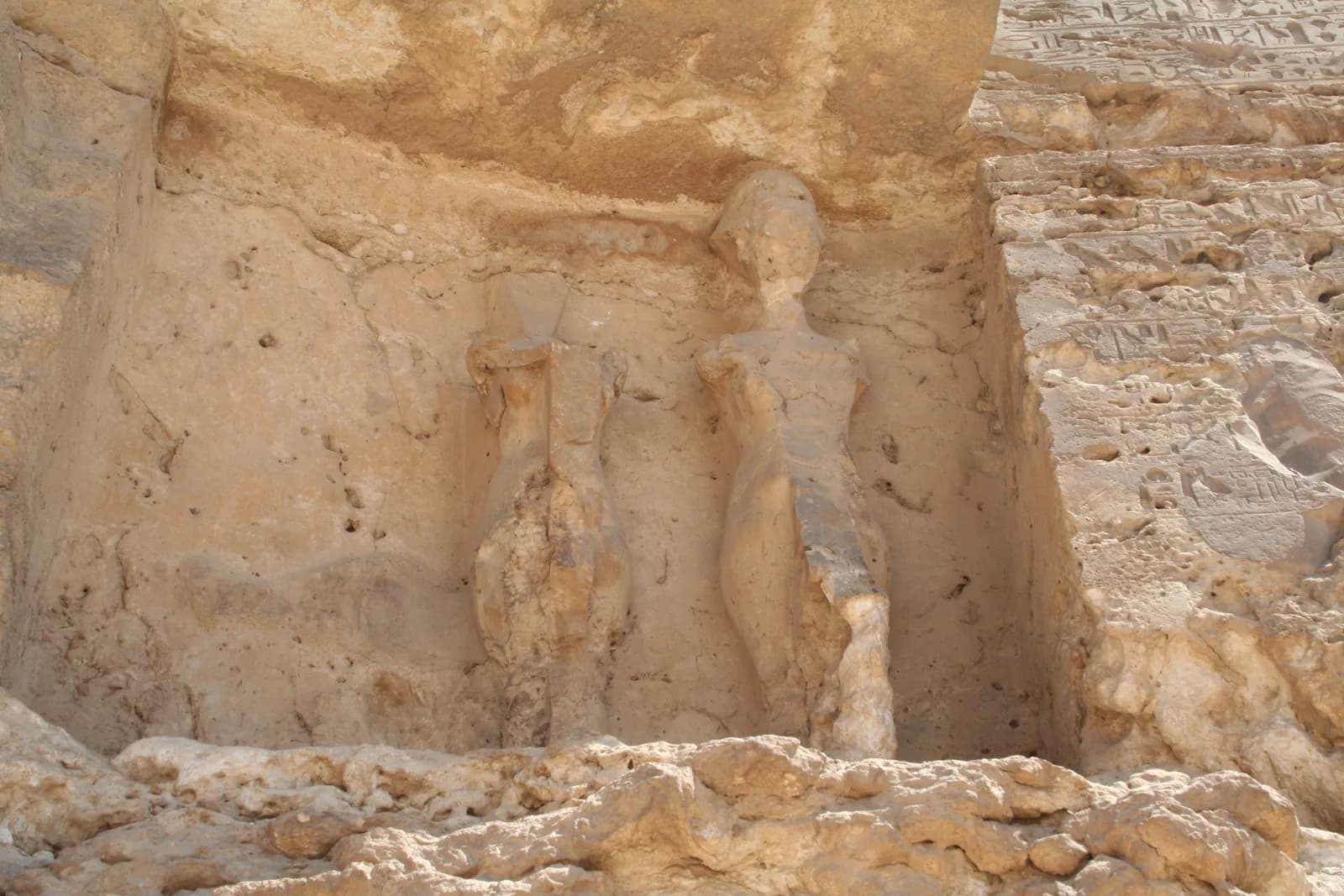
Fourteen or more large stelae cut into the cliffs, several with statues of the royal family beside them, carrying the foundation decree and the king's oath.
- Evidence level: Documented
c. 1345 BCE
The Central City and the Records Office
The administrative quarter, including the building labelled as the place of the correspondence of the pharaoh, from which the cuneiform archive came.
- Evidence level: Documented
c. 1345 BCE
The workmen's village
Seventy-odd small houses of identical plan inside a wall, in the desert away from the city, with chapels outside. The layout is bureaucratic; the private chapels show household religion continuing regardless of the official cult.
Finds and where they went
Almost nothing recovered from these sites is still on them. Where an object has a full provenance record on this platform, it is linked.
- Evidence level: Documented
The Amarna Letters
Around three hundred and eighty clay tablets in Akkadian cuneiform: correspondence between the Egyptian court and the kings of Babylon, Mitanni, Hatti, Assyria and Cyprus, and with the vassal rulers of Syria and Canaan. The single most important source for Late Bronze Age international relations, and the reason a diplomatic system can be described at all.
Vorderasiatisches Museum, Berlin; the British Museum; the Egyptian Museum, Cairo
- Evidence level: Documented
The bust of Nefertiti
Painted limestone over a plaster layer, one eye inlaid and one deliberately left blank. Found in a sculptor's workshop, which is why it is generally read as a master model rather than a finished portrait.
Neues Museum, Berlin
- Evidence level: Documented
The talatat from Karnak and Hermopolis
Blocks from Akhenaten's dismantled buildings, reused as fill elsewhere. They carry the decoration of the Amarna-period temples and are the main evidence for what the buildings looked like.
Luxor Museum and collections worldwide
- Evidence level: Documented
The South Tombs Cemetery skeletons
Burials of the ordinary population: high juvenile mortality, stunted growth, frequent spinal trauma and evidence of nutritional stress. The people who built the city were working hard on inadequate food, in a place whose art shows abundance everywhere.
Studied on site
Ancient testimony
What ancient authors say about the place, and how far it can be trusted.
The boundary stelae of Akhetaten Stelae K, X, and others
Akhenaten's own foundation decree: the choice of virgin ground, the extent of the city, and the oath not to exceed it. A royal document about the site, cut into the site.
The Great Hymn to the Aten Tomb of Ay, Amarna
The fullest statement of the Aten theology, carved in a courtier's tomb. Its similarity to Psalm 104 has been much discussed; the resemblance is real, direct dependence is not demonstrated, and both may draw on a shared regional tradition of solar praise.
The Amarna Letters EA 1–382
The diplomatic archive. Not a narrative source but a correspondence file, which is why it is so much more useful than one.
How the site has been interpreted
Amarna is the best-understood ancient Egyptian city because it is the only one that can be dug as a whole. Egyptian settlement sites are normally under later towns, under cultivation, or under the water table; this one is on desert that nobody wanted, occupied briefly and left. Almost everything general accounts say about Egyptian urban life, house plans and neighbourhood organisation rests on it, which is a problem, because a purpose-built royal foundation occupied for fifteen years is not a typical city.
The religious change is real and it should be described precisely. Akhenaten promoted the Aten, the visible disc, above other gods, closed temples, and had the plural word for gods erased in places. Whether that constitutes monotheism in any useful sense is argued; the royal family remained the sole intermediaries, and household religion at the workmen's village continued with Bes, Taweret and the ordinary domestic deities throughout.
The letters show the empire from outside. Vassal rulers write asking for troops that do not come, accusing each other, and reporting the 'apiru causing trouble; great kings write about gold, marriage alliances and the quality of gifts. It is a picture of Egyptian imperial management as distracted and cheap, which is not how Egyptian monuments present it.
The cemeteries are the correction the site needed. For a century Amarna was known through its art — the royal family, the sunlight, the intimacy — and through the tombs of officials. The ordinary burials describe a population dying young under heavy physical load. Both things are evidence, and only one of them was on display.
Unresolved
Should the Nefertiti bust be in Berlin?
It left Egypt under a division of finds approved by the Antiquities Service in 1913. Egypt has argued since the 1920s that the division was obtained by misrepresenting the object's importance, pointing to the way it was listed and to Borchardt's own account of the day. Germany holds that the division was lawful and has been repeatedly reviewed. The documents are published and are read differently by each side.
Did Akhenaten have a co-regency, and who succeeded him?
The sequence at the end of the reign involves a figure called Smenkhkare and a ruler called Neferneferuaten, who may be Nefertiti under a throne name, may be a daughter, and may be either co-regent or sole ruler. Every reconstruction is built from a small number of inscriptions, several of them altered in antiquity. There is no agreed order of events.
How to read the evidence labels
- Evidence level: Documented
- Supported by a named primary text or by excavated material evidence.
- Evidence level: Probable
- Supported by strong inference that most specialists accept.
- Evidence level: Disputed
- Substantial specialist disagreement exists; competing readings are stated.
- Evidence level: Literary
- Belongs to poetic or mythological construction rather than to history.
- Evidence level: Mythological
- Belongs to shared religious or mythic tradition rather than to any single text.
- Evidence level: Unknown
- The available evidence is insufficient to decide.
These labels describe the status of the evidence, not our confidence in a conclusion. A claim marked Literary is not a claim we doubt; it is a claim about what kind of thing a poem is.