What it is
The Temple of Apollo at Delphi — the Alcmaeonid rebuilding, the earthquake of 373 and the Panhellenic subscription that paid for the replacement, the adyton, and the question of the vapours.
Built Successive temples from the 7th century BCE; the standing remains c. 366–329 BCE. The principal date, the standing temple c. 366–329 BCE, is range endpoint.
7th century BCE
The early temples
Ancient tradition listed a series of earlier temples of laurel, of wax and feathers, of bronze and finally of stone, attributed to Trophonios and Agamedes. The list is myth-history; a seventh-century stone temple is archaeologically probable.
c. 548–510 BCE
The Alcmaeonid temple
Built after a fire, with the contract taken by the exiled Athenian Alcmaeonid family. Herodotus records that they built the east front in Parian marble though the contract specified poros stone.
373–c. 329 BCE
Earthquake and rebuilding
Destroyed by earthquake and rockfall in 373 and rebuilt over four decades on the same foundations, funded by subscription across the Greek world. The subscription lists survive on stone and name the donors and their contributions.
late 4th century CE
Closure
The oracle ceased under the anti-pagan legislation. The building was quarried and the site was covered by the village of Kastri.
Who ordered it built
Each attribution carries what supports it. Ancient buildings are routinely credited to people on the authority of writers centuries later, and that is not the same claim as an inscription on the building.
- Evidence level: Documented
Commissioned by
The Alcmaeonids
Herodotus 5.62: the family, in exile from Athens, contracted to build the temple and completed the front in marble at their own expense beyond what was agreed.
- Evidence level: Documented
Architect
Spintharos of Corinth
Named in the fourth-century building accounts inscribed at the sanctuary, together with his successors Xenodoros and Agathon.
What it was for
A temple of Apollo and the working premises of the oracle. Consultation took place inside: the Pythia sat in the adyton, a sunken area at the west end, and the enquirer put a question after preliminary sacrifice, having established by the twitching of a sacrificial goat that the god was willing to answer that day.
The temple was also a treasury and a repository of dedications, and the sanctuary around it functioned as a bank and a diplomatic clearing-house for the Greek world.
Its walls and forecourt carried the maxims — know thyself, nothing in excess — which Greek writers report as inscribed there and attribute to the Seven Sages.
How it was built
A Doric peripteral temple on a terrace held up by a polygonal retaining wall of the sixth century — the wall is itself one of the sanctuary's most important monuments, because its irregular masonry face was used for centuries to inscribe manumission records, and some eight hundred survive on it.
The fourth-century rebuilding follows the archaic plan closely and reuses its foundations, so the two phases are difficult to separate in the surviving stonework.
The adyton at the west end is not preserved in a state that allows its arrangement to be reconstructed, which is the central difficulty in describing what actually happened at a consultation.
Materials
- Evidence level: Documented
Poros limestone
The body of the archaic temple, and the fourth-century rebuilding
- Evidence level: Documented
Parian marble
The east front of the archaic temple, and its pedimental sculpture
Measured
Every figure states what it rests on. A modern survey, an ancient text, a conversion from an ancient unit and a modern estimate are four different kinds of statement and are not interchangeable.
Stylobate
about 60 × 23 m
Modern survey of the fourth-century foundations, which reuse the archaic ones.
Columns
6 by 15
Modern survey of the surviving stylobate and column positions.
What it meant
The Alcmaeonid contract is one of the clearest ancient examples of religious patronage as political investment. Herodotus says the family's generosity with the marble front bought them the favour of the Pythia, and that the oracle then pressed the Spartans repeatedly to free Athens from the tyranny — which they did, and the Alcmaeonids came home. Herodotus reports this as an Athenian account and does not endorse it, and the platform reports it the same way.
The fourth-century subscription lists are a different kind of political document: a record of which cities and individuals across the Greek world paid to rebuild a shared sanctuary, and how much, published on stone.
Delphi's Amphictyonic council administered the sanctuary and was repeatedly used as an instrument by whoever could control it. Philip II of Macedon's entry into Greek politics ran through a Sacred War fought over this temple.
The oracle is the best-documented institution of Greek divination and the least well understood in its mechanics. What is attested: a monthly consultation day, preliminary sacrifice, a fee, an order of precedence that could be sold, a woman speaking, and responses recorded in verse or prose by others.
What is not attested by any contemporary source is a chasm, a tripod over a fissure, or intoxicating vapours in the form the popular account gives. Those elements enter the record in later writers, principally Plutarch — himself a priest at Delphi — and Diodorus, and the excavators of the temple found no chasm.
After antiquity
Quarried after the sanctuary closed; the village of Kastri grew over the site and remained there until 1892, when it was moved to allow the French excavation. Moving a village to dig a site is a decision worth recording plainly.
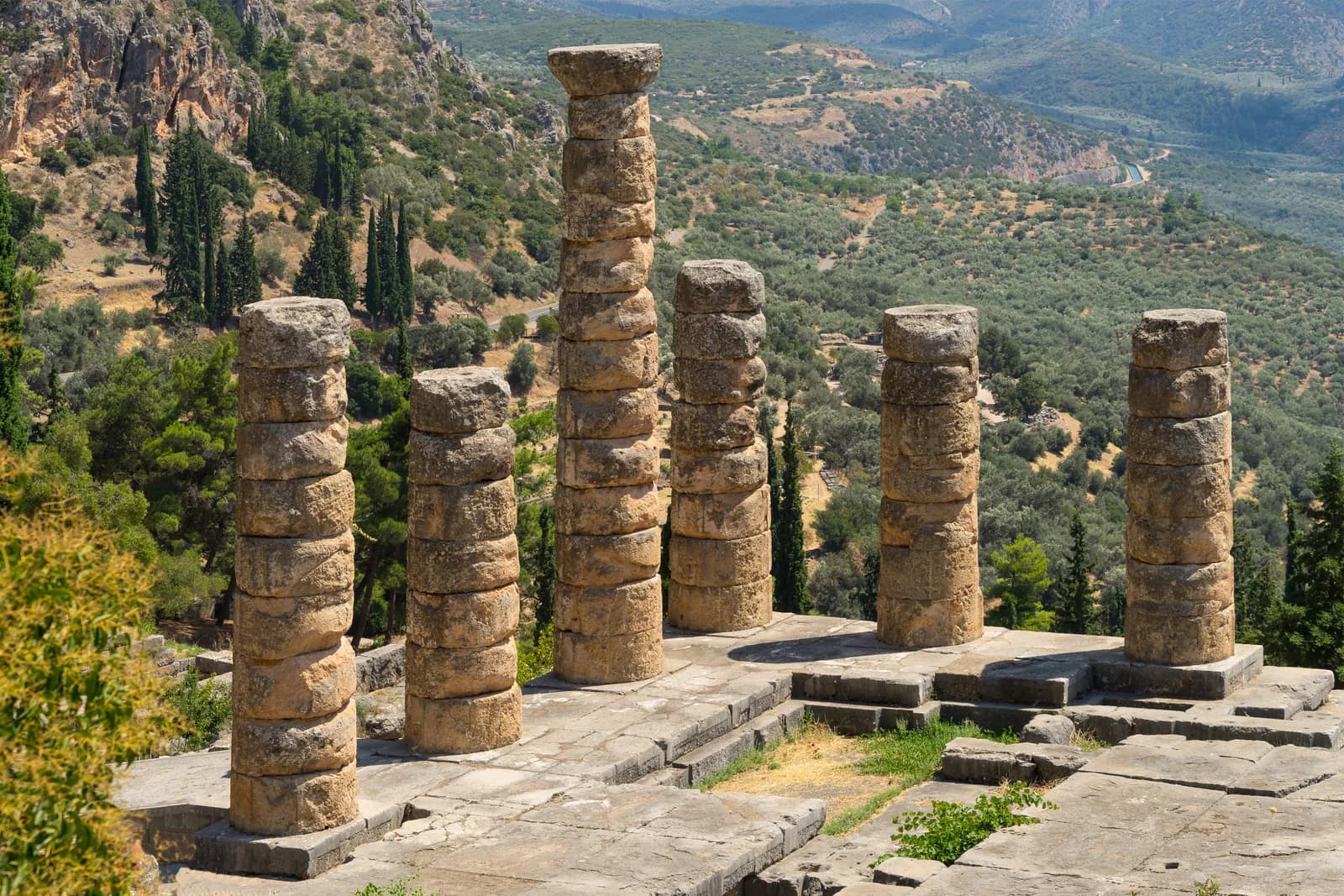
Six columns of the fourth-century temple were re-erected in the twentieth century.
Condition today
Standing ruin
The terrace, the foundations, the polygonal retaining wall with its inscriptions, and six re-erected columns. Nothing of the interior arrangement survives.
The French School's Grande Fouille from 1892 exposed the sanctuary. It recovered the building accounts, the subscription lists, the manumission inscriptions on the polygonal wall, and the archaic pedimental sculpture.
No fissure or chasm was found under the temple. A geological study published in 2001 identified faults crossing beneath the site and reported traces of light hydrocarbons including ethylene in the spring water and travertine. The finding has been contested on the grounds of concentration and of the geology, and it has not settled the question.
Scattered fragments
What has left the building, and where it is now. Where a holding is contested, the museum page says so.
- Evidence level: Documented
Archaic pedimental sculpture from the Alcmaeonid temple
- Evidence level: Documented
The building accounts and subscription lists of the fourth-century rebuilding
Written about in antiquity
Herodotus, Histories 5.62
Herodotus on the Alcmaeonids' contract for the temple, the marble front they were not obliged to build, and the Athenian claim that the oracle then favoured them.
Pausanias, Description of Greece 10.5–24
Pausanias walks the sanctuary and the temple, listing the dedications and reporting the tradition of the successive temples.
Plutarch, Moralia On the Obsolescence of Oracles; On the E at Delphi
Plutarch, who held a priesthood at Delphi, discusses the oracle's decline and the mechanism of inspiration. A source with unmatched access and a philosophical agenda, writing five centuries after the classical oracle's height.
Still argued
Were there vapours?
No fifth-century source mentions them; Plutarch, five centuries later, discusses a pneuma and its weakening. The excavators found no chasm. A 2001 geological study proposed ethylene from faults beneath the temple; critics have argued the concentrations are far too low and the geology does not support the mechanism. The honest position is that the physical basis of the Pythia's state is unknown and may not have existed.
How were the responses produced?
Accounts range from incoherent utterance versified by priests to lucid speech recorded verbatim. The surviving responses are mostly literary, shaped by the outcomes they were later said to have predicted, and the lead tablets from Dodona show that real oracular practice was overwhelmingly a matter of short yes-or-no questions rather than riddling hexameters.
How to read the evidence labels
- Evidence level: Documented
- Supported by a named primary text or by excavated material evidence.
- Evidence level: Probable
- Supported by strong inference that most specialists accept.
- Evidence level: Disputed
- Substantial specialist disagreement exists; competing readings are stated.
- Evidence level: Literary
- Belongs to poetic or mythological construction rather than to history.
- Evidence level: Mythological
- Belongs to shared religious or mythic tradition rather than to any single text.
- Evidence level: Unknown
- The available evidence is insufficient to decide.
These labels describe the status of the evidence, not our confidence in a conclusion. A claim marked Literary is not a claim we doubt; it is a claim about what kind of thing a poem is.