What it is
The Temple of Zeus at Olympia — Libon of Elis, the pediments and metopes, Pheidias's workshop and the cup with his name on it, and the collapse that left the columns in sequence.
Built Built c. 470–456 BCE; the cult statue added c. 430s. The principal date, c. 470–456 BCE, is approximate.
c. 470–456 BCE
Construction
Funded from the spoils of the Elean defeat of Pisa, and completed by 456, when a gilded shield was placed on the gable to commemorate a Spartan victory — the dedication is recorded and dates the finish.
c. 430s BCE
The statue of Zeus
Pheidias's chryselephantine Zeus, made in a purpose-built workshop beside the temple and installed a generation after the building.
1st century BCE – 4th century CE
Roman period
Repaired and re-roofed; the sanctuary continued to function and the games continued into the fourth century CE.
6th century CE
Collapse
Brought down by earthquake. The columns fell along their length and their drums lie where they landed, still in order.
Who ordered it built
Each attribution carries what supports it. Ancient buildings are routinely credited to people on the authority of writers centuries later, and that is not the same claim as an inscription on the building.
- Evidence level: Documented
Architect
Libon of Elis
Pausanias 5.10.3 names him as the architect of the temple.
- Evidence level: Documented
Sculptor
Pheidias
Pausanias 5.11 describes the statue in detail and names Pheidias. The workshop identified beside the temple produced tools, ivory and glass working debris, and a black-glaze cup inscribed with a statement of ownership naming him.
- Evidence level: Documented
Commissioned by
The Eleans
Pausanias 5.10.2: built from the spoils taken when Elis defeated Pisa and its allies.
What it was for
The principal temple of the sanctuary of Zeus and the house of the cult statue. The games were held in the sanctuary and the temple was their religious centre; the great altar of Zeus, where the sacrifices took place, stood outside it and was built up over centuries from the ash of the offerings.
It also held dedications, including the gold shield of the Spartan victory on its gable and the table on which the victors' crowns were laid.
How it was built
Built in coarse local limestone and rendered in fine stucco to imitate marble — a fact usually left out of accounts of Greek temples, and one that changes what the building looked like. Only the sculpture and the roof tiles were marble.
The proportions are heavy and archaic beside the Parthenon a generation later, and the temple is often used to date the transition; it is the canonical example of mature Doric before the Periclean refinements.
The pedimental compositions are among the most studied in Greek art. The east shows the moment before the chariot race of Pelops and Oinomaos, with the figures still and the outcome unstated; the west a centauromachy in violent motion with Apollo calm at the centre. The metopes over the porches show the twelve labours of Herakles, and it is here that the canonical set of twelve is first fixed.
Materials
- Evidence level: Documented
Local shelly limestone
The body of the temple, stuccoed to imitate marble
- Evidence level: Documented
Parian marble
The pedimental sculpture, the metopes and the roof tiles
- Evidence level: Documented
Gold and ivory
The cult statue, over a wooden armature
Measured
Every figure states what it rests on. A modern survey, an ancient text, a conversion from an ancient unit and a modern estimate are four different kinds of statement and are not interchangeable.
Stylobate
about 64.1 × 27.7 m
Modern survey of the platform.
Column height
about 10.4 m, with 6 columns on the front and 13 on the flanks
Modern survey and the reconstruction from the fallen drums.
The statue of Zeus
described as filling the temple, seated and nearly touching the roof
Strabo 8.3.30 makes the point that the seated god would have taken the roof off had he stood up, and treats it as a criticism of the proportions. No measurement survives; modern figures of eleven or thirteen metres are reconstructions from the temple's interior height.
What it meant
The temple was paid for out of a war between neighbours over control of the sanctuary, which is a reminder that Panhellenic did not mean neutral. Elis and Pisa fought repeatedly over who administered the games.
The shield on the gable commemorating a Spartan victory over Argos and its allies, placed on the temple of Zeus at the sanctuary all Greeks used, is a state advertising itself at everybody else's shrine. Dedications at Olympia and Delphi were a standing form of inter-city competition.
The great ash altar outside the temple, built up from the burnt thighbones of centuries of sacrifice, was the sanctuary's real centre. The temple housed the image; the altar was where the cult happened, which is the standard Greek arrangement and the one most often misdescribed.
After antiquity
The statue was reportedly taken to Constantinople in late antiquity and lost in a fire there; the report is late and the removal is not securely documented.
The temple was damaged by fire in the fifth century and thrown down by earthquake in the sixth. Later flooding by the Alpheios and the Kladeos buried the sanctuary in silt several metres deep, which is why so much survived to be excavated.
Condition today
Standing ruin
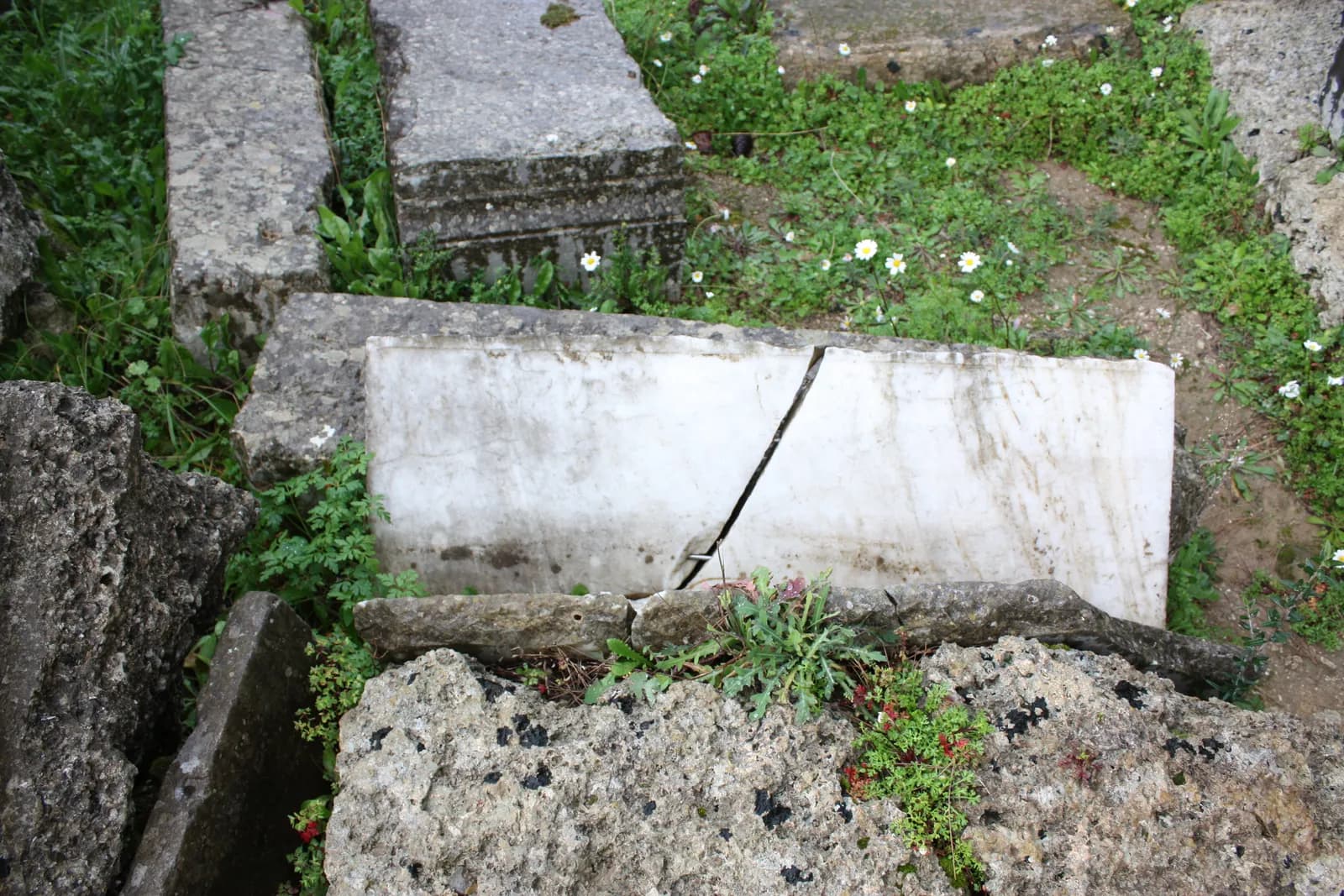
The platform, the fallen columns lying in sequence, and one column re-erected in 2004. The sculpture is in the site museum.
The German excavation begun in 1875 under Ernst Curtius was conducted under a formal agreement with the Greek state which provided that finds remained in Greece — the first excavation arranged on that basis, and a precedent that changed the terms of archaeology in the eastern Mediterranean.
Pheidias's workshop was identified in the 1950s beneath a later church, on the evidence of its dimensions matching the temple's cella, together with tools, ivory chips, glass and terracotta moulds for drapery, and a cup inscribed to say that it belonged to Pheidias. It is one of the very few ancient artists' workshops ever identified.
Scattered fragments
What has left the building, and where it is now. Where a holding is contested, the museum page says so.
- Evidence level: Documented
The pedimental sculpture, the metopes and the Nike of Paionios
- Evidence level: Documented
Tools, ivory working debris and the inscribed cup from Pheidias's workshop
- Evidence level: Documented
Metope fragments removed by the French expedition in 1829
Written about in antiquity
Pausanias, Description of Greece 5.10–11
Pausanias on the temple, its architect Libon, the pediments and metopes described figure by figure, and a long description of the statue of Zeus. The single most important text for any Greek building.
Strabo, Geography 8.3.30
Strabo on the statue: that Pheidias made it seated and nearly touching the roof, so that it would have unroofed the temple had it stood. A criticism, and the only ancient statement about its scale.
Still argued
What did the east pediment show, exactly?
Pausanias names the figures, and the surviving sculpture does not fit his account in every particular; the arrangement of the seers, the attendants and the chariot teams has been rearranged repeatedly since excavation. The current display is one reconstruction among several.
What happened to the statue?
A late tradition has it removed to Constantinople and destroyed in the fire of 475. Another has it burned at Olympia. No contemporary account of its removal survives, and the workshop evidence shows only where it was made.
How to read the evidence labels
- Evidence level: Documented
- Supported by a named primary text or by excavated material evidence.
- Evidence level: Probable
- Supported by strong inference that most specialists accept.
- Evidence level: Disputed
- Substantial specialist disagreement exists; competing readings are stated.
- Evidence level: Literary
- Belongs to poetic or mythological construction rather than to history.
- Evidence level: Mythological
- Belongs to shared religious or mythic tradition rather than to any single text.
- Evidence level: Unknown
- The available evidence is insufficient to decide.
These labels describe the status of the evidence, not our confidence in a conclusion. A claim marked Literary is not a claim we doubt; it is a claim about what kind of thing a poem is.