What it is
The Treasury of the Athenians at Delphi — the Marathon dedication and the dating problem, the Delphic hymns with their musical notation, and the 1906 re-erection from its own blocks.
Built Built around 500–485 BCE; the dating is argued. The principal date, c. 500–485 BCE, is disputed.
c. 500–485 BCE
Construction
Pausanias says it was built from the spoils of Marathon, which would put it after 490. The architectural style and the sculpture are argued by many to be earlier, which would make it a monument of the new democracy rather than of the battle.
after 490 BCE
The Marathon base
A terrace in front of the treasury carries an inscription recording a dedication to Apollo from the Persian spoils. It is separate from the building and it is what Pausanias's account most likely refers to.
128/7 BCE
The Delphic hymns
Two hymns to Apollo with musical notation were inscribed on the treasury's south wall, in connection with an Athenian religious embassy. The date of one is fixed by the archon named in it.
1903–1906
Re-erection
Rebuilt by the French School from its own fallen blocks, with modern stone filling the gaps.
Who ordered it built
Each attribution carries what supports it. Ancient buildings are routinely credited to people on the authority of writers centuries later, and that is not the same claim as an inscription on the building.
- Evidence level: Documented
Commissioned by
The Athenian demos
The building is identified as Athenian by its inscriptions and by Pausanias 10.11.5.
- Evidence level: Unknown
Architect
Unknown
No source names one.
What it was for
A treasury: a small, richly finished building put up by a city at a Panhellenic sanctuary to hold its dedications and to advertise itself. Delphi had more than twenty of them lining the Sacred Way, and they are the physical form of inter-city competition.
This one stood at the first turn of the path, where everyone climbing to the temple had to pass it.
How it was built
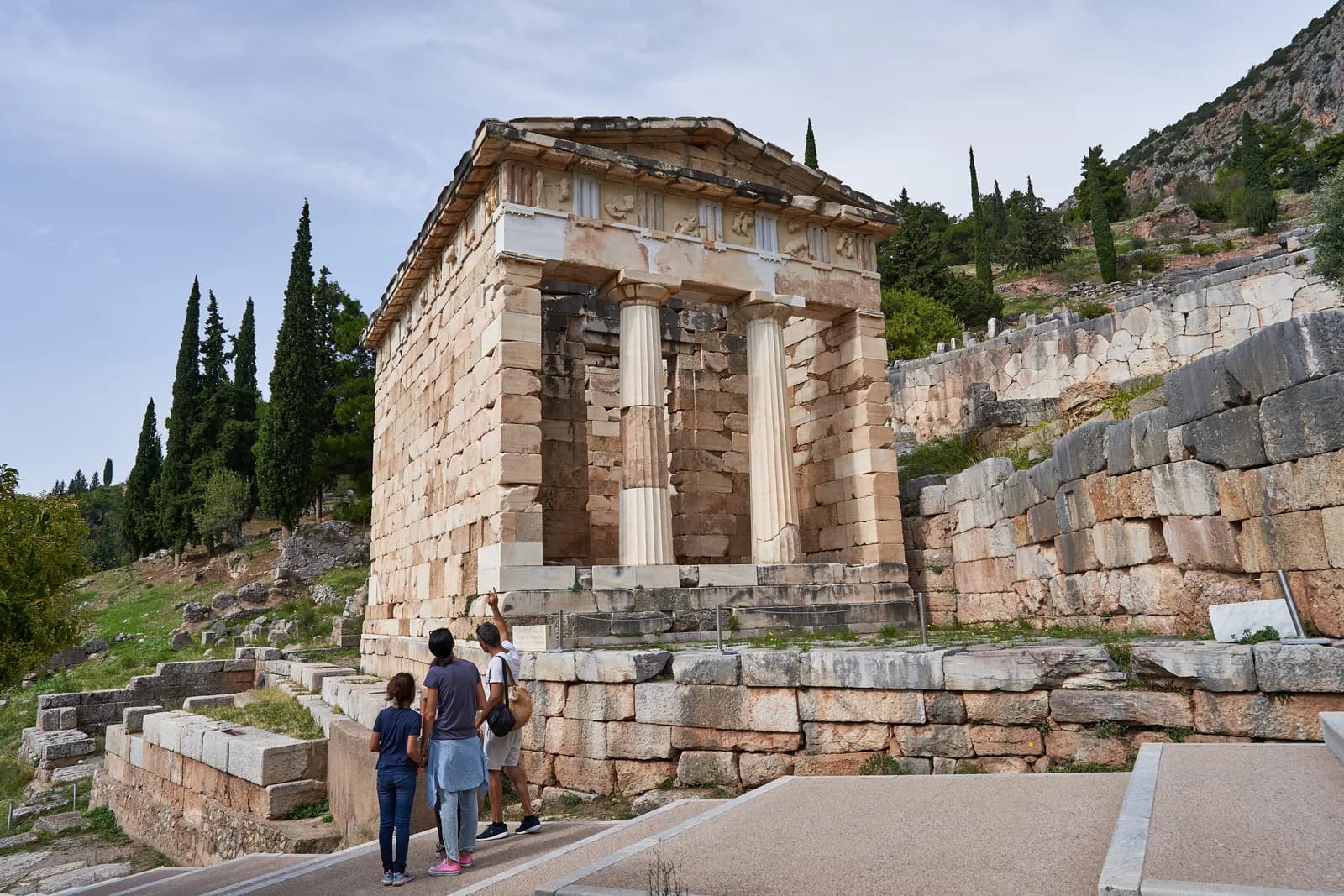
A small Doric building in antis — two columns between the projecting ends of the side walls — executed entirely in Parian marble, which for a structure of this size is a display of expenditure rather than of engineering.
The re-erection of 1903–1906 used the original blocks recovered from the site, supplemented with new marble where pieces were missing. It is one of the earliest large anastyloses and the new stone is distinguishable on close inspection.
Materials
- Evidence level: Documented
Parian marble
The whole building, at considerable expense for a structure this size
Measured
Every figure states what it rests on. A modern survey, an ancient text, a conversion from an ancient unit and a modern estimate are four different kinds of statement and are not interchangeable.
Ground plan
about 10 × 6 m
Modern survey of the re-erected building on its ancient foundations.
Metopes
thirty, showing the deeds of Herakles and of Theseus
Count from survey of the surviving and restored positions.
What it meant
Pairing the deeds of Theseus with the labours of Herakles on the metopes puts an Athenian hero on equal footing with the Panhellenic one, at the sanctuary where all Greeks would see it. Theseus was being systematically promoted at Athens in exactly this period as the founder-hero of the democratic city.
The dating dispute is therefore not a technicality. If the building precedes Marathon, it is a monument of the new democracy asserting itself at Delphi; if it follows the battle, it is a war memorial. The metopes read differently in each case.
The two hymns inscribed on the south wall were composed for an Athenian embassy to the sanctuary and carry vocal notation above the text — the earliest substantial surviving Greek music, and effectively the earliest written music from anywhere that can be performed.
That a hymn to Apollo survives with its melody on the wall of an Athenian building at Delphi is the closest the ancient world comes to leaving us a sound.
After antiquity
Collapsed and buried with the rest of the sanctuary; the site was covered by the village of Kastri until 1892.
Its blocks were recovered in the French excavation and the building was reassembled on its foundations in 1903–1906, funded by the city of Athens.
Condition today
Re-erected in modern times
Standing complete, rebuilt from its own blocks with modern infill. The metopes on the building are casts; the originals are in the site museum.
The 1903–1906 anastylosis is an early and influential example of the method: original material returned to its original position, new material used only where necessary and left plain. It also fixed a reconstruction of the metope sequence that has been revised since.
The building's blocks carried, in addition to the hymns, a large number of Athenian public inscriptions, so the treasury doubled as a noticeboard for Athenian business at the sanctuary.
The terrace in front carries the inscription recording a dedication from the Persian spoils, which is the evidential basis for the Marathon connection and belongs to a different structure from the treasury itself.
Scattered fragments
What has left the building, and where it is now. Where a holding is contested, the museum page says so.
- Evidence level: Documented
The original metopes
- Evidence level: Documented
The two Delphic hymns with musical notation
Written about in antiquity
Pausanias, Description of Greece 10.11.5
Pausanias states that the Athenians built the treasury from the spoils of the landing of Datis at Marathon. The sentence is the whole of the ancient evidence for the connection, and it is contested by the architecture.
The Delphic hymns inscribed on the south wall, 128/7 BCE
Two paeans to Apollo with vocal notation, composed for an Athenian embassy. The earliest substantial surviving music from the ancient world.
Still argued
Was it built before or after Marathon?
Pausanias says after, from the spoils. Many architectural historians date the style and the sculpture to the years around 500, before the battle, and read Pausanias as conflating the treasury with the separately inscribed dedication on the terrace in front of it. The question has been argued for over a century and is not settled.
How to read the evidence labels
- Evidence level: Documented
- Supported by a named primary text or by excavated material evidence.
- Evidence level: Probable
- Supported by strong inference that most specialists accept.
- Evidence level: Disputed
- Substantial specialist disagreement exists; competing readings are stated.
- Evidence level: Literary
- Belongs to poetic or mythological construction rather than to history.
- Evidence level: Mythological
- Belongs to shared religious or mythic tradition rather than to any single text.
- Evidence level: Unknown
- The available evidence is insufficient to decide.
These labels describe the status of the evidence, not our confidence in a conclusion. A claim marked Literary is not a claim we doubt; it is a claim about what kind of thing a poem is.