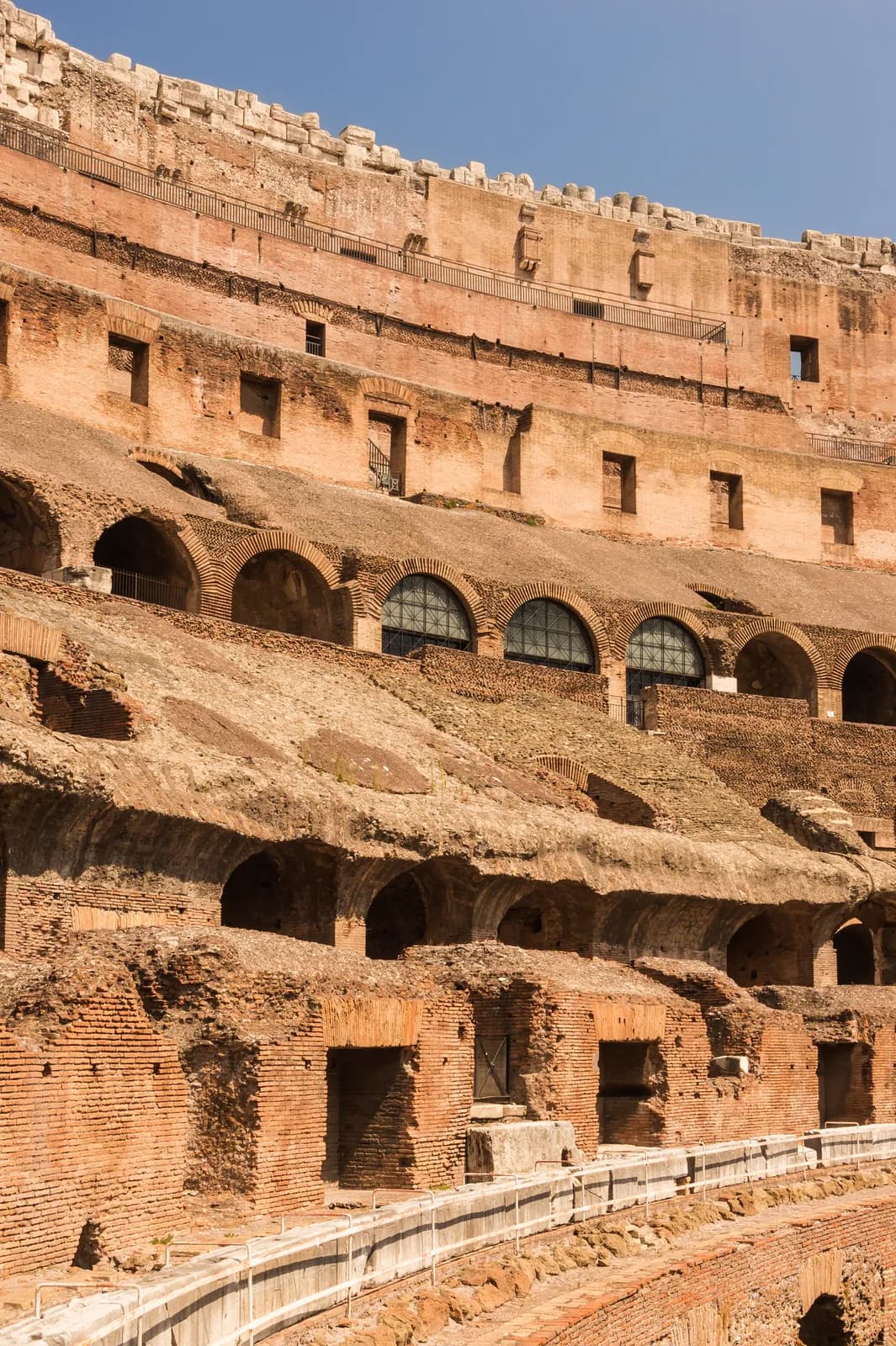
The amphitheatre is the one major Roman building type with no Greek ancestor, because the spectacle it housed had none. Two theatres face to face — amphi-theatron — produce an oval arena entirely surrounded by seating.
The earliest surviving stone example is at Pompeii, of about 70 BCE, more than a century before the Colosseum. The type is Campanian before it is Roman, which fits the origins of gladiatorial combat in Italy rather than at Rome.
The Colosseum is the engineering statement: an entirely free-standing structure of concrete, travertine and brick, with eighty arched entrances numbered so that ticket-holders reached their seats directly, and a substructure of tunnels and lifts beneath the arena floor. The seating was graded by rank, so the building displayed the social hierarchy to itself.
What the evidence supports
The amphitheatre has no Greek precedent.
No Greek city built one before Roman rule, and the spectacle it housed was not a Greek institution.
The Pompeii amphitheatre predates the Colosseum by roughly 150 years.
Dated by inscription and construction; it is the earliest surviving permanent stone amphitheatre known.
The Colosseum's arena substructures survive and are visible.
The hypogeum of tunnels, cages and lift shafts is excavated. How the machinery worked in detail is partly reconstruction.
Examples
The evidence level on each answers how we know what the building looked like, not whether it existed.
- Evidence level: Documented
Rome · Inaugurated 80 CE
The Colosseum (Flavian Amphitheatre)
Built on the site of the lake of Nero's Golden House — the return of appropriated ground to public use was part of the point. Standing to a great height, with the arena substructures excavated.
- Evidence level: Documented
Pompeii · c. 70 BCE
The amphitheatre at Pompeii
The earliest surviving stone example, and the scene of the riot of 59 CE that Tacitus records and a wall painting depicts. Excavated and substantially intact.
Primary sources
Tacitus, Annals 14.17
The riot at the Pompeii amphitheatre and the Senate's ten-year ban on games there.
Martial, On Spectacles
Poems written for the opening of the Flavian Amphitheatre.
How to read the evidence labels
- Evidence level: Documented
- Supported by a named primary text or by excavated material evidence.
- Evidence level: Probable
- Supported by strong inference that most specialists accept.
- Evidence level: Disputed
- Substantial specialist disagreement exists; competing readings are stated.
- Evidence level: Literary
- Belongs to poetic or mythological construction rather than to history.
- Evidence level: Mythological
- Belongs to shared religious or mythic tradition rather than to any single text.
- Evidence level: Unknown
- The available evidence is insufficient to decide.
These labels describe the status of the evidence, not our confidence in a conclusion. A claim marked Literary is not a claim we doubt; it is a claim about what kind of thing a poem is.