The Greek aspis is the determining object of hoplite warfare. Its double grip — armband at the centre, handgrip at the rim — puts the weight on the forearm and means the right-hand portion projects beyond the bearer, covering his neighbour. A hoplite line is a chain of overlapping shields, and its cohesion is a physical fact about how the shields are held.
The Macedonian pike phalanx needed both hands for the sarissa, so its shield was smaller and slung from the shoulder — a direct trade of protection for reach.
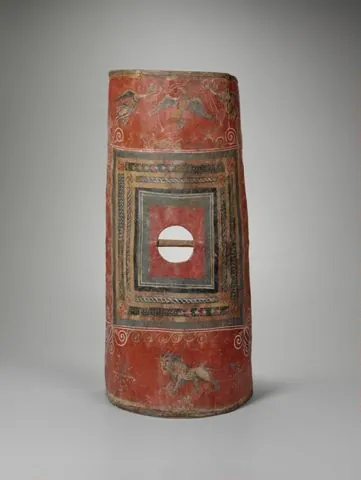
The Roman scutum was a curved plywood body shield, laminated and faced, large enough to cover the bearer and heavy enough to be used offensively with its boss. Its shape made possible the testudo, the tortoise, in which a unit locks shields overhead and to the sides for approaching walls. A complete painted scutum survives from Dura-Europos, which is exceptional.
What the evidence supports
The aspis's double grip determines hoplite formation.
Attested by surviving shields and fittings and by Thucydides' observation about lines drifting right.
A complete Roman scutum survives.
The Dura-Europos shield, preserved by desert conditions, shows plywood laminate construction and painted decoration.
The testudo is attested in text and in art.
Described in the narrative sources and depicted on Trajan's Column.
Whether the testudo was used in open battle is disputed.
Its attested uses are approaches to walls and withdrawals under missile fire. Its depiction on state monuments may reflect what looked impressive rather than what was routine, and reading it as a general battlefield formation goes beyond the evidence.
Archaeology
The Dura-Europos scutum is the outstanding survival. Greek shield facings and porpax fittings are known from sanctuary dedications, including examples inscribed as spoils taken from a named enemy.
Primary sources
Thucydides, History of the Peloponnesian War 5.71
Lines drifting rightward under the cover of the shield beside them.
Polybius, Histories 6.23
The dimensions and construction of the scutum.
Cassius Dio, Roman History 49.30
The testudo in use.
Battles
490 BCE
Marathon
An Athenian and Plataean hoplite force defeated a Persian expedition on the coast of Attica, and the Greek world learned that a Persian army could be beaten.
371 BCE
Leuctra
A Theban army under Epaminondas broke the Spartan phalanx in open battle, and with it the assumption that Spartan infantry could not be beaten.
216 BCE
Cannae
Hannibal destroyed the largest army Rome had ever put in the field by allowing his own centre to be pushed back, and produced the model double envelopment of European military history.
How to read the evidence labels
- Evidence level: Documented
- Supported by a named primary text or by excavated material evidence.
- Evidence level: Probable
- Supported by strong inference that most specialists accept.
- Evidence level: Disputed
- Substantial specialist disagreement exists; competing readings are stated.
- Evidence level: Literary
- Belongs to poetic or mythological construction rather than to history.
- Evidence level: Mythological
- Belongs to shared religious or mythic tradition rather than to any single text.
- Evidence level: Unknown
- The available evidence is insufficient to decide.
These labels describe the status of the evidence, not our confidence in a conclusion. A claim marked Literary is not a claim we doubt; it is a claim about what kind of thing a poem is.