The Corinthian helmet, beaten from a single sheet of bronze and enclosing the whole head, is the iconic Greek form and the most protective. It also nearly blinded and deafened the wearer, which in a formation that fought straight ahead was an acceptable trade and in any other context was not. Its replacement by open forms with cut-outs for ears follows the changes in how Greek armies fought.
Roman helmets evolve visibly. The Montefortino type derives from Celtic forms; Imperial Gallic helmets, manufactured in Gaul, add substantial neck guards and hinged cheek pieces while leaving the face and ears clear. The direction of travel is consistent: away from full enclosure, toward hearing, vision and command.
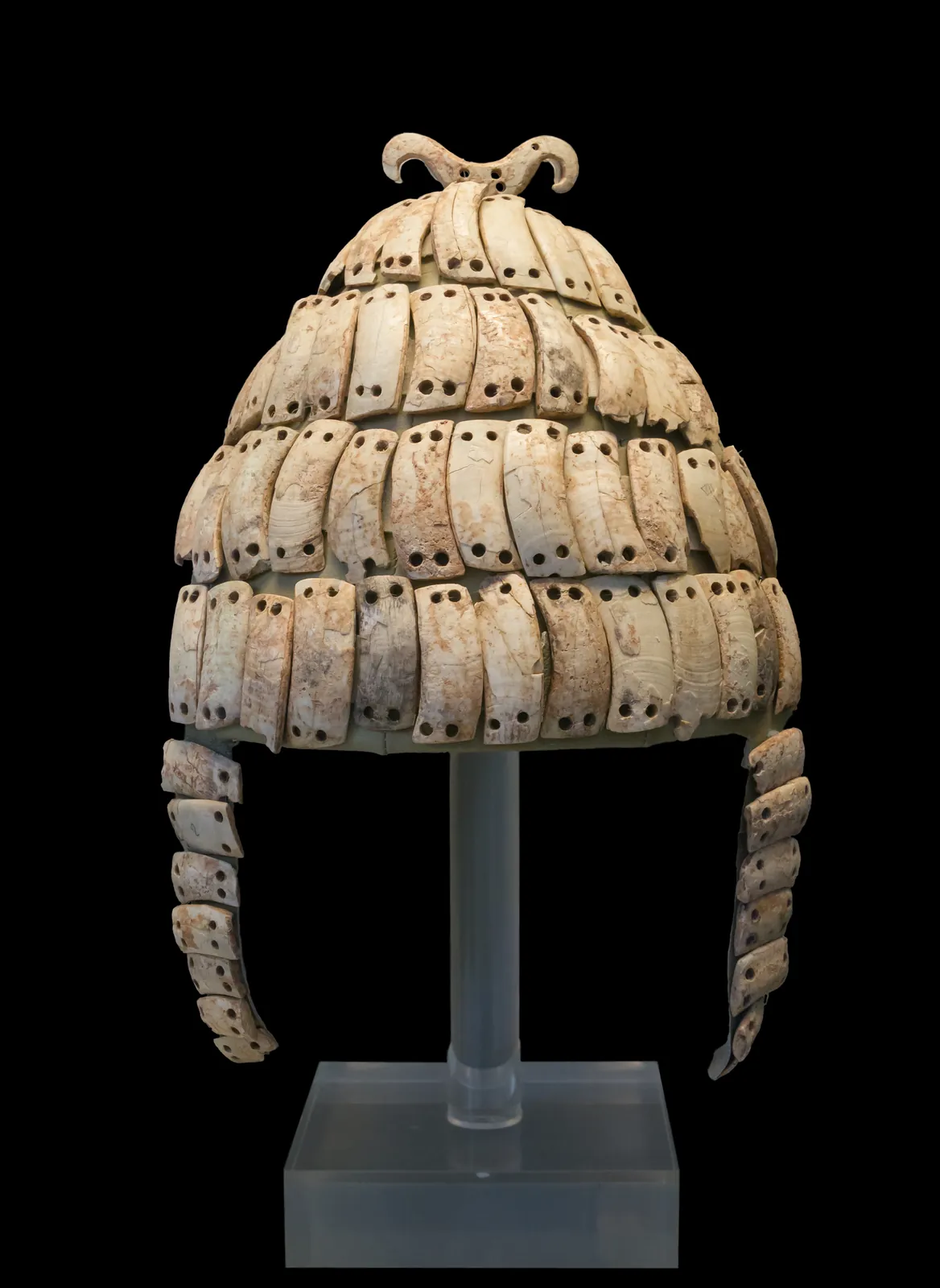
The boar's-tusk helmet of the Aegean Bronze Age, made of split tusks sewn to a leather cap, is the type described in the Iliad and excavated from Mycenaean contexts — a rare case of a Homeric object surviving in the ground.
What the evidence supports
The Corinthian helmet severely restricted hearing and peripheral vision.
Evident from surviving examples and from the later development of ear cut-outs specifically to address it.
Roman helmet types are well classified from finds.
The typology rests on large numbers of excavated examples with regional and chronological patterning.
Transverse crests as a mark of centurions are less securely attested than usually assumed.
The convention rests on a small number of depictions and on Vegetius; it is repeated with more confidence than the evidence supports.
Archaeology
Greek helmets survive in quantity as sanctuary dedications, many at Olympia, some inscribed as spoils. Mycenaean boar's-tusk helmets are known from excavation. Roman helmets are among the most numerous surviving items of military equipment.
Primary sources
Homer (attrib.), Iliad 10.261-265
The boar's-tusk helmet, an object centuries obsolete when the poem was composed.
Polybius, Histories 6.23
Roman helmet and crest.
Battles
490 BCE
Marathon
An Athenian and Plataean hoplite force defeated a Persian expedition on the coast of Attica, and the Greek world learned that a Persian army could be beaten.
480 BCE
Thermopylae
A Greek force held a coastal pass in central Greece for three days against the army of Xerxes, and was destroyed when the position was turned by a mountain path.
How to read the evidence labels
- Evidence level: Documented
- Supported by a named primary text or by excavated material evidence.
- Evidence level: Probable
- Supported by strong inference that most specialists accept.
- Evidence level: Disputed
- Substantial specialist disagreement exists; competing readings are stated.
- Evidence level: Literary
- Belongs to poetic or mythological construction rather than to history.
- Evidence level: Mythological
- Belongs to shared religious or mythic tradition rather than to any single text.
- Evidence level: Unknown
- The available evidence is insufficient to decide.
These labels describe the status of the evidence, not our confidence in a conclusion. A claim marked Literary is not a claim we doubt; it is a claim about what kind of thing a poem is.