Where the site is
At the northern foot of the Pierian mountains, above the plain of the Haliakmon, at the point where the Macedonian highlands meet the coastal lowland. Aigai was the old royal seat and remained the burial place of the dynasty after the administrative capital moved to Pella.
- Ancient region
- Macedonia
- Modern country
- Greece
- Position
- 40.481° N, 22.317° E — The Great Tumulus
- Given to three decimal places, about a hundred metres. It locates the named feature, not the extent of the site.
What survives
The Great Tumulus, a mound over a hundred metres across, now hollowed out and roofed as an underground museum with the tomb façades left in position and the finds displayed a few metres from where they were found. It is one of the few museums in the world that is the site.
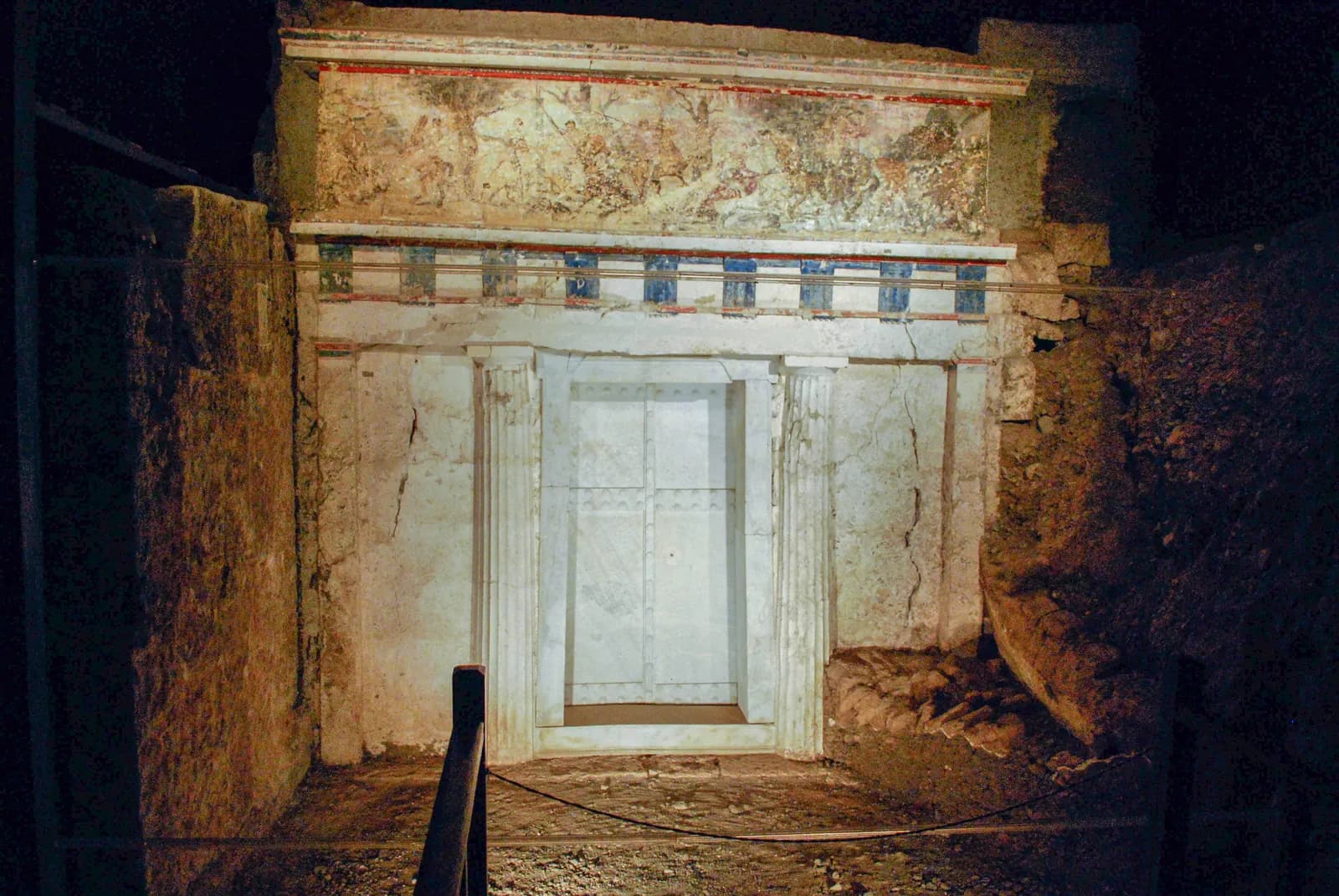
Tomb I is a cist grave, robbed in antiquity, with a wall painting of the abduction of Persephone that is among the very few surviving original Greek paintings of the fourth century BCE. Tomb II is a barrel-vaulted two-chamber tomb with a painted hunting frieze across its Doric façade, found intact. Tomb III, also unlooted, held a young man.
Above the tumulus, the palace of Aigai has been excavated and consolidated over decades and reopened to the public after a long restoration programme — a very large peristyle building with mosaic floors, a banqueting suite and a monumental façade over the theatre.
Occupation and chronology
Dates below are stored as signed years and rendered with the precision they actually carry. c. 1000 BCE is approximate; 168 BCE is fixed.
c. 1000–700 BCE
The Iron Age cemetery
Several hundred tumuli on the plain, excavated from the 1950s. The place was a burial ground for three centuries before there was a Macedonian kingdom to speak of.
6th–4th centuries BCE
The royal capital
Palace, theatre, sanctuaries and city wall. Philip II was assassinated in the theatre here in 336 BCE while attending his daughter's wedding.
later 4th century BCE
The royal tombs
The Great Tumulus was raised over a group of tombs, at least two of them unlooted. The mound itself may have been heaped to protect them after the Gallic raids of the 270s BCE.
168 BCE and after
Roman destruction
Aigai was destroyed after the Roman defeat of Perseus and never rebuilt at scale, which is why the site is recoverable.
History of excavation
Who recovered the evidence, when, and by what method. Where an excavation destroyed as much as it found, the entry says so.
- Evidence level: Documented
1855–1861
Léon Heuzey and Honoré Daumet
The French mission located and partly cleared the palace. The identification of the site as Aigai was not made then and remained disputed for over a century.
- Evidence level: Documented
1937–1976
Manolis Andronikos and others
The Iron Age cemetery, the palace and the theatre. Nicholas Hammond's argument in 1968 that Vergina was Aigai rather than Edessa is what redirected the search to the Great Tumulus.
- Evidence level: Documented
November 1977
Manolis Andronikos
Tomb II opened, unlooted: a gold larnax with a sixteen-rayed star on the lid holding cremated bone, a gold wreath, iron and gold armour, silver vessels, and in the antechamber a second burial of a woman with a gilded quiver. The most consequential Greek excavation of the twentieth century.
- Evidence level: Documented
1978–present
Aristotle University of Thessaloniki
Tomb III, the heroon above the tumulus, the city, the sanctuary of Eukleia, and the continuing study of the human remains — which is where the argument now lives.
Principal structures
The evidence level answers how we know what a structure looked like, not whether it existed.
- Evidence level: Documented
c. 340–310 BCE
Tomb II
Barrel-vaulted, two chambers, with a Doric façade carrying a painted frieze of a lion hunt. Unlooted, with its marble doors closed.
- Evidence level: Documented
c. 350–330 BCE
Tomb I
A cist grave, robbed, whose walls carry the Persephone painting. The painting survives because robbers take gold and not plaster.
- Evidence level: Documented
c. 340s BCE
The palace of Aigai
A vast square peristyle building with a mosaic-floored banqueting suite, probably built under Philip II. Its scale is the physical measure of what Macedonian kingship had become.
- Evidence level: Documented
mid-4th century BCE
The theatre
Immediately below the palace. The place where Philip II was killed, according to Diodorus — the identification of the venue is secure, the reconstruction of the event is not.
Finds and where they went
Almost nothing recovered from these sites is still on them. Where an object has a full provenance record on this platform, it is linked.
- Evidence level: Documented
The gold larnax and wreath from Tomb II
A gold chest with a rayed star on its lid, holding cremated bone wrapped in purple cloth, and a gold oak wreath of exceptional workmanship. Weight, workmanship and the absence of looting make this the richest documented Greek burial assemblage.
Museum of the Royal Tombs of Aigai, Vergina
- Evidence level: Disputed
The hunting frieze
A painted frieze across the façade of Tomb II showing a lion hunt with ten figures in a landscape. Original fourth-century Greek painting of this scale survives almost nowhere else, and identifications of individual figures as Philip or Alexander are proposals, not readings.
In position, Vergina
- Evidence level: Documented
The armour and the greaves
An iron cuirass with gold fittings, a gilded gorytos of Scythian type, and a pair of bronze greaves of unequal length. The greaves are one of the central pieces of evidence in the identification argument.
Museum of the Royal Tombs of Aigai, Vergina
- Evidence level: Probable
The Persephone painting
Hades seizing Persephone into a chariot, painted directly on the wall of Tomb I in rapid, confident strokes. Attributed by some to Nikomachos; the attribution rests on style and on ancient lists of painters, not on any signature.
In position, Vergina
Ancient testimony
What ancient authors say about the place, and how far it can be trusted.
Diodorus Siculus, Library of History 16.91–95
Diodorus on the wedding at Aigai and the assassination of Philip II in the theatre by Pausanias of Orestis, with the ceremonial that preceded it. The fullest ancient account of the event the site is famous for.
Plutarch, Life of Alexander 2–3, 9–10
Plutarch on Philip's court, the quarrel at the wedding of Attalus's niece, and the aftermath of the murder — written four centuries later and from a biographical rather than an archaeological interest.
How the site has been interpreted
Vergina changed what could be said about Macedonian material culture. Before 1977 Macedonia was largely a textual kingdom, described by Athenian orators who despised it; afterwards it was a kingdom with monumental painting, goldwork and architecture of the first rank, which made the Athenian characterisation of it as a half-barbarian frontier state look like what it was, which is polemic.
The tombs are also the best evidence for Macedonian burial practice at the top of society: cremation, a vaulted chamber, weapons and drinking equipment, a wreath, and a mound. The vaulted chamber matters because barrel vaulting in Greece appears at roughly this moment, and the date of its introduction is one of the arguments in the identification dispute.
The rayed star on the larnax became a modern political symbol in the 1990s during the dispute over the name of the neighbouring republic. That is a fact about the twentieth century and not about the fourth century BCE, and it is worth keeping the two firmly apart when reading anything written about this site since 1991.
Unresolved
Who is buried in Tomb II?
Andronikos identified the occupant as Philip II, killed in 336 BCE, and the identification is still widely held: the wealth, the date range, the greaves of unequal length matching Philip's recorded leg wound, and the traces some have read as an eye injury. The opposing case, argued by Phyllis Lehmann, Eugene Borza, Olga Palagia and others, holds that the barrel vault is too early for 336, that the Scythian gorytos and some pottery point later, and that the occupants are Philip III Arrhidaeus and Adea Eurydice, who died in 317 and were reburied at Aigai. A 2015 study proposed instead that Tomb I holds Philip II, on the basis of a fused knee joint in one skeleton. Osteological work since has been read both ways. There is no consensus, and pages that state one answer flatly are not reporting the state of the evidence.
Whom does the hunting frieze show?
Proposals identify individual riders as Philip II, Alexander, or a generic royal group, and read the setting as Macedonian or Asian. Each identification implies a different date for the tomb and therefore a different occupant, which is why the painting is argued about as hard as the bones.
How to read the evidence labels
- Evidence level: Documented
- Supported by a named primary text or by excavated material evidence.
- Evidence level: Probable
- Supported by strong inference that most specialists accept.
- Evidence level: Disputed
- Substantial specialist disagreement exists; competing readings are stated.
- Evidence level: Literary
- Belongs to poetic or mythological construction rather than to history.
- Evidence level: Mythological
- Belongs to shared religious or mythic tradition rather than to any single text.
- Evidence level: Unknown
- The available evidence is insufficient to decide.
These labels describe the status of the evidence, not our confidence in a conclusion. A claim marked Literary is not a claim we doubt; it is a claim about what kind of thing a poem is.