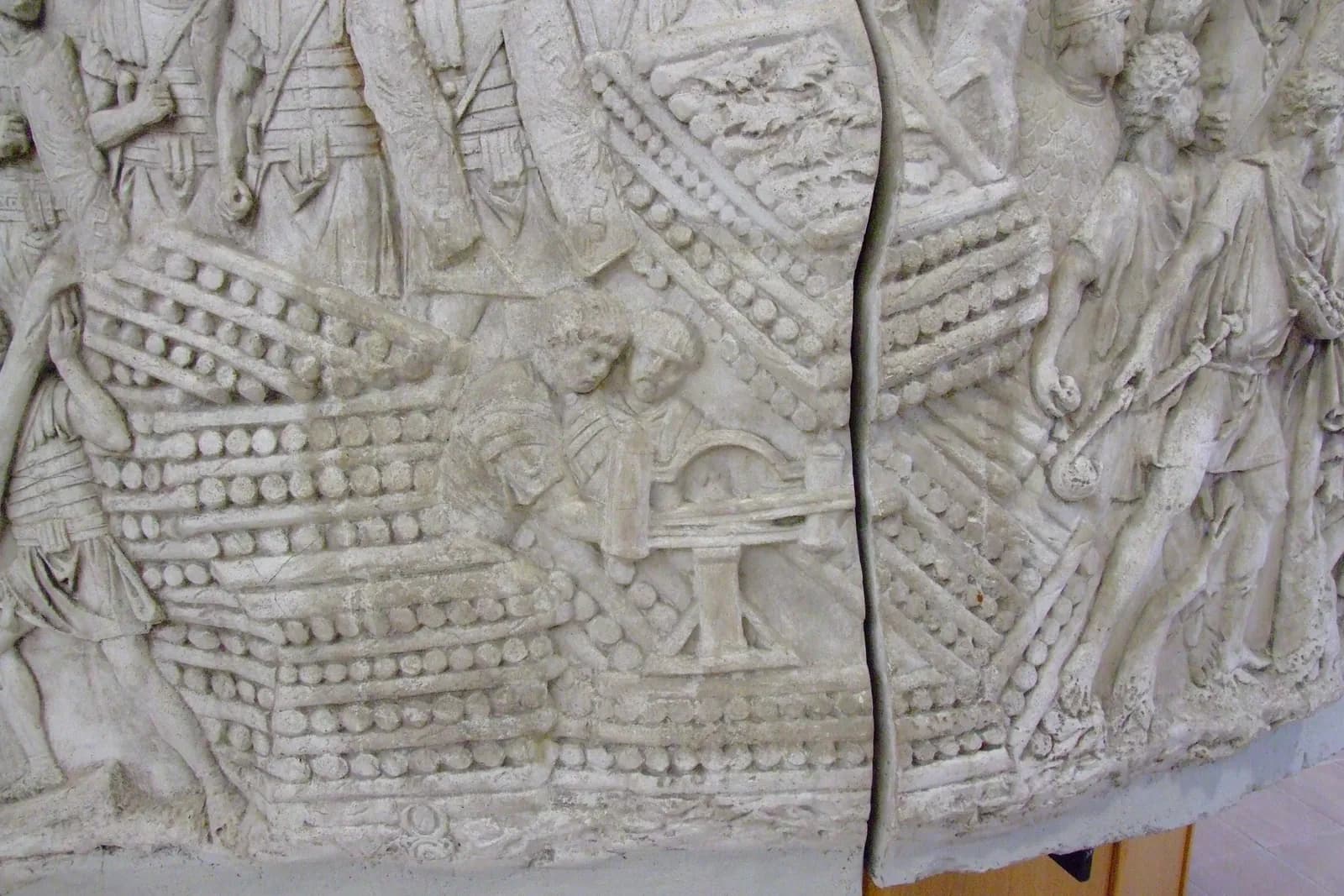
The ballista family is the torsion engine adapted for direct fire: two arms driven by separate spring-skeins, shooting a bolt or a stone along a slider. It served in sieges on both sides of the wall and in the field, where it gave a Roman army a reach nothing in an opposing line could match.
Roman and Greek terminology is unstable. In the earlier period ballista tends to name a stone-thrower and catapulta a bolt-shooter; by late antiquity the usage has effectively reversed. Reading a technical term without its date is a reliable way to get an ancient engine wrong.
The late-Roman iron-framed engines are the best-evidenced, because iron survives where wood does not. Fittings recovered at sites including Xanten and Hatra have allowed working reconstructions and confirmed that the design descriptions in the technical writers describe real machines.
What the evidence supports
Iron artillery frames survive and have been reconstructed.
Finds from Roman military sites have permitted reconstruction of late-Roman bolt-shooters that function, corroborating the technical treatises.
The terminology reverses over time.
Well established in the technical literature and a standard caution in the field.
Field use of artillery was routine by the Principate.
Artillery appears on Trajan's Column and in narrative accounts of set-piece battles as well as sieges.
Archaeology
Metal frame components, spring washers and bolt heads from military sites across the empire. Trajan's Column supplies the iconography, with the usual caution that state monuments idealise.
Primary sources
Heron of Alexandria, Cheiroballistra
A technical description of a late torsion engine.
Ammianus Marcellinus, Res Gestae 23.4
A fourth-century description of artillery in use by a serving officer.
Roman state monument, Trajan's Column reliefs
Pictorial evidence for artillery in the field, on a monument of 113 CE.
Battles
52 BCE
Alesia
Caesar besieged Vercingetarix inside a hilltop stronghold while simultaneously defending his own siege lines against a relief army, and ended organised Gallic resistance.
How to read the evidence labels
- Evidence level: Documented
- Supported by a named primary text or by excavated material evidence.
- Evidence level: Probable
- Supported by strong inference that most specialists accept.
- Evidence level: Disputed
- Substantial specialist disagreement exists; competing readings are stated.
- Evidence level: Literary
- Belongs to poetic or mythological construction rather than to history.
- Evidence level: Mythological
- Belongs to shared religious or mythic tradition rather than to any single text.
- Evidence level: Unknown
- The available evidence is insufficient to decide.
These labels describe the status of the evidence, not our confidence in a conclusion. A claim marked Literary is not a claim we doubt; it is a claim about what kind of thing a poem is.