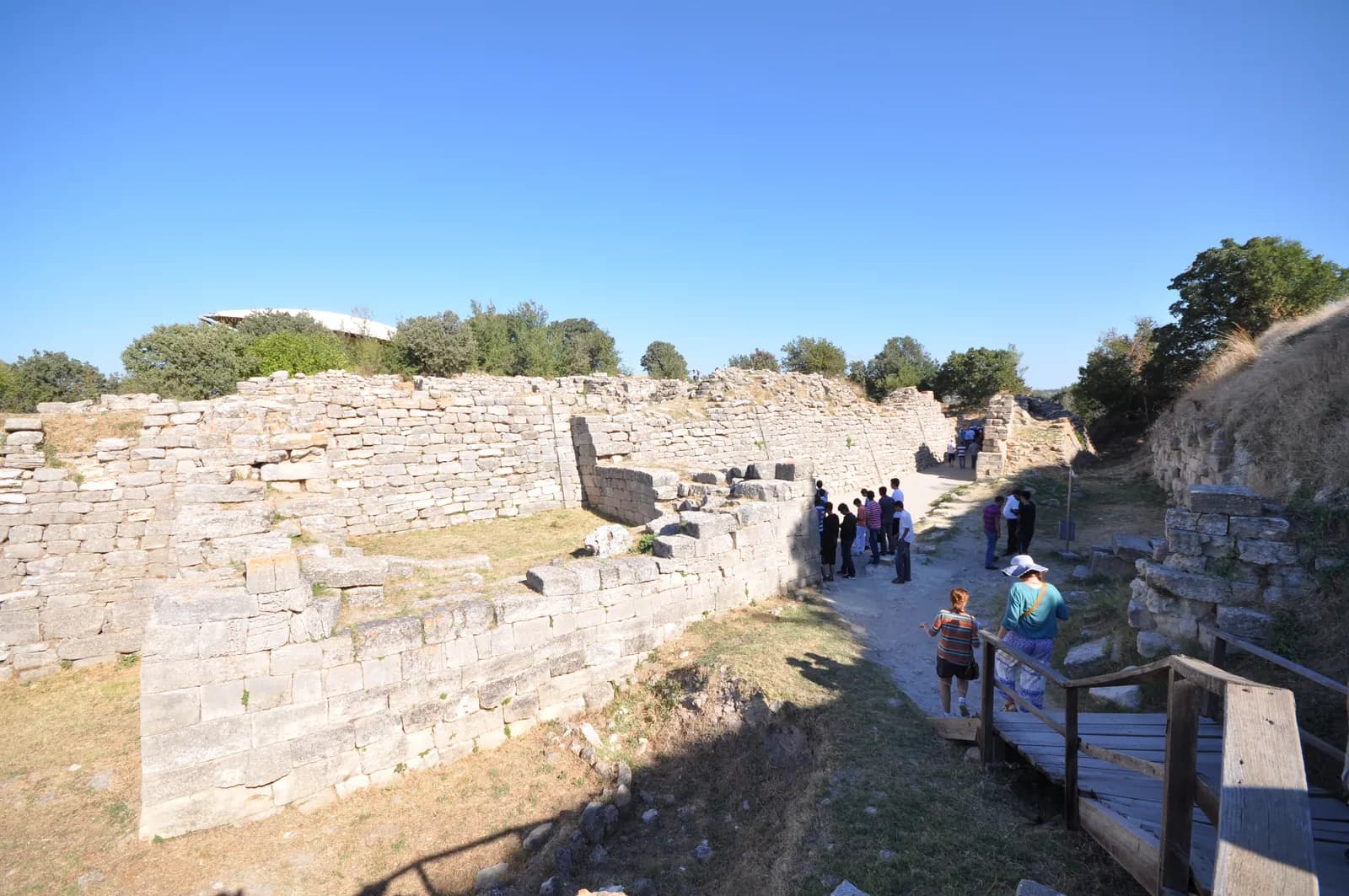
The site and its setting
Hisarlik is a mound at the western end of the Troad, commanding the approach to the Dardanelles — the strait connecting the Aegean to the Sea of Marmara and the Black Sea beyond.
That position is the site's whole significance: it controls a route, and the prevailing winds and current in the strait mean ancient ships often had to wait for conditions, in a place someone could tax them.
Foundation
Founded by Ilus, son of Tros, and walled by Poseidon and Apollo in servitude to Laomedon.
The foundation belongs to the Trojan cycle. Archaeologically the mound shows continuous occupation from the Early Bronze Age.
History of the settlement
The mound contains nine principal occupation levels, conventionally Troy I to IX, spanning roughly three thousand years, each built on the levelled remains of the last.
Troy VI, with substantial cut-stone walls and towers, and Troy VIIa, which shows destruction by fire and hastily built storage within the citadel, are the candidates usually discussed in connection with the Homeric city. Troy VIII and IX are the Greek and Roman city of Ilion, which existed as a real town with a temple of Athena and was visited by Alexander and later patronised by Rome.
Urban plan
The citadel is small — a few hundred metres across — with a fortification circuit, gates and a ramp, and buildings of megaron plan in the earlier phases.
Whether there was a substantial lower town outside the citadel is the central archaeological controversy of the site. Manfred Korfmann's excavations from 1988 identified a ditch and traces of settlement south of the citadel and argued for a lower city of some size; Frank Kolb argued that the evidence did not support a city of that character and that Troy was a modest citadel.
Economy and supply
Control of the strait, and probably of the waiting traffic. Textile production is attested by very large numbers of spindle whorls.
Troy VI shows imported Mycenaean pottery, which establishes contact with the Aegean world, though the volume and its meaning are argued.
Cult and sanctuaries
The Greek and Roman city maintained a temple of Athena Ilias, and the site had cult continuity as the supposed location of the Trojan War for as long as antiquity lasted.
That later cult is itself historically important: Troy in the classical and Roman periods was a place of pilgrimage for people who believed the Iliad happened there, and Rome claimed descent from Trojan refugees.
The city at war
The walls of Troy VI are substantial by Anatolian Bronze Age standards, with a pronounced batter and projecting towers, and they were built to be defended.
Destruction levels occur repeatedly in the sequence, by fire, by earthquake and by causes that cannot be distinguished. Interpreting any one of them as the war of the poems requires an inference the material does not supply.
Population
Ancient population figures are quoted with a confidence the evidence never supported. Each estimate below carries what it rests on and what it is worth.
The Late Bronze Age citadel
Perhaps a few hundred within the citadel
Modern estimate from the enclosed area
The citadel is small and its capacity can be estimated with some confidence. It is the lower city, and therefore the total, that is disputed.
The Late Bronze Age settlement including any lower town
Estimates range from a few hundred to around ten thousand
Depends entirely on the interpretation of the ditch and the extent of settlement outside the citadel
This is the substance of the Korfmann–Kolb controversy. The high figures make Troy a regional trading centre; the low ones make it a fortified seat with a small dependent settlement. The disagreement is about interpretation of the same evidence.
Monuments
- Evidence level: Documented
c. 1700–1300 BCE
The walls and gates of Troy VI
Cut-stone circuit with a distinctive batter, towers and gateways — the most impressive built remains on the site.
- Evidence level: Documented
1870s
Schliemann's trench
A great cut driven through the mound in search of the earliest levels, which destroyed much of the intervening stratigraphy. It is now itself a monument to the history of the discipline.
- Evidence level: Documented
Hellenistic and Roman
The theatre and sanctuary of Ilion
The classical and Roman city that grew on the mound because of what people believed had happened there.
Archaeology and excavation
Heinrich Schliemann excavated from 1870, driving a deep trench through the mound and reaching Troy II, which he identified as Priam's city — roughly a thousand years too early. The gold he called Priam's Treasure belongs to that early level; it was removed to Berlin, taken to Moscow in 1945, and its whereabouts were denied for decades before being acknowledged in 1993. Wilhelm Dörpfeld, Carl Blegen and, from 1988, Manfred Korfmann established the modern stratigraphy and investigated the area beyond the citadel.
Troy is the site where the limits of archaeology are clearest. Excavation can establish that a place was fortified, traded and burned. It cannot establish who burned it or why, and it cannot recover an individual. The identification of the mound with the Ilios of Greek tradition is probable; everything beyond that requires care.
Museum collections
Where the finds are now. Where a holding is contested, the entry says so.
Troy Museum · Tevfikiye, Çanakkale, Türkiye
Finds from the site across all periods, opened in 2018.
Pushkin Museum · Moscow, Russia
The greater part of the gold Schliemann called Priam's Treasure.
Removed from Berlin at the end of the Second World War; its presence in Moscow was denied until 1993 and remains disputed between Russia, Germany and Türkiye.
Istanbul Archaeological Museums · Istanbul, Türkiye
Material from Hisarlik retained in Türkiye.
Open questions
Was there a substantial lower city?
Korfmann's excavations identified a ditch and settlement traces south of the citadel and supported a reconstruction of Troy as a considerable Late Bronze Age town with Anatolian affinities. Frank Kolb argued publicly and sharply that the evidence was insufficient and that the reconstruction outran it. The controversy was among the most prominent in recent classical archaeology and is not settled.
Which level, if any, is the Homeric Troy?
Troy VI and Troy VIIa are the candidates, on the grounds of scale and of destruction respectively. Nothing found at either connects it to a Greek coalition or to any named person, and destruction by earthquake, fire and attack are not always separable in the record.
Primary sources
Homer (attrib.), Iliad
The poem the site is measured against, and not a description of it.
Strabo, Geography 13.1
A discussion of the site and of the identification of Ilion, showing the question was already argued in antiquity.
Hittite administration, Hittite archives from Hattusa the Alaksandu treaty and related texts
References to Wilusa, generally equated with Ilios, and to Ahhiyawa. The equations are widely accepted and are not certain.
How to read the evidence labels
- Evidence level: Documented
- Supported by a named primary text or by excavated material evidence.
- Evidence level: Probable
- Supported by strong inference that most specialists accept.
- Evidence level: Disputed
- Substantial specialist disagreement exists; competing readings are stated.
- Evidence level: Literary
- Belongs to poetic or mythological construction rather than to history.
- Evidence level: Mythological
- Belongs to shared religious or mythic tradition rather than to any single text.
- Evidence level: Unknown
- The available evidence is insufficient to decide.
These labels describe the status of the evidence, not our confidence in a conclusion. A claim marked Literary is not a claim we doubt; it is a claim about what kind of thing a poem is.