What the Odyssey is
The Odyssey is a poem of roughly twelve thousand one hundred lines in dactylic hexameter, divided in the transmitted text into twenty-four books. Its subject, announced in its first line, is a man: ándra moi énnepe, Moûsa, polýtropon — "tell me, Muse, of the man of many turns." The adjective is the poem's first difficulty. Polytropos means turned many ways, and it can be praise or accusation: widely travelled, or shifty. The poem never resolves the ambiguity, and readers who want a straightforward hero have been arguing with the first line for two and a half thousand years.
What follows is the story of a return. Odysseus, king of Ithaca, has been away twenty years — ten at Troy and ten getting home. The poem begins in the last of those years, with the hero held on a distant island, his son grown, his father withdrawn to the country, his wife besieged by suitors who are eating his estate while they wait for her to choose one of them, and his household staff quietly dividing into the loyal and the disloyal. Over twenty-four books he gets home, conceals himself, tests everyone, and takes the house back by killing every man in it.
It is not principally an adventure story, though it contains the most famous adventures in European literature. The monsters occupy four books of twenty-four. The other twenty are about a household, a kingdom, a marriage, a son, a set of obligations between hosts and guests, and the question of what a man is when nobody knows who he is.
Traditional authorship
The poem is attributed to Homer. That attribution is ancient, nearly universal in antiquity, and not verifiable. Whether one poet composed both Homeric epics was already disputed in antiquity — the ancient scholars who separated them were called the chorizontes — and the modern argument about composition, unity and transmission has run since 1795. This platform treats the attribution as traditional rather than established, and sets out the state of the question at The Homeric Question.
What is not in doubt is that the poem stands at the end of a long oral tradition. Its language is a Kunstsprache, an artificial poetic dialect nobody ever spoke, built out of layers of different ages and carrying a formulaic system of remarkable economy. See Oral tradition and the making of the poems.
Approximate composition context
The conventional dating is the eighth or early seventh century BCE, with the Odyssey generally held to be the later of the two epics. The dating is an inference from language, from the material culture the poem describes, and from datable references — the Phoenician traders who appear repeatedly belong to the world after about 800 BCE. It is not a transmitted fact and it is not precise.
The poem's own setting is the aftermath of the Trojan War, which the Greeks placed in what we call the Late Bronze Age. The distance between the world the poem describes and the world of the poet is one of the central problems in reading it, and it cannot be resolved by choosing one of them. See Homer and history.
Relationship to the Iliad
The two poems share a world, a metre, a diction and a cast, and they are almost opposite in temperament.
The Iliad is a poem of a few weeks, in one place, about the wrath of a man who chooses a short glorious life. It ends with a funeral. The Odyssey is a poem of ten years across the known and unknown world, about a man who wants above all to survive and get home, and it ends with a household restored. The Iliad is concerned with honour and mortality; the Odyssey with endurance, disguise, recognition and property.
The Odyssey also knows the Iliad's story and takes positions on it. Achilles, met among the dead in Book 11, says he would rather be a landless labourer among the living than king of all the dead — a direct repudiation of the value system the Iliad is built on, spoken by the man who embodied it. Agamemnon's homecoming, murdered by his wife and her lover, is invoked repeatedly as the shadow-version of Odysseus's own: the return that goes wrong, held up as a warning to Telemachus and as the reason Odysseus tests his household before revealing himself.
See Iliad and Odyssey.
Narrative structure
The poem's architecture is its most sophisticated feature and the one most often lost in retelling. It falls into four movements:
Books 1–4, the Telemachy. Odysseus does not appear. The poem opens in Ithaca with the crisis in his house and follows his son Telemachus to Pylos and Sparta in search of news. The effect is to establish what is at stake before the hero exists on the page.
Books 5–8, from Ogygia to Scheria. Odysseus appears in Book 5, weeping on Calypso's beach. He is released, wrecked, and washed up among the Phaeacians, who receive him with perfect hospitality.
Books 9–12, the Apologoi. Odysseus tells his own wanderings, in the first person, at the Phaeacian court. The Cyclops, Circe, the dead, the Sirens, Scylla and Charybdis, the cattle of the Sun — all of the poem's famous material is narrated by the character with the strongest reason to shape a story in his own favour, and the poem knows this.
Books 13–24, Ithaca. The longest movement, and the one popular memory shortens most. Odysseus lands disguised, lodges with a swineherd, reveals himself to his son, enters his own house as a beggar, is abused there, is recognised by an old servant from a scar, strings the bow, kills the suitors, is tested by his wife, and faces the consequences.
Beginning in the middle, withholding the hero, and putting the marvels into retrospective first-person narration are choices. The poem is constructed, not assembled.
The poem's twenty-four books
The book divisions are probably Alexandrian rather than original, but they are the universal reference system and they map onto real structural joints. Each book has its own page in our book-by-book guide, which sets out summary, characters, places, themes, narrative function, the Greek concepts in play, and the connections to the rest of the poem.
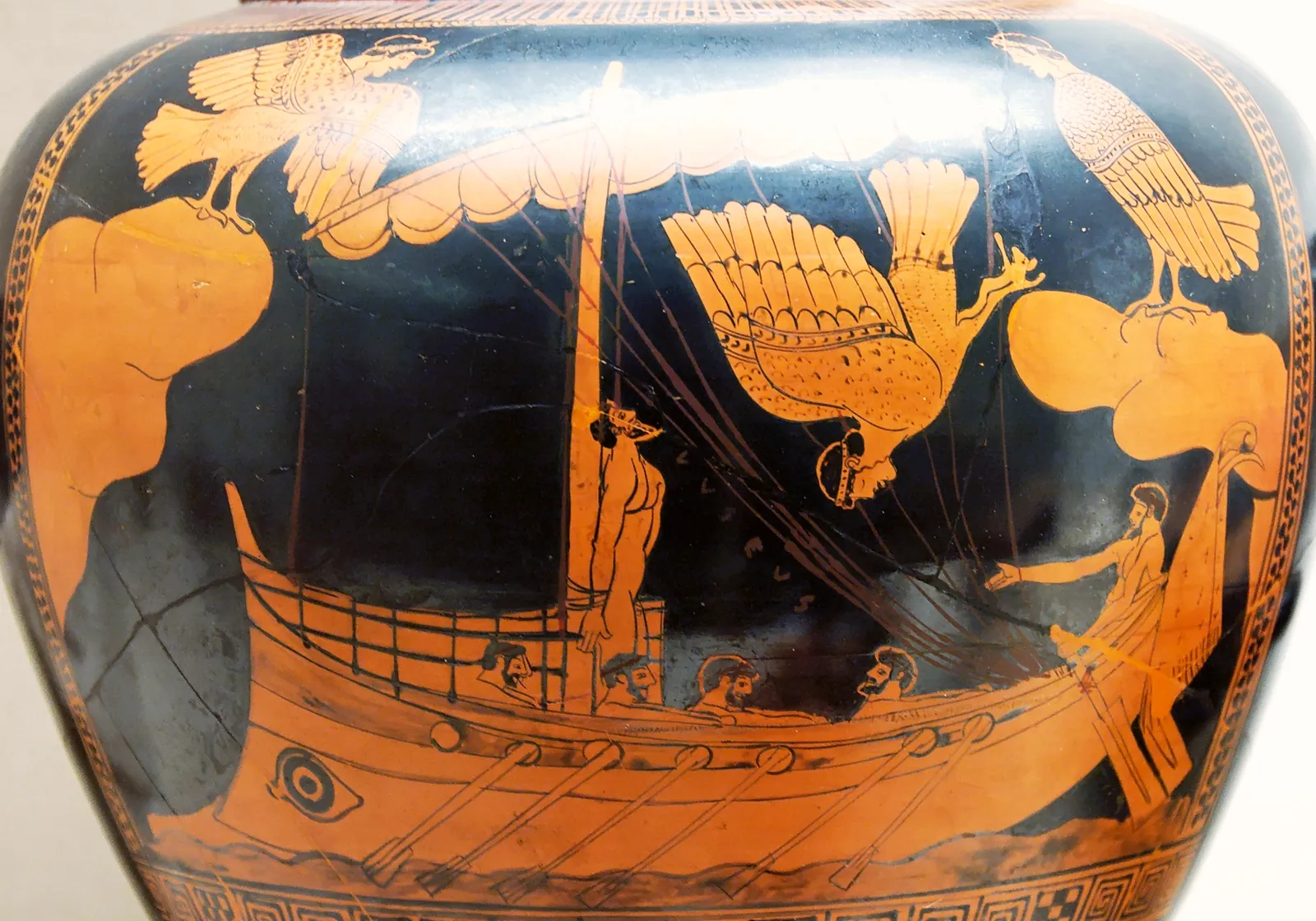
The journey home
The wanderings occupy Books 9 to 12 and are told by Odysseus at a banquet. The sequence is: the Cicones, whose city he sacks and where he loses men to his crew's refusal to leave; the Lotus-Eaters, whose food destroys the will to return; Polyphemus the Cyclops, blinded by a trick of language as much as of violence; Aeolus, whose bag of winds the crew opens in sight of Ithaca; the Laestrygonians, who destroy all the ships but one; Circe, who turns the men into swine and then becomes a host; the journey to the edge of the world to consult the dead; the Sirens; Scylla and Charybdis, where six men are eaten because there is no better option; Thrinacia, where the crew eat the cattle of the Sun and are destroyed for it; and Ogygia, where Calypso holds him seven years.
Two things about this sequence are worth insisting on. First, it is told, not shown: it is the hero's account of himself. Second, its moral logic is consistent. Odysseus loses his men in stages, and in almost every stage the loss is caused by appetite, disobedience or his own conspicuousness — the taunt he shouts at the blinded Cyclops gives Polyphemus his name and makes possible the curse that follows him home.
Ithaca and political order
The Ithaca of the poem is not a functioning kingdom. It is a kingdom with a vacancy. The assembly in Book 2 is the first held in twenty years, and it achieves nothing. There is no institution capable of removing the suitors, because the only authority the society recognises is the absent king's, and his heir is too young to be obeyed.
This is why the poem is a political work and not only a domestic one. It is an anatomy of what happens to a community when legitimate authority is absent for a generation: the young men of the leading families consume the royal estate, courtship becomes a mechanism for transferring power, the household staff divide, and no lawful process exists to stop any of it. The suitors are not bandits. They are the aristocracy of the region, and their claim — that a woman whose husband is twenty years gone should remarry, and that whoever marries her has a claim on the kingdom — is not absurd. That is what makes the situation intractable.
See The household and political order and Kingship in the Odyssey.
Odysseus as a complex hero
Odysseus is defined by mētis, cunning intelligence — practical, adaptive, deceptive, opposed in Greek thought to brute force. He is also a liar. He lies to Athena when she meets him disguised on Ithaca, and she laughs and praises him for it. He tells at least four elaborate false life stories in the second half of the poem. He tests people who have every claim on his trust. He is capable of great patience and of catastrophic self-indulgence, and the poem records both without adjudicating.
He is also frightened, exhausted and often weeping. The poem's Odysseus cries more than any modern adaptation has been willing to show: on Calypso's shore, at the Phaeacian court when the bard sings about Troy, on being recognised. His standing epithet is polytlas, "much-enduring".
Reducing him to a clever action hero flattens the thing the Greeks found most interesting about him. So does reducing him to a war-damaged everyman. He is a king trying to get back a kingdom, and both his virtues and his vices are the virtues and vices of that project.
See Odysseus and Cunning and mētis.
Penelope and intelligence
Penelope holds the position for twenty years. Her defence is the famous trick of the shroud: she tells the suitors she will choose when she has finished weaving a burial cloth for Laertes, and unpicks by night what she weaves by day, for three years, until a maid betrays her. That is not passivity. It is the same weapon her husband uses, applied continuously under worse conditions.
The poem is unusually interested in what she knows and when. She interviews the disguised beggar at length in Book 19, sets the contest of the bow immediately afterwards — a contest only her husband can win, announced the moment a stranger has told her that her husband is near — and then, after the killing, refuses to accept the man in front of her until she has tested him with a secret about their bed that only he could know. Whether she has recognised him earlier is one of the oldest interpretative questions in Homeric scholarship and it has no agreed answer.
What is not in question is that the poem treats her intelligence as comparable to his. When they are finally reunited the narrator compares her to a shipwrecked swimmer sighting land — a simile that belongs to him, transferred to her.
See Penelope and Women in the Odyssey.
Telemachus and maturation
The first four books are his. He begins unable to control his own house, is prompted by Athena in disguise to act, calls an assembly that fails, goes to sea without telling his mother, and is received by Nestor and by Menelaus and Helen as his father's son. The journey gives him almost no information. What it gives him is a demonstration that other households work, and standing as a person who has been received abroad.
By the time he returns he can hold a room. In the killing he fights beside his father; afterwards he takes charge of the execution of the disloyal maids, and does it with a cruelty the poem does not soften. The maturation the poem depicts is not moral improvement. It is the acquisition of authority, and the poem is candid about what authority consists of.
See Telemachus.
Hospitality and xenia
Xenia, guest-friendship, is the moral spine of the poem. It is not politeness. It is a reciprocal institution with divine sanction — Zeus is Zeus Xeinios, protector of guests — governing how strangers are received, in a world with no other mechanism for safe movement between communities. The correct sequence is fixed: receive, seat, wash, feed, and only then ask who the guest is.
The poem tests it in every episode. The Phaeacians perform it perfectly and convey Odysseus home. Nestor and Menelaus perform it well. Circe and Calypso perform a distorted version, where the hospitality becomes detention. Polyphemus inverts it completely: asked for the guest-gift, he says his gift will be to eat Odysseus last. And the suitors violate it from the inside, as guests consuming a host's substance — which is why the poem regards their deaths as just.
Identity, disguise, and recognition
The second half of the poem is a sequence of recognitions, each one constructed differently, and this is where its literary sophistication is most concentrated. Telemachus is told. Eurycleia the old nurse discovers it by touch, finding the boar-scar on his thigh while washing his feet, and the poem breaks off for eighty lines to tell the story of how he got the scar before letting her drop his foot. Eumaeus and Philoetius are shown the scar deliberately, as credentials. The dog Argos, lying on a dung-heap, knows him immediately, wags his tail, and dies.
Penelope's recognition is the most elaborate and the most withheld. She orders the marriage bed moved out of the chamber; Odysseus reacts with anger, because he built the bed himself around a living olive tree rooted in the ground and it cannot be moved. The secret is the immovability of the marriage, expressed as a fact about furniture.
That scene is the poem's climax in the sense that matters. The killing resolves the political problem; the bed resolves the human one.
Memory and storytelling
The Odyssey contains its own theory of poetry. Bards appear in it as professionals with a social function: Phemius on Ithaca, singing under duress to the suitors, and blind Demodocus among the Phaeacians. When Demodocus sings about Troy, Odysseus weeps, and the poem compares him to a woman being dragged into slavery over the body of her husband — placing the sacker of cities, for the length of a simile, in the position of his own victims.
The wanderings are themselves a performance: the hero singing his own story to an audience that is deciding whether to help him. The poem is aware that this is a reason for caution. When Odysseus finishes, his host remarks that he is not like the liars and cheats one meets — a compliment the audience is in a position to weigh.
Loyalty and betrayal
The household divides. Eumaeus the swineherd, himself a slave and by his own account a kidnapped king's son, keeps faith. So does Philoetius the cowherd, and Eurycleia the nurse. Against them: Melanthius the goatherd, who kicks the disguised Odysseus and later arms the suitors, and Melantho the maid, who insults him.
The poem's interest is in loyalty maintained without evidence, over twenty years, by people with nothing to gain. It is also unsentimental about the reward: Eumaeus and Philoetius are promised wives, property and standing as brothers to Telemachus — payment, publicly stated.
Violence and restoration
Book 22 kills a hundred and eight men in a hall. It is a massacre, and the poem describes it in detail, with the floor running and the bodies heaped. The suitors ask for terms; Odysseus refuses them. Two men are spared — a herald and the bard Phemius — on the grounds that they were compelled.
Then the twelve maids who had slept with the suitors are made to carry out the bodies and clean the hall, and are hanged. Odysseus orders a clean death by sword; Telemachus refuses it and hangs them instead, and the poem compares them to thrushes caught in a net, kicking a little. It is one of the most disturbing passages in Greek literature and it is not presented as a crime.
The violence is restorative in the poem's own logic: the suitors broke xenia under Zeus's protection, and their deaths reset the order they broke. That logic is intelligible without being ours. A serious reading has to hold both — that the poem regards this as justice, and that the enslaved women who are killed had no capacity to consent to anything.
The gods and human agency
The gods are characters. They meet, argue, take sides and intervene directly. Athena is Odysseus's patron and is present throughout, disguised as Mentes, as Mentor, as a shepherd, as a girl with a pitcher; Poseidon pursues him for the blinding of his son Polyphemus; Zeus arbitrates. The poem opens with Zeus complaining that mortals blame the gods for troubles they bring on themselves — a statement of the poem's position on responsibility, in the first divine speech.
Homeric religion is not a system of belief in the modern sense and the gods are not moral exemplars. They are powers with interests, bound by themis and by each other. Divine intervention in Homer characteristically works through a human faculty rather than around it: Athena "puts strength" into someone, or an idea into their mind, and the person still acts. Double motivation of this kind is the norm, and reading it as a denial of human agency misreads how the poem's causation works.
Slavery, hierarchy, and household order
The oikos of the poem runs on slave labour, and the poem is entirely open about it. Eumaeus was bought. Eurycleia was bought, by Laertes, and the price is given. Female slaves grind grain through the night; one of them, exhausted, prays for the suitors' last meal, and her prayer is taken as an omen. Twelve of them are executed for sexual relations with the suitors, relations they were in no position to refuse.
Modern readers are sometimes told that noticing this is an imposition of present-day values. It is not: the poem itself distinguishes between fair and unfair treatment of slaves, and Eumaeus states that a man loses half his worth on the day he is enslaved. The hierarchy is described from inside, by people who accept it and who nonetheless know what it costs.
Any account of the poem that omits this is describing a different and more comfortable work.
The problem of the suitors
The suitors number a hundred and eight, from Ithaca and three neighbouring islands, with a herald, a bard and two attendants. They are not a mob; they are the region's young aristocracy, and they have been in the house for years.
Their offence, precisely stated, is not wanting to marry Penelope. It is courting her in her husband's house at her husband's expense instead of in her father's house with gifts, as custom required — consuming the estate they hope to inherit. The poem builds a graded case against them: Antinous is the worst, Eurymachus the most plausible liar, Amphinomus decent enough that Odysseus warns him to leave, which he does not. Amphinomus dies with the rest.
That gradation matters. The poem takes care to establish that they were warned, that they were offered a way out, and that one of them was better than the others and died anyway. It is not interested in making the massacre easy.
The ending and restoration of authority
The poem does not end with the reunion. A note preserved in the scholia records that the Alexandrian scholars Aristophanes and Aristarchus marked line 23.296 — the point at which husband and wife go to bed — as the end of the poem, and the status of what follows has been argued over ever since.
What follows is Book 24: a second scene among the dead, in which the suitors' shades tell Agamemnon what happened and he pronounces Penelope's fame secure; the reunion with Laertes in his orchard, where Odysseus tests his own grieving father with another false story before proving himself by naming the trees Laertes gave him as a boy; and then the families of the dead suitors arming for vengeance. Three generations of the family stand together in the field. Athena stops the fighting, imposes an oath of peace, and the poem ends.
The ending is therefore not restoration achieved but restoration imposed. Without divine intervention Ithaca falls into a blood feud, because killing a hundred and eight aristocrats does not solve a political problem, it creates one. The poem knows that. This is the single most important thing about the ending and the thing adaptations most often discard.
Myth versus historical evidence
The Odyssey is not a historical source and does not present itself as one. It is set in a heroic past its own audience regarded as distant, and it contains material of visibly different periods — bronze weapons and iron tools, cremation, Phoenician traders, assemblies that look like later civic practice.
Whether anything corresponds to Odysseus, to his Ithaca, or to a Trojan War is treated at length elsewhere on this platform, with each claim carrying an explicit evidence level: Odyssey: myth and history, Was Odysseus real?, Was Ithaca Homer's Ithaca?, and The Odyssey and Mycenaean Greece.
The short version: the poem is literary, some of its furniture is old and real, the identification of Hisarlik with Ilios is probable, the existence of Odysseus is unknown, and no amount of excavation is going to bear on Circe.
Reception in antiquity
The poem was the common inheritance of Greek culture and was argued with rather than merely admired. Plato treats Homer as the great rival of philosophy in education and excludes most poetry from the ideal city. Aristotle in the Poetics praises the Odyssey's construction and takes it as a model of unified plot.
Odysseus himself split the tradition. The Cynics and Stoics made him a model of endurance and self-sufficiency. Attic tragedy frequently did the opposite: the Odysseus of Sophocles' Philoctetes is a manipulator, and Euripides uses him similarly. Latin literature inherited the hostile version — for Virgil, whose Trojan perspective requires it, Ulysses is cruel and treacherous. Dante puts him in the eighth circle and gives him a magnificent final voyage that has no warrant in Homer at all.
The geographers argued about his route. Strabo discusses whether the wanderings can be located and is sceptical of literal-minded mapping, while granting that the poet worked from real knowledge of the sea.
Later European reception
The Latin West largely lost the Greek text and knew the Trojan story through Latin intermediaries. Byzantium kept it; Eustathius of Thessalonica's twelfth-century commentary is vast. Print restored it to the West: the Greek editio princeps appeared at Florence in 1488.
In English the poem has been continuously rewritten. Chapman's verse Odyssey appeared in 1614–15 and Pope's in 1725–26. Tennyson's Ulysses (1842) is Dante's hero rather than Homer's. Joyce's Ulysses (1922) transposes the structure onto a single Dublin day and made the poem's architecture a permanent part of modern fiction. Later reworkings — Kazantzakis, Derek Walcott's Omeros, Margaret Atwood's The Penelopiad, Madeline Miller's Circe — have tended to take up the characters the poem subordinates.
Modern adaptations
Screen adaptation has been continuous and mostly unsuccessful at the poem's actual difficulties, which are structural rather than spectacular: retrospective narration, an absent protagonist, a hero whose defining quality is deception, and an ending that refuses to close.
The most recent is Christopher Nolan's The Odyssey, released 17 July 2026 — a film shot entirely on IMAX 70mm, with Matt Damon as Odysseus and Anne Hathaway as Penelope. Our analysis treats it as both cinema and adaptation, and sets its choices against the poem claim by claim: the film hub, the review, and Homer versus the film.
Recommended translations and editions
The choice of translation changes the poem more than most readers expect. Some orientation:
- Public domain, freely available. Samuel Butler's prose (1900) is plain and readable and has no verse ambitions. Butcher and Lang (1879) is deliberately archaising and now reads as Victorian pastiche. Chapman (1614–15) and Pope (1725–26) are major English poems in their own right and are period interpretations as much as translations. A. T. Murray's Loeb prose (1919) faces the Greek.
- Modern verse translations by Lattimore, Fitzgerald, Fagles and Emily Wilson are in copyright and are not reproduced here. Lattimore is the most literal in line and word order; Fitzgerald and Fagles read most fluently as English poetry; Wilson's (2018) — the first published English translation of the poem by a woman — uses iambic pentameter and matches the Greek line for line, which produces a markedly faster, plainer poem.
- Greek text. The Oxford Classical Text of the Odyssey is the standard critical edition.
We quote sparingly, cite by book and line, and use public-domain versions for any extended excerpt, naming the translator. See our Sources page.
Primary-source navigation
The standard citation is by book and line: Odyssey 9.105, meaning Book 9, line 105. Line numbers refer to the Greek; translations vary, and a verse translation matching the Greek line count is the exception rather than the rule.
For the poem book by book, with characters, places, themes and source notes for each, begin at Book 1. For the cast, see Figures of the tradition. For the historical questions, begin at Homer and history.