Ancient object
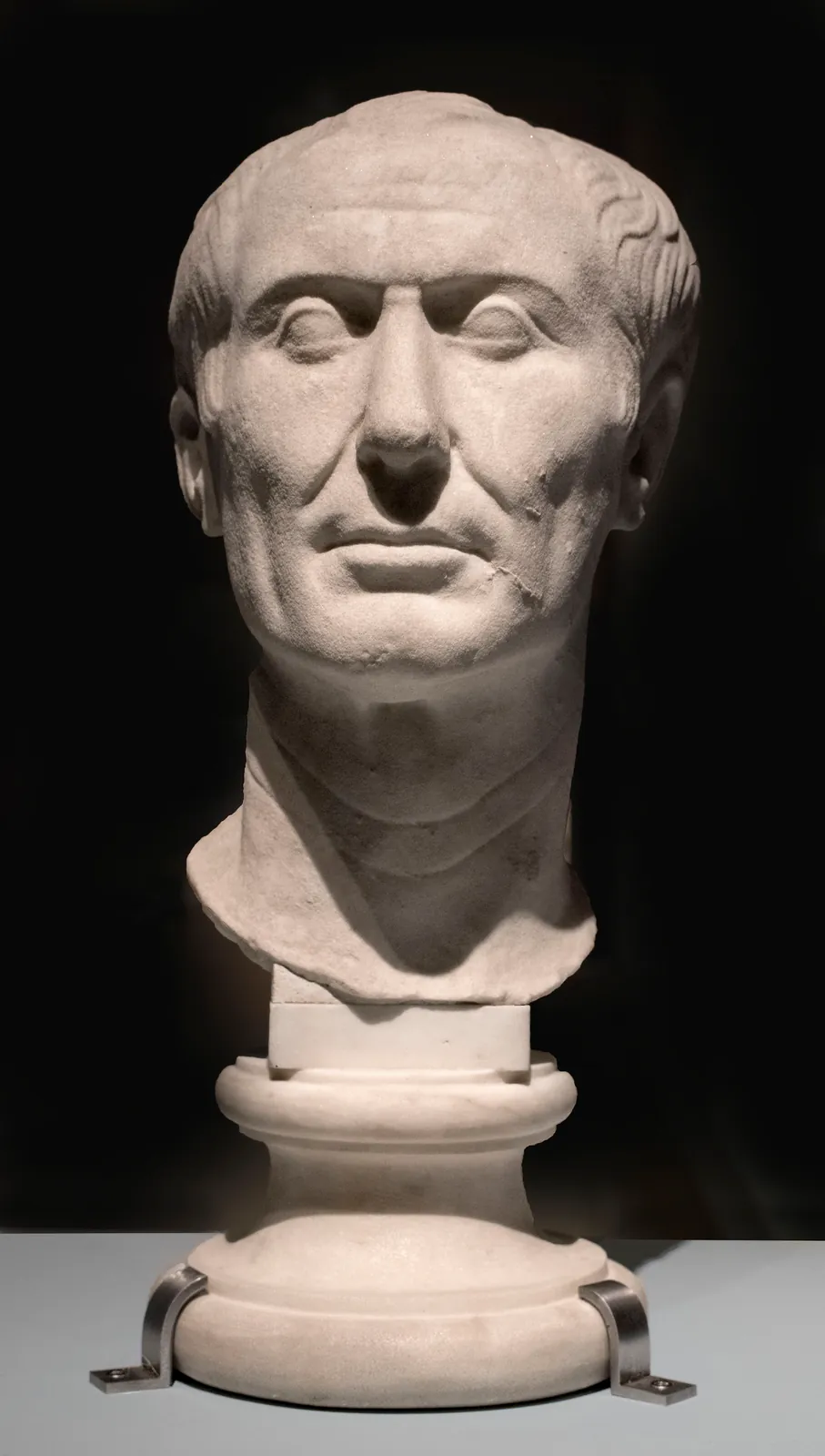
The Tusculum portrait of Julius Caesar
Marble portrait head
Museo di Antichità, Turin
Object provenance
Record checked- Object
- Marble portrait head
- Material
- Fine-grained marble
- Dimensions
- Approximately 32 cm high
- Made
- Evidence level: ProbableAround 50–40 BCE
- Found
- Evidence level: DocumentedThe forum at Tusculum, Latium
- Excavated
- 1825 · Lucien Bonaparte
- Inventory
- Not recorded in this catalogue
- Identification
- Evidence level: ProbableJulius Caesar
Not recognised as Caesar until Maurizio Borda identified it in 1940 — a hundred and fifteen years after excavation. The identification rests on correspondence with the portrait on denarii struck by Marcus Mettius shortly before the assassination, which are securely dated and securely identified. It is now widely though not universally accepted.
Bibliography and comparanda
Roman mint, Denarii of Marcus Mettius
Coins struck at Rome in 44 BCE carrying a portrait of Caesar in his lifetime — the dated comparison on which the identification of the Tusculum head rests.
Read across
How to read the evidence labels
- Evidence level: Documented
- Supported by a named primary text or by excavated material evidence.
- Evidence level: Probable
- Supported by strong inference that most specialists accept.
- Evidence level: Disputed
- Substantial specialist disagreement exists; competing readings are stated.
- Evidence level: Literary
- Belongs to poetic or mythological construction rather than to history.
- Evidence level: Mythological
- Belongs to shared religious or mythic tradition rather than to any single text.
- Evidence level: Unknown
- The available evidence is insufficient to decide.
These labels describe the status of the evidence, not our confidence in a conclusion. A claim marked Literary is not a claim we doubt; it is a claim about what kind of thing a poem is.