Ancient object
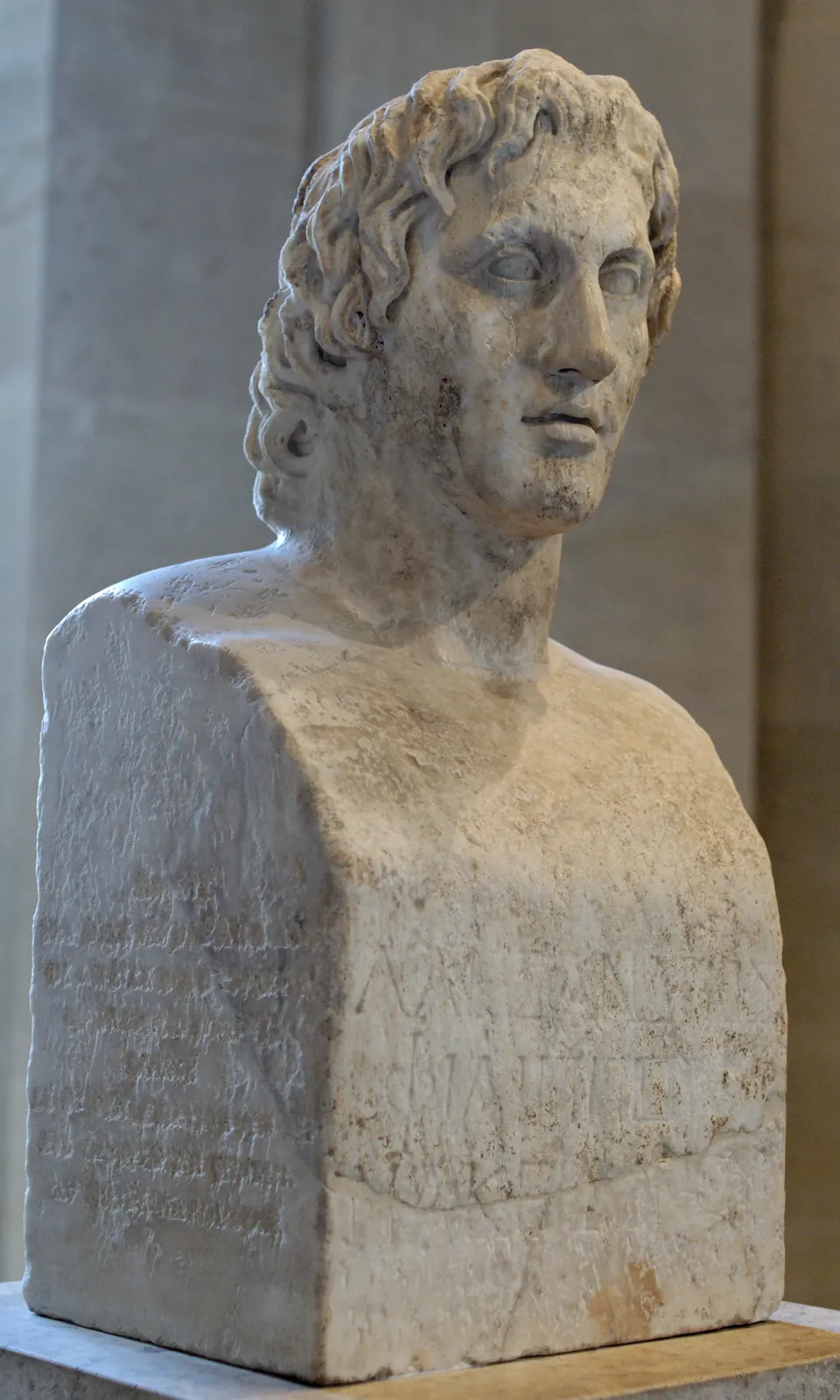
The Azara herm of Alexander
Marble portrait herm
Louvre, Paris
Object provenance
Record checked- Object
- Marble portrait herm
- Material
- Pentelic marble
- Made
- Evidence level: Probable1st or 2nd century CE
- Copy of
- A lost bronze by Lysippus, conventionally the Alexander with a Spear. Ancient tradition holds that Alexander permitted only Lysippus to portray him in sculpture; the tradition is well attested and is a statement about court policy rather than a verified fact about every surviving portrait.
- Found
- Evidence level: DocumentedTivoli, in the villa of the Pisones
- Excavated
- 1779 · Excavation organised by José Nicolás de Azara
- Now at
- Louvre, Paris
- Inventory
- MR 405 (Ma 436)
- Identification
- Evidence level: DocumentedAlexander III of Macedon
The herm is inscribed, which places this among the securely identified ancient portraits — a rarity. What is inferred rather than documented is the attribution of the lost original to Lysippus.
Condition — A herm bust; the head is ancient and the herm shaft carries an inscription naming Alexander.
Read across
How to read the evidence labels
- Evidence level: Documented
- Supported by a named primary text or by excavated material evidence.
- Evidence level: Probable
- Supported by strong inference that most specialists accept.
- Evidence level: Disputed
- Substantial specialist disagreement exists; competing readings are stated.
- Evidence level: Literary
- Belongs to poetic or mythological construction rather than to history.
- Evidence level: Mythological
- Belongs to shared religious or mythic tradition rather than to any single text.
- Evidence level: Unknown
- The available evidence is insufficient to decide.
These labels describe the status of the evidence, not our confidence in a conclusion. A claim marked Literary is not a claim we doubt; it is a claim about what kind of thing a poem is.