What it is
Luxor Temple — Amenhotep III and Ramesses II, the Opet festival, the Roman camp and the imperial cult chamber, the mosque of Abu el-Haggag, and the obelisk in the Place de la Concorde.
Built Built under Amenhotep III, extended by Ramesses II, added to for fifteen centuries. The principal date, principally c. 1390–1350 BCE, is approximate.
c. 1390–1350 BCE
Amenhotep III
The core of the temple: the sanctuary, the hypostyle, the sun court and the great colonnade, whose decoration was left unfinished.
c. 1330–1290 BCE
Tutankhamun and Horemheb
The colonnade decorated with the Opet festival procession — the fullest surviving depiction of an Egyptian festival, completed after the Amarna interlude.
c. 1279–1213 BCE
Ramesses II
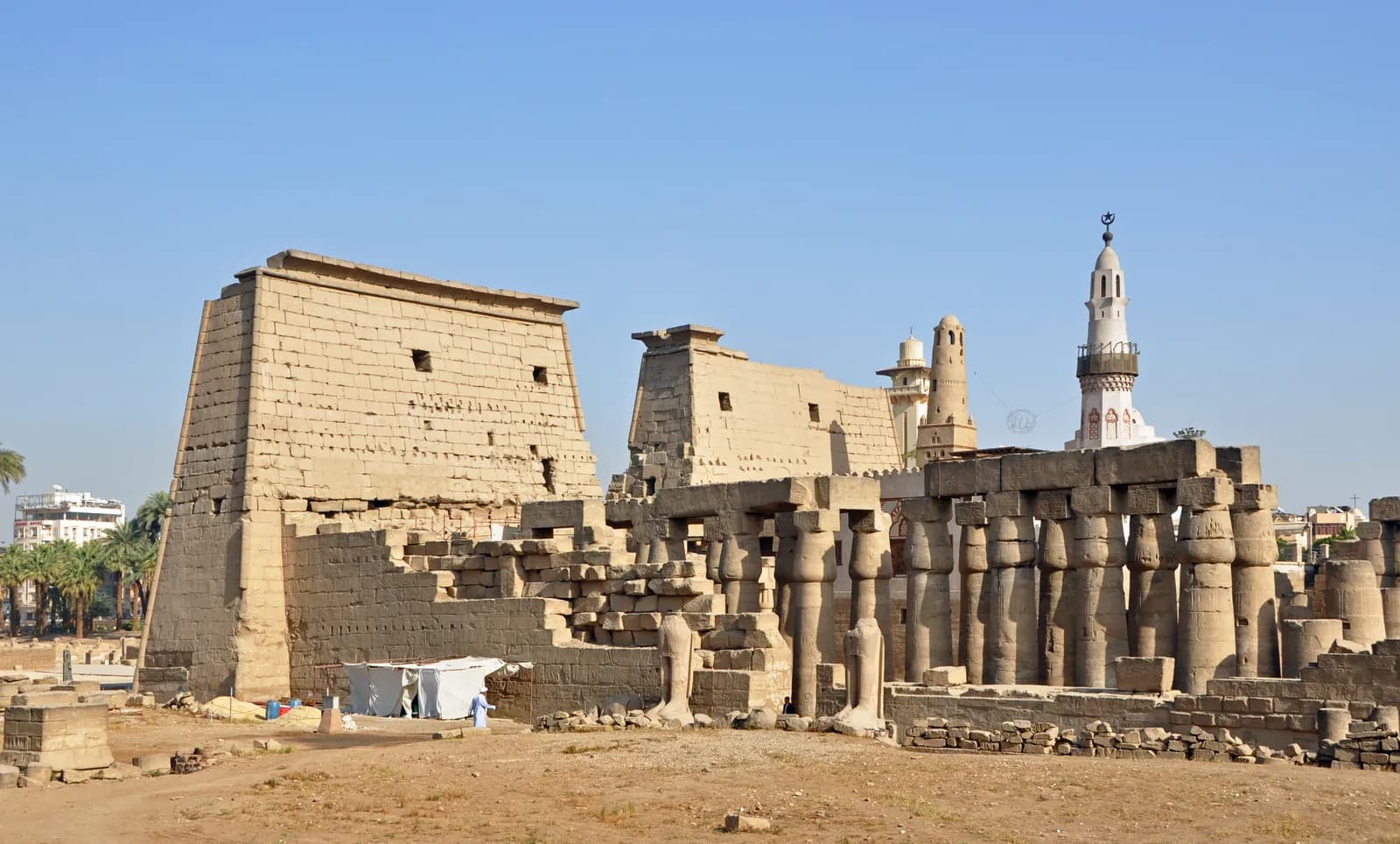
The pylon, the forecourt, the colossi and the obelisks added at the front, on a slightly different axis from the older building.
4th century BCE – 4th century CE
Alexander and the Romans
Alexander rebuilt the barque shrine in granite with his own cartouches; under Diocletian a legionary fortress enclosed the temple and a hall was converted into a chamber of the imperial cult with painted figures of the tetrarchs.
13th century onwards
The mosque
The mosque of Abu el-Haggag was built into the forecourt when the temple was buried to that level. When the court was excavated the mosque was left in place, and it is still in use — its door now opens onto a drop.
Who ordered it built
Each attribution carries what supports it. Ancient buildings are routinely credited to people on the authority of writers centuries later, and that is not the same claim as an inscription on the building.
- Evidence level: Documented
Commissioned by
Amenhotep III
His cartouches and building inscriptions throughout the southern part of the temple.
- Evidence level: Documented
Commissioned by
Ramesses II
His cartouches on the pylon, the forecourt and the colossi, and his dedication texts.
- Evidence level: Disputed
Engineer
Amenhotep son of Hapu
Amenhotep III's overseer of works, attested by his own statues and later deified. His responsibility for this temple specifically is inferred from his titles rather than recorded.
What it was for
The southern sanctuary of Amun, and the destination of the Opet festival: once a year the barques of Amun, Mut and Khonsu travelled from Karnak to Luxor, by river or along the sphinx avenue, and the king's own divine nature was renewed inside.
The temple is therefore not primarily a house for a resident god but a stage for a journey, and its plan is a route: pylon, court, colonnade, court, hypostyle, sanctuary, in a straight processional line.
How it was built
The building's axis bends: Ramesses II's forecourt sits at a slight angle to Amenhotep III's temple, because the new front had to align with the route from Karnak rather than with the older building. The kink is visible on the ground and is a piece of urban planning overriding architectural symmetry.
Ramesses also built his court around three existing barque chapels of Hatshepsut and Thutmose III rather than removing them, so the older structures stand inside the newer court at an angle to it.
Materials
- Evidence level: Documented
Sandstone
The temple throughout
- Evidence level: Documented
Granite
The obelisks, the colossi and Alexander's barque shrine
- Evidence level: Documented
Paint and plaster
The Roman-period imperial cult chamber, painted over the pharaonic relief
Measured
Every figure states what it rests on. A modern survey, an ancient text, a conversion from an ancient unit and a modern estimate are four different kinds of statement and are not interchangeable.
Overall length
about 260 m
Modern survey along the processional axis.
The great colonnade
fourteen columns about 19 m tall
Modern survey.
The standing obelisk
about 25 m
Modern survey. Its twin, about 23 m and the shorter of the pair, has stood in the Place de la Concorde since 1836.
What it meant
The temple's function was the renewal of the king's divinity. The Opet reliefs show the procession, the offerings and the rites; what happened inside the sanctuary is not shown, and the ideology is stated rather than illustrated.
The Roman conversion is the sharpest example anywhere of one imperial cult occupying another's building. A hall on the pharaonic axis was given an apse and painted with the tetrarchs, so that the room where Egyptian kingship was renewed became the room where the Roman emperors were honoured. The paintings survive and have been conserved.
The obelisk in Paris was given to France in 1830 by Muhammad Ali and erected in 1836. The gift and its acceptance are documented; whether such transfers should be revisited is a live question, and Egypt has at times raised the obelisk in that context.
The Opet festival is the best-documented Egyptian festival, because its procession is carved along both walls of the colonnade with the boats, the crowds, the musicians, the offerings and the return. It is the closest thing to a film of an Egyptian religious event.
The mosque of Abu el-Haggag continues a use of the site that has not been interrupted: the saint's annual festival involves boats carried in procession, and the resemblance to the Opet procession has been much discussed. Whether that is continuity or coincidence is not established, and the platform does not assert it.
After antiquity
Enclosed by a Roman fortress under Diocletian; the modern name Luxor comes from the Arabic for the palaces or fortifications, referring to that camp rather than to the temple.
Buried by settlement debris to a depth of several metres, with a village and the mosque built on top. Cleared by Gaston Maspero from 1881 onwards; the mosque was left standing and the village removed.
The avenue of sphinxes running to Karnak was excavated over decades and reopened along its full length in 2021.
Condition today
Standing
Standing to roof level in the sanctuary area and to full height in the colonnade and pylon. One obelisk, two seated colossi and parts of the standing ones survive at the front; the mosque remains in the court.
A cache of statues was found under the floor of the sun court in 1989 — over twenty pieces, including a quartzite Amenhotep III, buried in antiquity as the Karnak Cachette material had been. It is the second great statue deposit from Thebes and it was found by chance during floor conservation.
The Roman wall paintings in the imperial cult chamber were conserved and published in a project completed in the 2000s, recovering images that had been covered and then damaged by earlier clearance.
Scattered fragments
What has left the building, and where it is now. Where a holding is contested, the museum page says so.
- Evidence level: Documented
The western obelisk, in the Place de la Concorde, Paris
Place de la Concorde, Paris
- Evidence level: Documented
The statue cache from the sun court
Luxor Museum
Written about in antiquity
The Opet festival reliefs the great colonnade, north and south walls
The procession from Karnak to Luxor and back, carved under Tutankhamun and Horemheb: the barques, the escort, the offerings and the crowds. The fullest visual record of an Egyptian festival.
Herodotus, Histories 2.42, 2.58–59
Herodotus on Egyptian festivals and processions, and on the Theban cult. A Greek account of practice a thousand years after these reliefs were carved.
Still argued
Is the Abu el-Haggag festival descended from the Opet festival?
Both involve boats carried in procession at the same site, and the resemblance has been noted for over a century. Documented continuity across the intervening periods does not exist, and boat processions are not unique to Thebes. It is a striking parallel and it has not been demonstrated as descent.
How to read the evidence labels
- Evidence level: Documented
- Supported by a named primary text or by excavated material evidence.
- Evidence level: Probable
- Supported by strong inference that most specialists accept.
- Evidence level: Disputed
- Substantial specialist disagreement exists; competing readings are stated.
- Evidence level: Literary
- Belongs to poetic or mythological construction rather than to history.
- Evidence level: Mythological
- Belongs to shared religious or mythic tradition rather than to any single text.
- Evidence level: Unknown
- The available evidence is insufficient to decide.
These labels describe the status of the evidence, not our confidence in a conclusion. A claim marked Literary is not a claim we doubt; it is a claim about what kind of thing a poem is.